
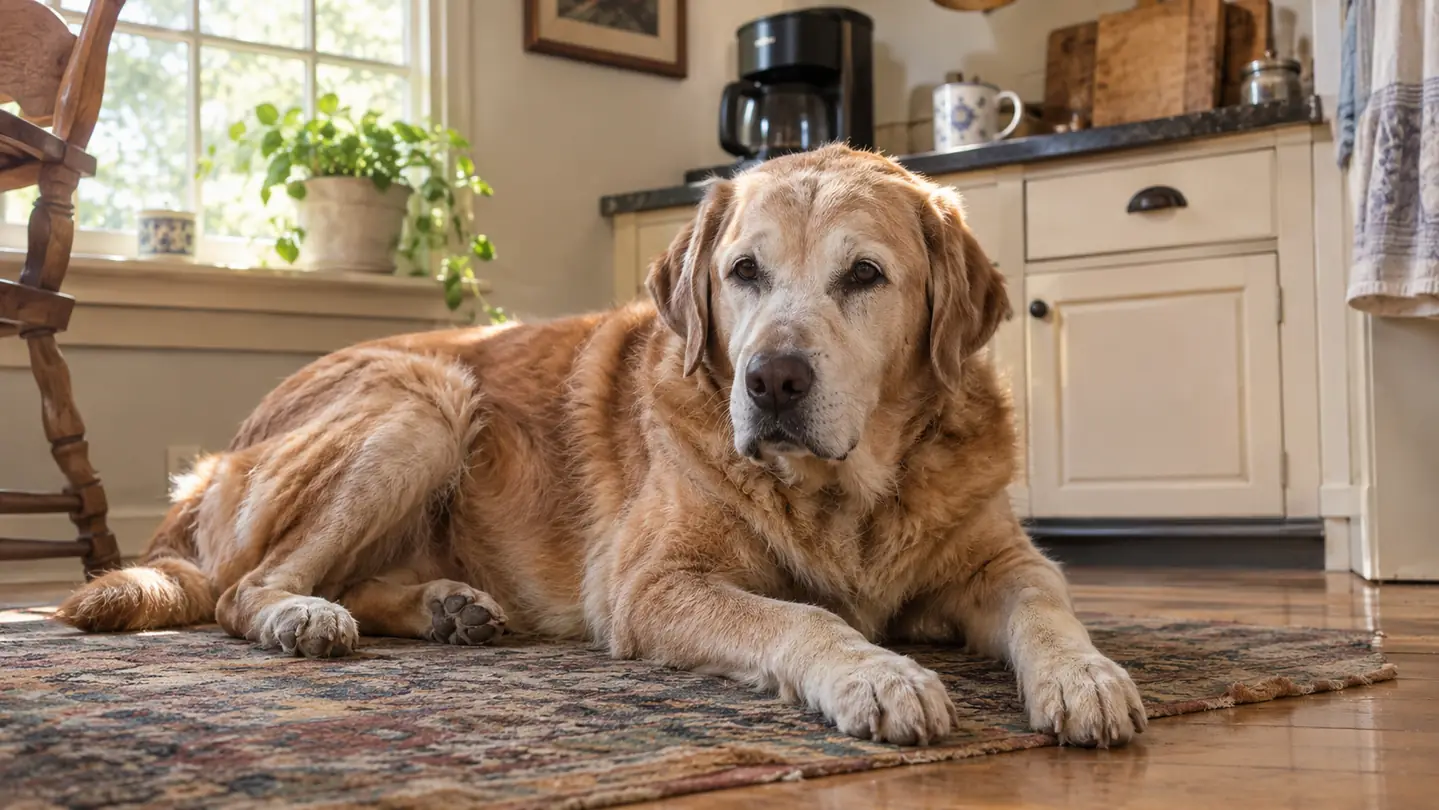
I keep a worn wheel bearing on a shelf in the pole barn to show people what I mean about joints. The race is pitted, the grease is gone, and no amount of fresh grease puts the metal back. What you can do is lower the load and keep it turning. Our vet said nearly the same thing about Duchess's hips two years ago, in different words, and that is how a bottle of Cosequin Maximum Strength ended up next to the coffee maker in our kitchen.
Duchess is a yellow Labrador, nine years old now, about sixty-four pounds on the feed store scale. She was seven when our vet read the x-rays and called it hip dysplasia with early arthritis in both hips. I had been telling myself she was just stiff from the concrete in the barn. He suggested a joint supplement, named Nutramax Laboratories, and told me straight that it was not a repair and would not be one. I ordered the 75 count chewable tablets that week on Amazon and paid for them myself. Two years later I have a fair amount to say about what changed, what did not, and what I would tell the next person standing in my barn.
The Quick Verdict
Two years in, this is the easiest part of Duchess's routine and the first thing I would buy again. Six weeks to a change I could see with my own eyes, no fight getting it down her, and honest limits: it does not fix a bad hip and it does not replace a bed, a ramp, or our vet.
Amazon Check Today's Price →The one part of her morning she thinks is a treat
Cosequin Maximum Strength chewable tablets, 75 count. Glucosamine, chondroitin, MSM and hyaluronic acid in a tablet most dogs will take straight out of your hand.
Amazon Check Today's Price on Amazon →How I've Used It
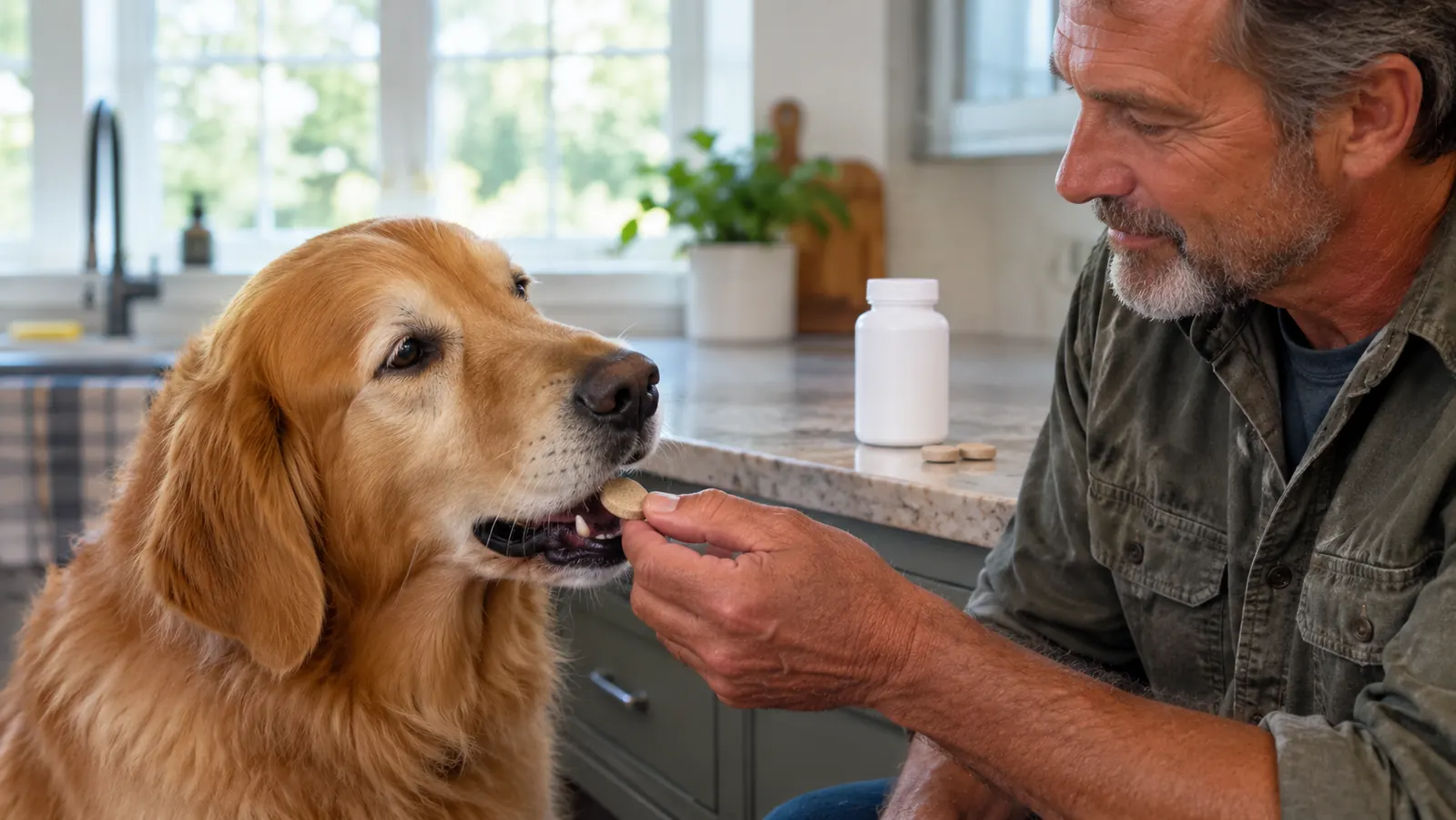
The routine has not changed in two years. I come down the stairs, start the coffee, and set out the number of tablets the label lists for her weight. She sits by the counter and takes them one at a time out of my hand, dry, the way she takes a biscuit. No wrapping in cheese, no peanut butter, no grinding anything into her kibble. That was the part I expected to be a fight and it never was, not once.
The first morning I did it wrong. I dropped the tablets in her bowl on top of the kibble and she nosed them off to the side and ate around them, clean as you like, then looked up at me. So I tried the hand instead, holding one out at nose height, and she took it before she had time to think about it. That has been the routine ever since, and I have never had to hide one in anything.
The chart on the label goes by weight, and her weight has held between sixty-two and sixty-five pounds since the diagnosis, so the amount has not moved. I count them out on the counter before I put the bottle back, because a bottle that runs out on a Sunday morning when the roads are bad is an annoyance I can avoid with ten seconds of attention.
I have missed a morning here and there, usually when I am out the door before daylight to help a neighbor with a stuck tractor. Nothing dramatic happened either way. That tells you something useful. This is a slow supplement, not a pain pill. You are not going to see a difference on the mornings you skip, and you are not going to see one on the mornings you do not.
What Is Actually in the Tablets
The label lists glucosamine hydrochloride at 600 mg, sodium chondroitin sulfate at 300 mg, MSM, and hyaluronic acid. The glucosamine and chondroitin carry the FCHG49 and TRH122 designations, which is Nutramax Laboratories telling you which specific forms are in the bottle. That matters more than it sounds. Glucosamine is not one thing, and the source and form vary plenty between brands. A label that names its raw material is a label that expects to be checked.
What those ingredients do, in plain terms, is feed the tissue that is left. Glucosamine and chondroitin are building blocks for cartilage and for the fluid in the joint. MSM is in there for inflammation and comfort. None of it grows a new hip socket. The research in dogs is thinner than the research in people, and the research in people is mixed. Anybody who tells you a tablet reverses dysplasia is selling you something. Our vet put it this way: it might buy some comfort, it will not hurt, and if it does nothing in eight weeks you will know.
The form matters for a different reason. A chewable tablet is only useful if the dog eats it, and some dogs will not. If yours turns its nose up, you can crumble a tablet over wet food, which is fiddly and wastes a little every time. Duchess has never given me that problem, and after hearing from people whose dogs pick the tablet out of the bowl and leave it on the floor, I know how lucky that is.
She got up off the barn floor without the rocking motion. That was the whole change. Two years later it has held, and for a dog with dysplasia in both hips, flat is a win.
What Changed, and When
I noticed the first change at about six weeks. It was not dramatic. She got up off the barn floor without the rocking motion, the one where the front end comes up and then there is a pause while the back end decides whether it is coming along. She just stood up. I watched her do it three or four times over the following week to be sure I was not seeing what I wanted to see, and it held.
The morning I finally believed it was a cold one in late February, the kind where the barn door is frozen to the track and you have to lift it with your shoulder to get it rolling. She had been lying on the folded blanket in the aisle while I changed the hydraulic hose on the log splitter. When I called her she came up on the first try, no pause, no rocking, and walked out into the yard on her own. I stood there with a hose in my hand and watched her go.
That is the whole of what I can honestly credit to the tablets. She still takes the three back porch steps slow on a cold morning. She still does not jump into the truck, and at her size that was never something I wanted her doing anyway. By the time I added a better bed, a sling and a ramp, the timeline had moved on, and I am not going to sit here and pretend I can separate one thing from another. What I can tell you is that the first change came before the rest of it.
Two years in, the trend line is flat, and flat is a win. A nine-year-old Labrador with dysplasia in both hips, moving about the same as she did at seven and no worse on the last set of x-rays, is a good outcome. Our vet said as much at the last check. He also said the honest thing, which is that we do not know which part of what we do is doing the work.
The Boring Part: Two Years of Mornings
Nobody writes about the mornings. The supplement is now the easiest piece of what we do for her. The bed in the living room gets its cover washed about once a month, more in mud season. The sling hangs on a hook by the back door and comes down on icy mornings and after long days. The ramp lives folded in the truck bed under the cover. On top of all that sits a bottle of tablets beside a coffee maker, and that is the ten seconds of the day that takes the least thought.
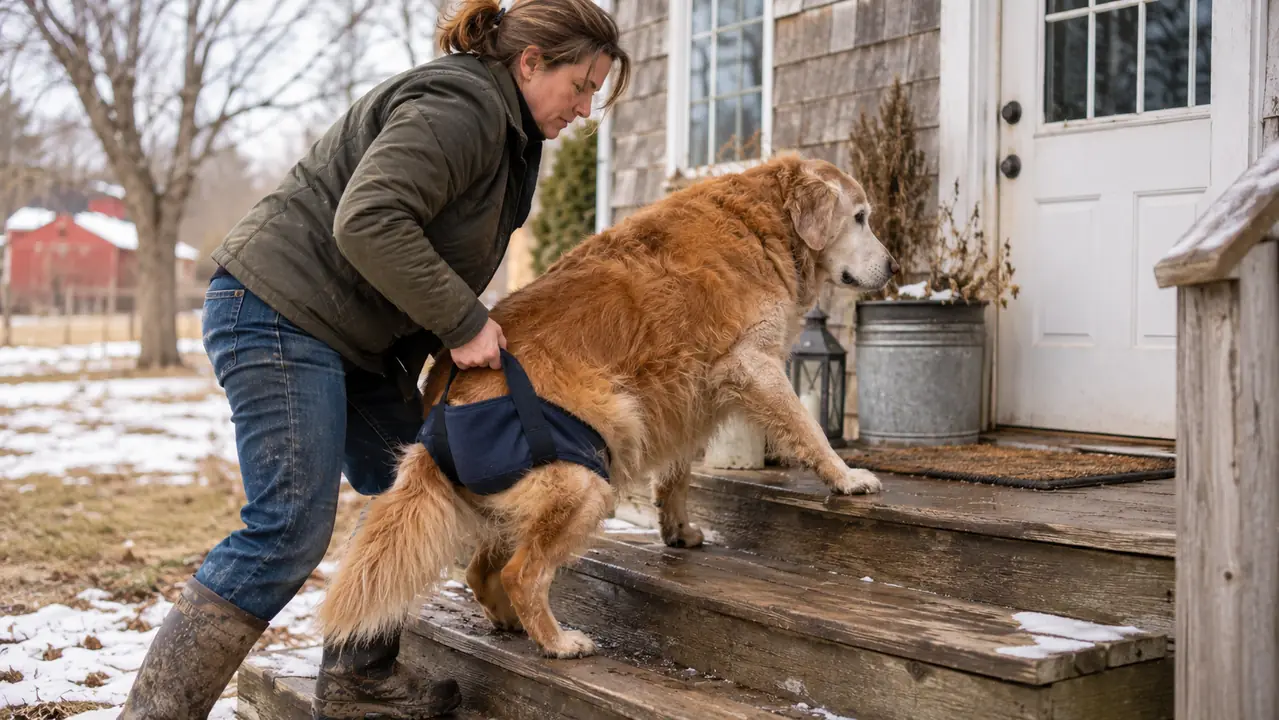
The sling earned its hook on a January morning after an ice storm, when she stood at the bottom of the three porch steps and could not get her back legs under her. I put the strap under her hindquarters and took her weight on the way up. She looked back at me once, then climbed. Ten months later it still hangs there. I use it maybe twice a week in winter and hardly at all in July, but I would not be without it on the mornings the yard is a sheet of ice.
If you are thinking about this for a dog of your own, understand what you are signing up for. It is not one purchase. It is a small daily task with no visible reward for weeks, and it only pays off if you keep at it for months. The dogs that benefit are the ones whose people are boring about it. I am good at boring. I fix tractors for a living.
One practical note from two years of this. Keep the bottle where you will see it at the same time every day. Mine is by the coffee maker, so the tablet and the first cup are the same event. When I moved it into a cabinet for a week during a kitchen project, I missed two mornings and did not notice until I found the tablets behind a stack of plates.
How It Compares to the Cheaper Bottles
The first thing I did after the vet visit was look at what the farm store had on the shelf, because it was closer than the computer. What I found was a wall of bottles that said glucosamine on the front and not much on the back. Some listed a total for a blend. Some listed the form. Almost none told you plainly how much of the ingredient was in a single tablet against how much was in a scoop of powder. If you cannot do that arithmetic on the label, you cannot compare two products at all.
What I settled on was simple: a tablet, a stated amount per tablet, named forms, and a company that has been at it long enough to answer a question. The bottle notes that Nutramax Laboratories has been in pet health for over twenty five years, and the listing calls it the top vet recommended retail joint supplement brand. I do not put much weight on a line like that. I do put weight on the fact that our vet named it without me asking. A neighbor up the road asked me about the soft chews her sister uses, and I wrote up the difference between Cosequin and Zesty Paws mostly because I had already done the reading for myself.
What It Does Not Do
It does not take the place of a diagnosis. If your dog is lame, or favoring a leg, or yelping when you lift the back end, that is a vet visit and probably an x-ray, not a bottle of tablets. Pain that comes on fast is often an injury, and an injury is not something a supplement touches. I have watched people spend two months on chewables while their dog had something else entirely going on.
It does not replace weight control either, and our vet was blunt about that one. Every extra pound on a dog with bad hips is a pound of load on a joint that is already worn out. He puts his hands on her ribs at every visit and tells me the same thing, that he can feel them without pressing and that is where he wants her. I keep a feed scoop in the bin and I do not eyeball it. The one winter I did eyeball it she crept up about four pounds, and I saw it in how she took the porch steps before I ever saw it on a scale.
What I Liked
- Duchess takes the chewable tablets dry out of my hand, no hiding them in food
- The label names the specific forms of glucosamine and chondroitin instead of just listing ingredients
- First change I could see at about six weeks: she got up off the barn floor without the rocking motion
- Two years in, her movement is about the same and the last x-rays were no worse
- One bottle, one daily task, nothing to mix, nothing to refrigerate, nothing to measure
Where It Falls Short
- It is not a repair. The hips are dysplastic and they are going to stay that way
- Six weeks is a long stretch to keep going on faith before you know if it helps your dog
- A dog that will not eat a chewable tablet turns this into a chore, and crumbling one over food is fiddly
- Once you add other things like oil or a prescription diet, you cannot tell which one is doing the work
Who This Is For
This is for the owner of a middle-aged or older large dog that has been diagnosed with arthritis or dysplasia and whose vet has cleared a joint supplement as part of the plan. It is for someone who can commit to a daily tablet for a couple of months before passing judgment. And it is for someone whose dog will actually eat a chewable, because that is the whole ballgame.
It also fits the dog that is just starting to show it. Slow to rise, stiff after lying on a hard floor, hesitant on the steps. That was Duchess at seven. Catching it at that stage is the closest thing to an advantage you get with hips.
Who Should Skip It
Skip it if your dog is lame right now, or if the stiffness showed up over a week instead of over a year. That is a vet appointment, not a shopping decision. Skip it if your dog has a sensitive stomach or is on a prescription diet and you have not asked your vet about adding anything, because stacking new intake on top of a history you have not discussed is how people get into trouble.
And skip it if you are hoping it replaces the unglamorous work: the lean weight, the soft bed, the ramp into the truck, the sling on ice. Duchess gets all of it, and the tablets are the least of it. If you are only going to do one thing, do the weight and the bedding.
Two years of mornings, and I would buy the same bottle again
If your vet has cleared a joint supplement and your dog will take a chewable, this is the one that has stayed on my counter. Start it, give it eight weeks, and judge it on how your dog gets up off the floor.
Amazon Check Today's Price on Amazon →