
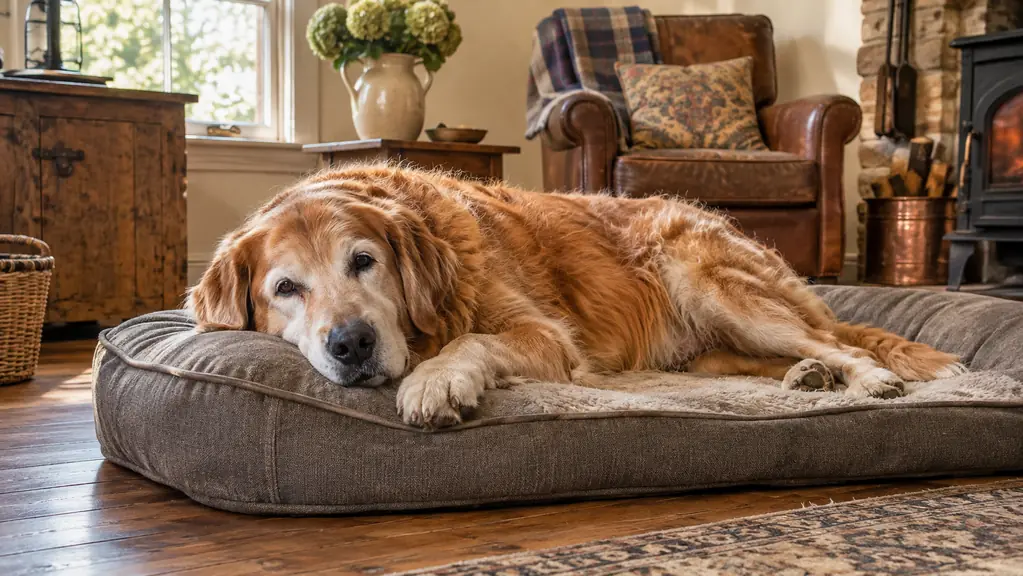
When Duchess started sleeping on the bare living room floor instead of her old cushion, I did not think much of it. She was nine and old dogs change their habits. Then I watched her circle, lie down, and end up with her back half hanging off the edge. The fill in that old bed had gone flat as a pancake. She had picked the floor because the floor was at least honest about being hard.
Duchess is a 9-year-old female yellow Lab, 64 pounds, diagnosed with hip dysplasia in both hips and early arthritis at age seven. Our vet put her on a joint supplement that week and it helped. A supplement does not put anything soft under a dog, though. About fourteen months ago I bought the EHEYCIGA orthopedic bed in the 44 by 32 inch extra large size and set it down next to the woodstove, and it has been her bed every night since. I am not a vet. I fix tractors out of a pole barn for neighbors and I have kept big dogs my whole life. So this is a report on a piece of gear, used daily, for fourteen months, not medical advice.
The Quick Verdict
Fourteen months, one 64 pound arthritic Lab, and a cover wash about every month. The EHEYCIGA held its shape, kept her off the cold floor, and survived one accident without soaking the foam. It is not a cure for hip dysplasia and it is not the thickest foam you can buy, but it does the one job I needed it to do.
Amazon Check Today's Price →She stopped sleeping on the bare floor in the first week
The extra large is 44 by 32 inches with 6.5 inches of memory and egg crate foam, a washable zip cover, and a waterproof film under the fleece. Rated to about 100 pounds.
Amazon Check Today's Price on Amazon →How I've Used It
The bed showed up compressed in a box. I cut the wrap, laid it flat in the spare room, and left it alone for two full days because the listing says to allow 24 to 48 hours for it to expand. It got most of its height back in the first day and finished sometime during the second. If you unbox one of these and drop it on the floor the same afternoon, your dog is going to lie on a half-expanded slab for a night and probably will not go back to it. That is the single most common mistake I see with any foam bed shipped in a box.
It sits on the living room floor about four feet from the woodstove. That is where she goes after her evening meal and where she stays until I let her out at six the next morning. Wood floors, old farmhouse, cold in January. Before the bed she would circle a while and then lie down on the floor with her back end off whatever cushion she had. Now she walks over, steps on, turns twice, and is down. Nine-year-old Labs do not do anything quickly, but she does not hesitate at the edge of it either.
In the pole barn she still lies on an old folded moving blanket. I thought about buying a second bed for out there and decided against it. The barn floor gets wet, that blanket gets shaken out and thrown in the wash, and a foam bed in that building would be a mess by March. One bed, one dog, one room. That is how I have used it, and that is the honest scope of this review.
What the Foam Actually Does
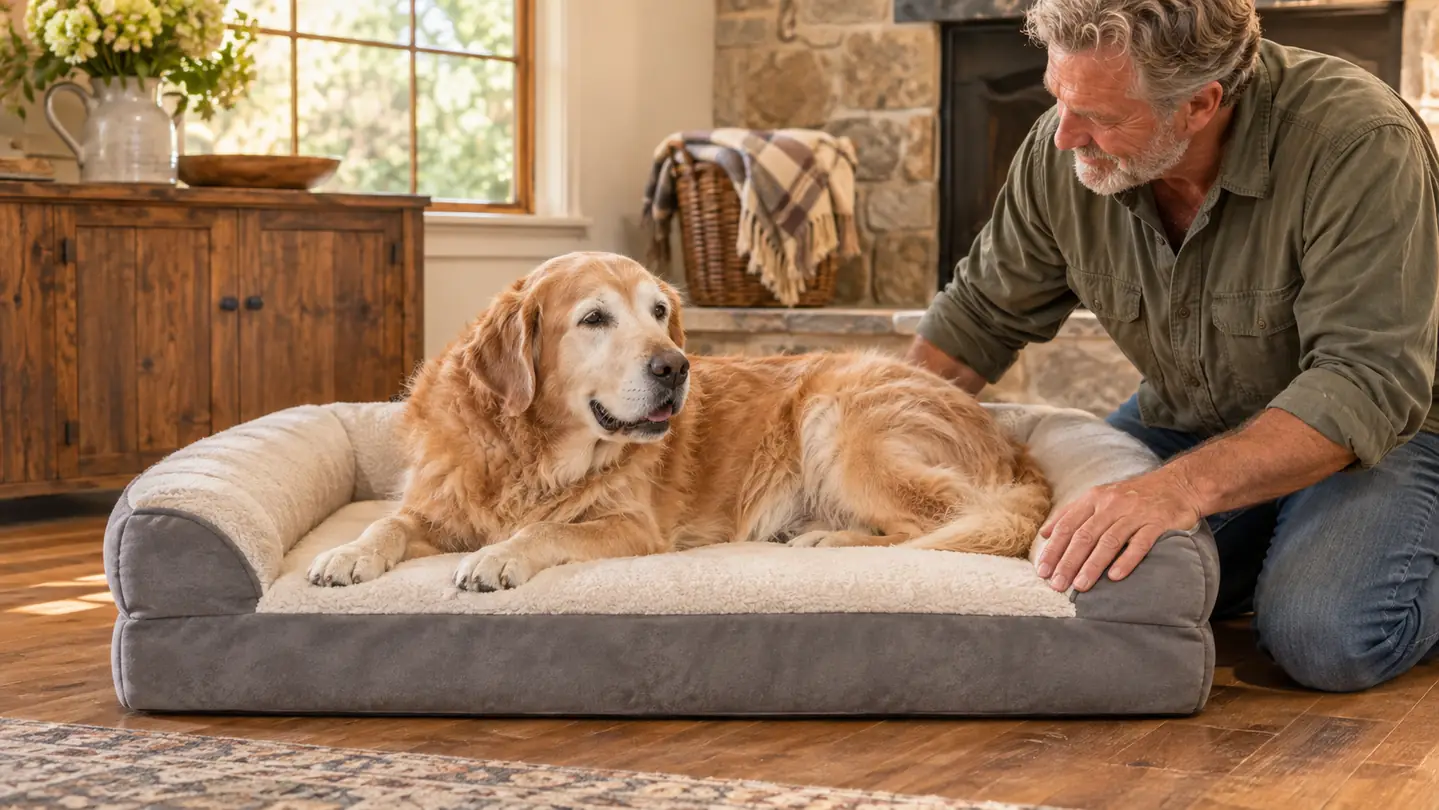
The listing describes two layers, memory foam and egg crate foam. In practice that means a firmer base with a bumpy top layer that lets some air move and gives a little under the pressure points. I put my knee into it. It compresses maybe an inch and a half under a grown man's weight and comes back when I stand up. That is more give than the polyester fill bed she had before, and less give than a mattress topper. It is foam, not a hospital mattress.
The bed is 6.5 inches thick at the edge, and the three-sided bolsters give her something to put her head against. Duchess is a sprawler, she does not curl up, so I did not expect her to use the bolsters much. She uses the one on the stove side every single night. Head up, chin on the bolster, back legs out straight behind her. That is how she sleeps now and that is how she slept on it in month one.
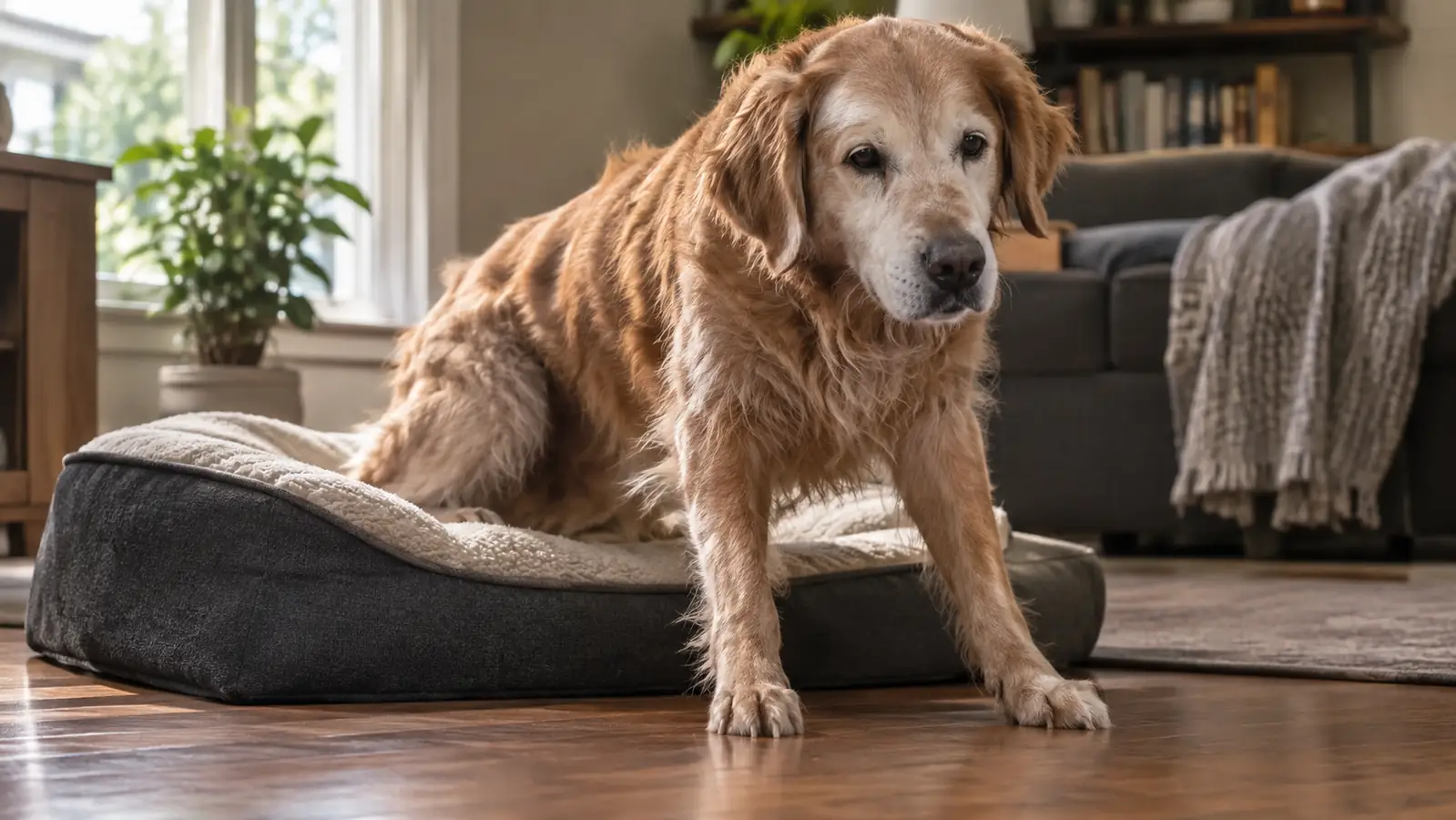
Here is my honest read after fourteen months. This is not a medical device and it will not fix hip dysplasia. What it does is spread a 64 pound dog's weight across a soft surface instead of letting it sit on two contact points on a hard floor. Our vet's line, roughly, was that anything keeping a stiff dog off a cold hard surface and getting her up less sore is worth doing, and that matches what I saw. She gets up with less rocking than she did off the floor. She gets up about the same as she did off the old bed, maybe slightly better. We also use a rear support sling on bad mornings, and that does more for her than any bed will. The bed is one piece of a routine, not the routine itself.
Size, Fit, and the 100 Pound Rating
The size I bought measures 44 inches long by 32 wide by 6.5 thick. Duchess is 64 pounds and takes up maybe two thirds of it when she stretches out flat. A 64 pound Labrador is not a giant dog. I would not push this size much past 85 or 90 pounds unless your dog sleeps curled in a ball, and a dog that sprawls at 95 pounds is going to hang off one end.
The EHEYCIGA listing puts the maximum weight recommendation at 45.36 kg, which is about 100 pounds. Trust that number over any photo of a dog on a bed. If you have a 130 pound Mastiff or a Great Dane, this is not the bed, no matter what the size label says. The extra large name gets used loosely across brands and I have been burned by it before. This one was accurate for us.
My advice is to measure your dog nose to tail base while they are lying flat, then add a few inches. That is the only number that matters. This bed also fits across the back seat of a full-size crew cab, which is how Duchess rides to town and to the vet, though I do not haul the bed around. It is 7.96 pounds and awkward to carry one-handed. If you need a travel bed, buy a separate thin one.
Washing, Accidents, and the Waterproof Layer
The cover unzips and comes off. I wash it about once a month, more in mud season when she comes in from the barn wet and gritty. Cold water, regular detergent, hang it over the porch rail to dry. Fourteen months of that and there are no split seams, no pilling on the fleece side that mattered, and no shrinkage worth mentioning. The zipper still runs.
Under the fleece there is a waterproof film between the surface and the bottom fabric. That is the feature I care about most and it is the one I tested by accident. She had one episode on it during her first winter on the bed, which is an old dog thing. I blotted the cover, washed it the next morning, and the foam core underneath was dry. Had that gone through, the whole bed would have been finished. Old dogs have accidents. A bed you cannot save from one is a bed you replace.
The bottom has a non skid surface. On our wood floor it stays put when she pushes up off it. That sounds like a small detail until you have watched a stiff dog try to stand on a bed that slides out from under her and go down in a heap. I have. It is the reason I will not buy a bed without one again.
What Held Up After 14 Months, and What Didn't
The foam has softened. It has not collapsed. There is a shallow dip where she lies, maybe half an inch, and the corners still hold their height and still sit square. Fourteen months of a 64 pound dog every night, through a Michigan winter with the stove going and that floor cold enough to feel through a sock. I expected to be shopping for a replacement by now. I am not.
What did not hold up as well is the fleece on the bolster where her head rests. It has gone matted and a little rough in that one spot. Not torn, not worn through to the fill, just flattened and coarsened. It is cosmetic and I only notice it when the cover is off for a wash. If you are the kind of person who needs a bed to look new in year two, this will bother you.
One thing I would tell anyone with a cold room: this is a floor bed, not an elevated cot. Foam on a floor is still foam on a floor. It insulates better than bare wood or concrete, but if your dog sleeps in an unheated mudroom or out in a barn, consider something with air underneath. Duchess sleeps eight feet from a woodstove, so that has never been our problem. Out in the pole barn she still uses that folded blanket, and I have no plan to change it.
What I Liked
- Held its shape through 14 months of nightly use by a 64 pound dog
- Waterproof film kept the foam core dry through one accident
- Cover unzips and machine washes, no split seams after a year of washing
- Non skid bottom stays put on a slick wood floor
- Three-sided bolsters give a stiff dog something to brace her head against
- 6.5 inches of memory and egg crate foam, rated to about 100 pounds
Where It Falls Short
- Needs 24 to 48 hours to fully expand before a dog uses it
- Fleece on the bolster matted where her head rests
- Foam has a shallow dip after 14 months
- The extra large size tops out around 100 pounds, not a giant breed bed
- Bulky and awkward to carry, so it is not a travel bed
She had one accident on it in the first winter. I blotted the cover, washed it the next morning, and the foam inside was dry. That was the test I actually cared about.
Who This Is For
This bed is for the owner of a large senior dog, somewhere between 50 and 90 pounds, who has started choosing the floor over a flattened cushion. It is for a dog with a diagnosis you already got from your vet, and a routine you are already running, that just needs a softer place to land at night. Duchess is exactly that dog: hip dysplasia in both hips, early arthritis, stiff getting up off the barn floor, slow on the three porch steps. The EHEYCIGA bed is the cheapest part of her routine and the one she uses the most hours of the day.
It also suits a household where the bed lives on a hard floor in one room and does not move. Wood floors, tile, concrete. The non skid bottom and the waterproof layer both matter more in that setup than they would on carpet. And if you wash things, this cover will take it. A dog that comes in muddy three times a week is not a problem for this bed.
Who Should Skip It
Skip it if your dog is over 100 pounds. The listed maximum is 45.36 kg and I would respect that. A giant breed needs more foam and a bigger footprint, and there are beds built for that. Skip it too if your dog destroys beds. This one has a foam core and a zippered cover, and a determined chewer will have the foam out on the rug in an afternoon. No bed survives that, and this is not the one to test it on.
Skip it if your dog sleeps somewhere unheated, or if you want an elevated cot with air moving under it. Skip it if you need something portable. And skip it if you are hoping a bed will replace a vet visit. Duchess's hips were diagnosed by our vet, her dosing decisions come from our vet, and if she had suddenly gotten worse instead of slowly better, the bed would not have been the answer. If your dog is limping, dragging a leg, or will not stand up, that is a call to your vet, not a shopping trip.
If your dog is picking the floor over the cushion, start here
The 44 by 32 inch extra large has 6.5 inches of foam, a washable zip cover, and a waterproof film that saved ours in the first winter. Unbox it two days before you need it.
Amazon See the Current Price and Sizes on Amazon →