
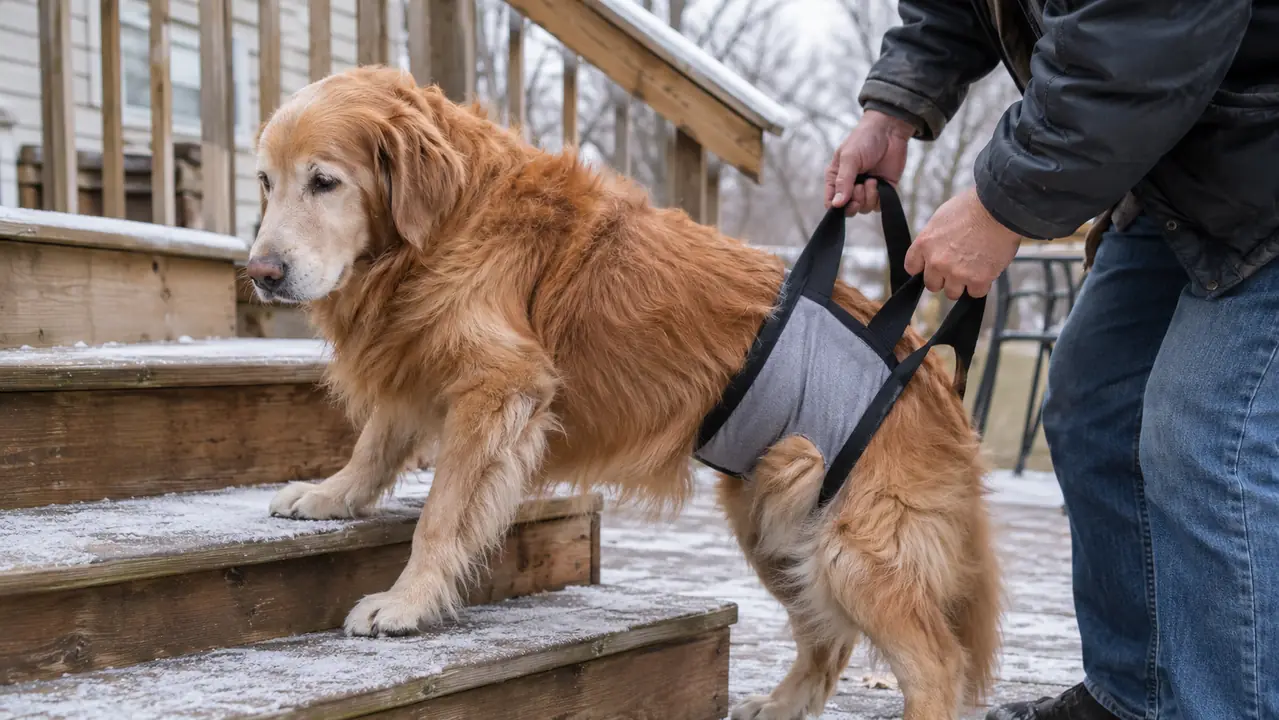
The first time I understood what hip dysplasia was going to cost us, the back porch steps had a glaze of ice on them and it was not yet seven in the morning.
Duchess is a nine-year-old yellow Lab, about 64 pounds. Our vet found dysplasia in both hips when she was seven, with a little arthritis coming along behind it. For two years the changes were small enough to explain away. She got up slower off the barn floor. She quit jumping into the truck. Then that January morning she stood at the bottom of three steps with her back legs going nowhere and looked up at me, and I quit explaining it away.
What changed that morning was a rear support sling. The one hanging on a hook by my back door is the LOOBANI adjustable dog sling in size Large, and I bought it myself off Amazon about ten months ago, the week after that ice. Here is how I sized it, how I got a proud old Lab to tolerate it in a few days, and the mistakes I made with my own back before I got the mechanics right.
Before the sling I did what most people do first. I put a bath towel under her belly and lifted. A towel works for about a week and then it does not. It bunches. It slips forward until you are hauling on a rope of wet cotton, and by the time you have a 64 pound dog halfway up a step you are taking the whole load in your lower back. I am 61 and I repair tractors out of a pole barn for neighbors. My back is a tool I need for that. The towel was borrowing against it.
I spent ten months lifting a 64 pound dog with a bath towel. Skip that part.
The LOOBANI rear support sling is nylon with a soft sheepskin-like lining that goes against the dog, a drawstring that keeps it snug, and a bag it folds into. Size Large is listed for dogs from 15 to 30 kilograms. Duchess at 64 pounds sits near the top of that range, so if your dog runs heavier, sort that out before you order.
Amazon Check Today's Price on Amazon →How to Lift a Large Dog with the LOOBANI Sling, Step by Step
Step 1: Get the Vet's Read Before You Buy Anything
A sling is hardware. Hardware does not diagnose. Hip dysplasia, plain arthritis, a soft tissue strain, a bad disc and a torn cruciate can all present the same way, as a dog who will not get up, and they are not managed the same. Duchess was diagnosed at seven on x-rays, and our vet has seen her every year since.
The three things I ask him now, every visit: how much weight should she be carrying on the hind end, is she cleared for short walks, and is there anything in her spine I need to know before I start hoisting her. His answers change how I use the sling that month. Some months it is only the porch steps. After a bad stretch it is the barn floor too, and short leash walks on grass and nothing else.
I will say one more thing plainly. If your dog yelps when you take weight, or snaps, or goes rigid, stop and call the vet. That is not a stubborn dog. That is information, and it is worth the cost of a visit to find out what it means.
Step 2: Size It Right and Check the Fit
The LOOBANI Large is listed for dogs from 15 to 30 kilograms, which works out to roughly 33 to 66 pounds. Duchess at 64 pounds sits near the top of that range. I would rather say that out loud than have somebody with a 90 pound shepherd order one and be disappointed. If your dog runs past the top of the range, that is a conversation to have before you buy, not after.
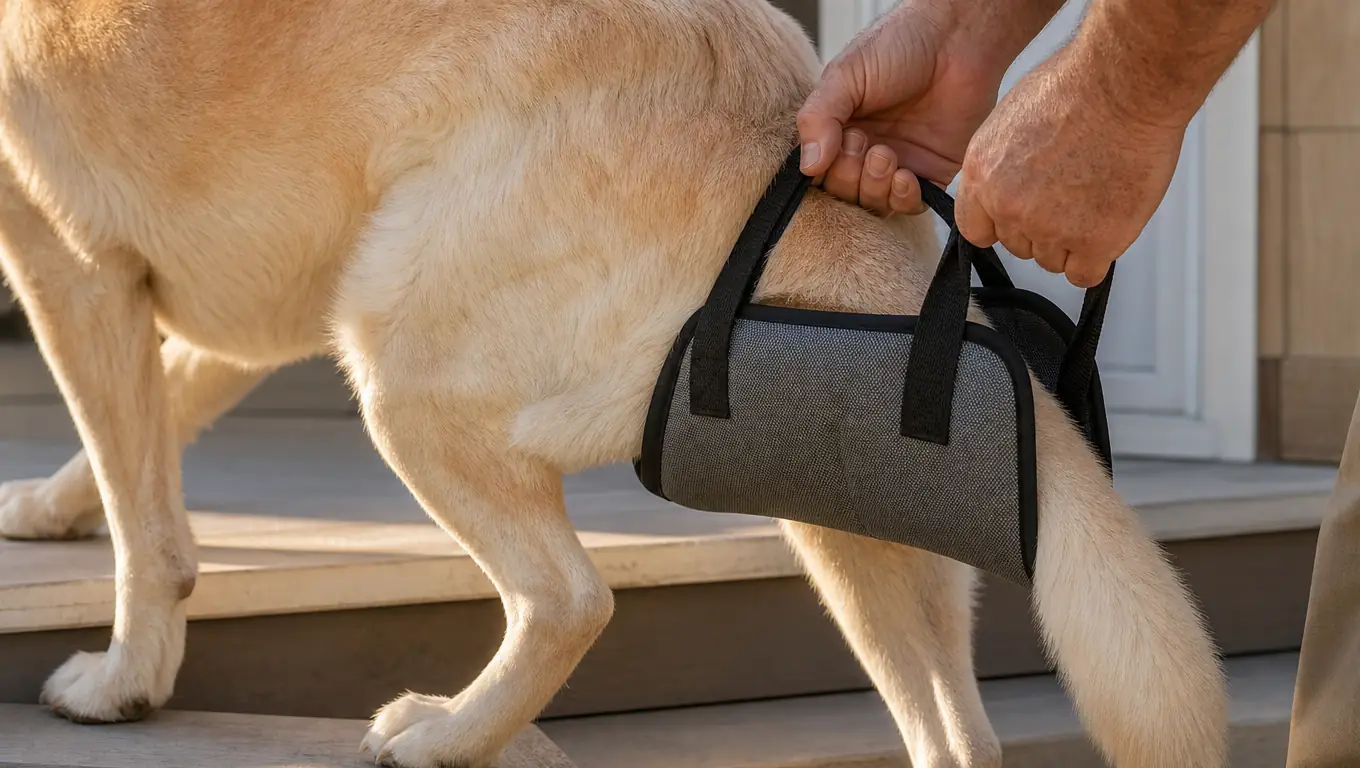
Fit is where people get it wrong. The sling passes under the hindquarters, behind the ribs and ahead of the tail, so the lift sits on the pelvis and the belly instead of on the tail base or the back legs themselves. The soft sheepskin-like lining goes against the dog. The nylon is what your hand holds. The drawstring snugs it so it does not shift while she is moving.
Three checks before you go anywhere. Can you slide two fingers under the lining without pinching her. Does the sling stay where you put it when she shifts her weight. And is there any redness at the inside of the thigh after five minutes. That last one shows up the next morning, not during, so look at the skin the day after the first few uses.
Step 3: Teach Her the Sling on a Good Day
Duchess was used to it inside a week. That did not happen on its own.
The first session I did not lift her at all. I set the sling under her while she stood in the kitchen, handed her a piece of kibble, took it off. Twice, and we were done. The second day I took maybe half an inch of weight for two seconds. The third day we did one step on flat ground with the sling barely taut. By the end of that week she was walking to the back door when she saw me reach for the hook.
Do not introduce it on the worst morning of the year. If the only time that sling touches her is when she is already hurt and frightened, she learns to hate the sight of it, and then you own a piece of nylon that lives in a drawer. Practise on a good day, in the kitchen, with your pocket full of food.
Step 4: Get Your Own Mechanics Right
This is the part nobody mentions, and it is the reason I nearly quit on the idea. The sling does not lift the dog. You do. The sling gives you a place to hold that is not her skin and not her tail.
Stand beside her, slightly behind the hip, not out in front where she will lean on you. Bend your knees. Keep her hindquarters close to your thigh so the weight travels down through your feet instead of hanging off the end of your arms. Short lift, step, set down, reset. Long lifts at arm's length are how backs get ruined, and a ruined back is no help to a dog who needs one.
The other half is not doing the work for her. On the steps I keep the sling just taut enough that she is carrying most of herself. If I take all the weight, she stops trying, and the muscle she still has goes away faster than it otherwise would. Support, not carry. That distinction matters more every year she gets.
Step 5: Use It Where She Struggles, and Nowhere Else
Three places for us. The porch steps. The concrete pole barn floor when she has been lying on it all afternoon. And any kind of ice, which around Kalamazoo runs from December into March.
For the truck the sling only got me partway, and I want to be straight about that. Lifting 64 pounds of dog onto the back seat of a crew cab two or three times a week was not something my back was going to keep tolerating. About eight months ago I added a folding ramp that hooks over the door sill, and now she walks up on her own and the sling stays on the hook. The two tools do different jobs and I needed both.
I keep the LOOBANI hanging right inside the back door, because the morning I need it I am not walking out to the barn to find it. It folds into the small bag that comes with it and takes up about as much room as a folded towel. Ten months of Michigan winters and it still lives by that door.
The sling has not made her hips any better. It has kept those three porch steps something she still does herself, and that is the part I care about.
How Long You'll Actually Need It
Ten months in, ours is not a daily tool. It comes down on bad mornings, on ice, and on the days she has been on the concrete too long. In July it can hang there untouched for two weeks.
That is the honest picture for a dog with dysplasia who is still getting around. It is not a harness she wears all day. It is a piece of equipment you reach for when the day's load is heavier than her hips can carry. Some dogs end up needing one every single day. Some need it for a few weeks after surgery and then not again. Neither of those is you doing it wrong.
If her mobility is trending down rather than holding steady, that is a conversation for our vet, not for a product page. The sling buys her a way to keep doing the things she still wants to do. It does not stop the clock.
What Else Helps
A sling manages a moment. It does not manage the condition, and I would be lying if I said otherwise.
Weight is the biggest lever and the hardest one to pull. Every pound Duchess carries is a pound her hips have to move. Our vet has her on a measured scoop and she has held around 64 pounds, which for her frame is where he wants her. If your dog is carrying extra, that conversation is worth more than any equipment on this page, mine included.
She has been on a joint supplement since the diagnosis, at the dose our vet worked out, and salmon oil on her evening kibble for about a year now. Her coat got noticeably shinier in about a month. Whether the oil did anything for the hips I honestly cannot tell you, and I would not trust anybody who says they can separate it from the rest.
The other thing that helped cost more than the sling and I would buy it again. We put a thick orthopedic bed next to the woodstove and she sleeps on it every night instead of the floor. The difference in how she gets up after a night on that bed compared to a night on the concrete is not subtle, and I did not need a study to see it. Rugs over the wood floor help too. So do trimmed nails, which I never thought about until our vet pointed out that long nails change how a dog stands.
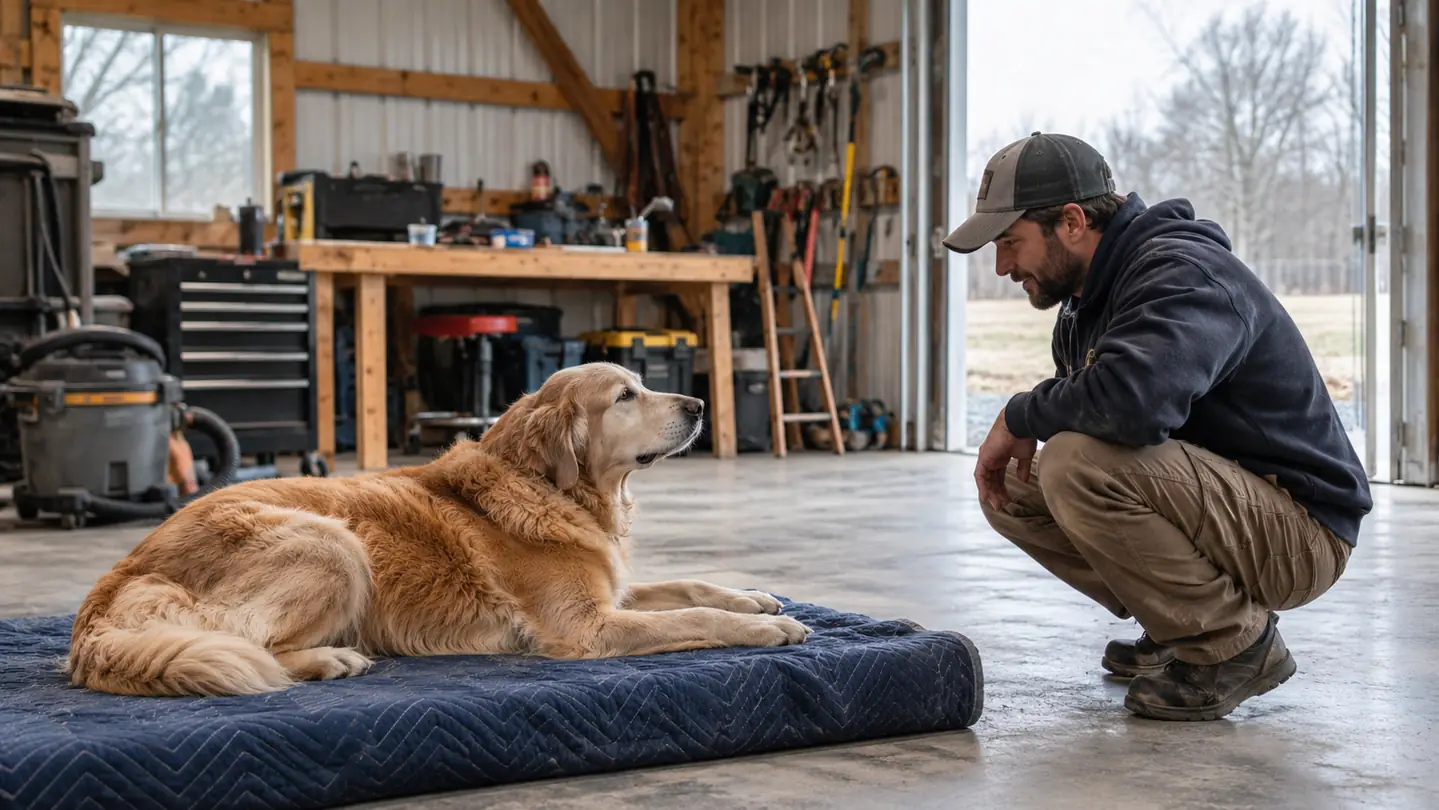
In the pole barn she lies on a folded moving blanket, not the good bed. Concrete pulls heat out of an old dog faster than most people realize, and a blanket costs nothing. It is not a fix. It is one less thing working against her.
And keep her moving. Our vet's line is that a stiff dog who lies still gets stiffer. Short walks on good footing, a slow wander around the yard, a swim in the pond in summer if your dog will do it. The sling is there so she can keep moving on the bad days, not so she can stop.
What This Sling Will Not Do
It will not repair a hip. It will not replace medication, weight management, or a plan from your vet. It will not make an unwilling dog walk. And it will not save your back if you use it like a crane with your arms out and your knees locked.
What it will do is get a heavy dog up three steps on an icy morning without either of you getting hurt. That is a smaller promise than most product pages make. It is also the one that has held at my house for ten months.
One hook by the back door beats a towel and a sore back.
Size Large, listed for dogs from 15 to 30 kilograms. Nylon, machine washable, folds into the bag it comes with. Duchess has been on ours since January, and it has not come apart yet.
Amazon Check Today's Price on Amazon →