

Two years ago our vet put an x-ray up on the light box and showed me two hip sockets that had stopped doing their job. Duchess was seven then, a yellow Lab who had spent most of her life on the concrete floor of my pole barn, and she had been slow getting up for a couple of months. I had been calling it age. It was not age. He wrote a supplement name on the back of a receipt and told me to give it six weeks before I decided anything about it. That name was Cosequin, made by Nutramax Laboratories, and I have bought it every month since. This is the review I wish somebody had handed me that afternoon, because most of what I found online was either a sales page or a four-day rave from a stranger.
I am not a vet and I am not going to pretend to be one. I am 61, I run a 20-acre hobby farm outside Kalamazoo, and I fix small tractors and implements for neighbors out of a pole barn. I have kept big dogs my whole life, and I think about a dog's joints the way I think about a worn bearing on a hay elevator: catch it early, take some load off it, keep it moving, and do not expect a grease gun to fix a bearing that is already chewed up. If your dog is suddenly lame, dragging a back leg, or yelping when you touch a hip, close this page and call your vet. That is not a supplement problem, and no bottle in my kitchen is going to solve it.
The Quick Verdict
The bottle that has stayed on my kitchen counter for two years. It will not rebuild a hip and it will not make an old dog young, but the change in how Duchess gets up off the barn floor is real, and I can point to the week it started.
Amazon Check Today's Price →Two years on, this is still the bottle next to my coffee maker
Cosequin Maximum Strength chewable tablets, from Nutramax Laboratories. Duchess takes hers dry off the counter every morning and has never once turned her nose up at one.
Amazon Check Today's Price on Amazon →What Nobody Tells You Before You Buy
The first thing is that this is maintenance, not repair. Nothing you pour out of a bottle puts cartilage back. Our vet was blunt about that: the point of a joint supplement is to feed the tissue that is still there and make the daily grind easier on it, and the dogs that get the most out of it are the ones whose owners started before things got ugly. I will not dress that up as a cure, because it is not one. It is the difference between a hinge that gets oiled and a hinge that does not, and after two years I can tell you which one my dog is.
The second thing is that six weeks is a real number and not a line from a brochure. Our vet told me to give it six weeks and not to form an opinion before then, and he was right. I watched her like a hawk for the first month and saw nothing, which is exactly the point where people quit and leave a one-star review. Somewhere in week six or seven she got up off the barn floor without that three-beat rocking motion where she pushed herself up with her front end first. Nothing dramatic. Just less of that.
The third thing is that the label doses by weight, and a big dog is on more tablets than the picture on the bottle suggests. A 64-pound dog is not a lap dog and does not get a lap dog amount. My advice, and it is the same advice I got in the exam room, is to read the weight chart on the label and then ask your vet whether your dog's number should be higher or lower given what is actually wrong with the joint. Do not eyeball it, and do not split the difference because you want the bottle to stretch.
How I've Used It, Morning After Morning
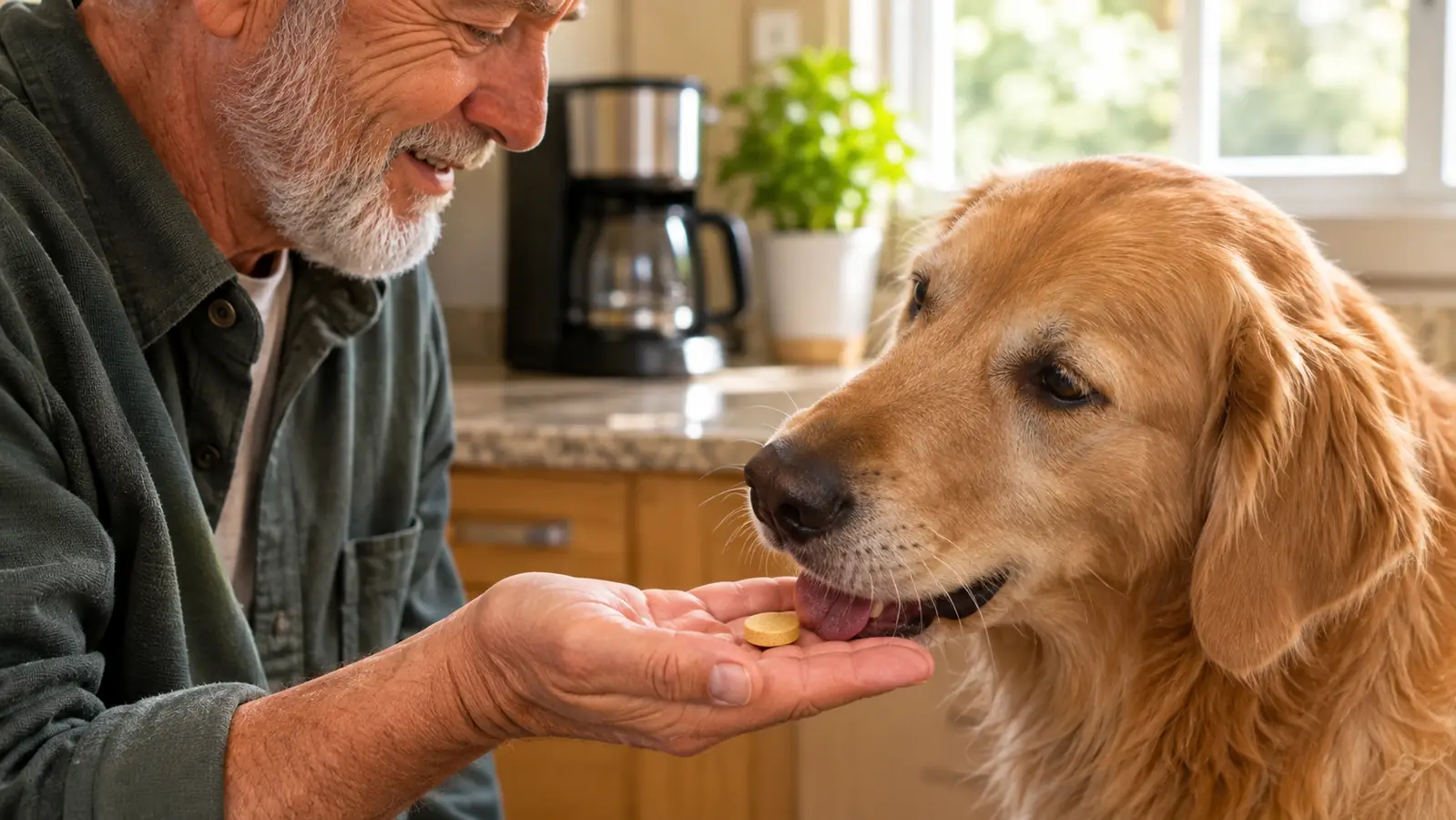
The bottle sits on the kitchen counter next to the coffee maker. That was an accident at first and it turned into the system. Coffee goes on, tablets come out, dog gets hers, I get mine. If I had put the bottle in a cupboard I would have forgotten it by the second week, and a supplement you forget is a supplement that does nothing but take up shelf space.
She takes them dry, straight off the counter, like a treat. That surprised me, because she is fussy about most things and will pick the kibble she likes out of a bowl and leave the rest sitting there. I never had to hide one in cheese and I never had to hold her mouth open. I know people whose dogs spit them across the floor, and if you have one of those, the tablet form is the weak point of this whole product. More on that below.
Two years, every morning, and I have missed maybe a handful. I am telling you that because consistency is doing a lot of the work here and nobody prints it on the label. A dog on a joint supplement six days a week for a year is a different situation from a dog on it for six weeks and then off it because the owner did not see a big enough change. I also cannot separate out how much of what I see is the tablet. We added a salmon oil about a year ago, she sleeps on an orthopedic bed, and the sling and the ramp came later. I am one dog and one kitchen, not a study. What I can tell you is that the first change showed up before any of that other stuff was in the house.
The first change was not a limp going away. It was that she stopped rocking back on her haunches three times before she could get her back legs under her on the barn floor.
What Is Actually in the Tablet
The label lists glucosamine hydrochloride at 600 mg and sodium chondroitin sulfate at 300 mg per tablet, along with MSM and hyaluronic acid. Those four names are the whole reason this bottle is on my counter and not some other one. Glucosamine and chondroitin are the pair that most of the vet recommendations I have ever been handed come back to, and MSM is the one people add for everyday comfort. I am not going to pretend I can explain the biochemistry of it. I can tell you what my vet said, which was that this combination at these amounts is the one he trusts and the one he has watched work often enough to keep writing down.
It comes as a chewable tablet, 75 to a bottle. The listing gives the bottle at 2.66 by 2.66 by 5.21 inches and 6.4 ounces, so picture something small sitting on the counter, not a tub. That is worth knowing if you are expecting a big jug to show up and are already clearing shelf space.
Nutramax Laboratories has been in pet health for over 25 years, and the listing calls Cosequin the number one vet recommended retail joint health supplement brand. I read that as marketing copy, because it is marketing copy. But it lined up with what actually happened in the exam room, which was a man in a white coat writing the name on the back of a receipt before I had looked at a single listing. That is the endorsement I care about, and it is the reason I did not go shopping for something cheaper after the first bottle ran out.
What Changed and What Did Not
What changed: she gets up off the concrete in the barn with less rocking. She is quicker on the three steps off the back porch, especially in warm weather. She moves around the yard in the evening more than she did at eight. Two winters ago she would stand at the bottom of those porch steps and stare at them like they were a wall. Now she takes them, slowly, and only on the bad icy mornings does she need the sling.
What did not change: the x-ray. The diagnosis. She stopped jumping into the back seat of my pickup around age eight, and Cosequin did not bring that back, the ramp did. On a cold damp morning in February she is stiff, and no tablet has ever fixed February. She is nine now and she is not going to get younger, and I would rather say that out loud than sell you a fantasy. Anyone who tells you a supplement handed their dog its puppyhood back is selling something, or remembering wrong.
That is the honest shape of it. The supplement moved the floor up a little. It did not move the ceiling. If you are expecting the ceiling to move you will be disappointed, and you will blame the product, and the product never promised you that. For what it is worth, the label does not promise it either. It is the reviews that do.

The Parts I Do Not Love
It is a tablet, and a tablet is the worst delivery method there is for a picky dog. Duchess happens to take them dry, which is luck and not a feature of the product. A neighbor's dog will not touch one, and she has to bury it in canned food every single morning, and she has told me more than once that she resents paying for the privilege of a fight at breakfast. If your dog is a spitter, know that going in and plan for it.
The other thing is the recurring cost. This is not a one-time purchase like a bed or a ramp. It is a line item that comes back every month for the rest of the dog's life, and with a large dog on a weight-based dose it is a bigger line item than it is for a spaniel. I am not going to quote you a number because prices move around. Sit down and do the monthly math against your own budget before you start, so you are not deciding to quit in month three for money reasons. Quitting in month three is the worst possible outcome, because that is roughly when it starts to show.
And it does not replace any of the boring stuff. Weight. Gentle daily movement. A soft place to lie down. A vet who is actually managing the dysplasia instead of just handing you a bottle and wishing you luck. A joint supplement on top of a dog carrying extra weight on bad hips is money thrown at a problem that has another solution first, and I say that as somebody who has had to take weight off a dog before and did not enjoy a single week of it.
What I Liked
- Duchess takes the chewable tablet dry off the counter, no hiding it in food
- Noticeable change in how she rises off the concrete floor, starting around week six
- Glucosamine hydrochloride 600 mg and sodium chondroitin sulfate 300 mg per tablet, plus MSM and hyaluronic acid
- The brand my own vet wrote down before I ever looked at a listing
- Two years of daily use with no upset stomach, no refusal, and no mornings I had to fight her over it
Where It Falls Short
- Tablet form is a real problem for picky dogs and dogs that spit
- A monthly cost that never ends, and a big dog is on more tablets than a small one
- Six weeks before you know anything, which is longer than most people's patience
- Does nothing about the dysplasia itself, only about how she handles it
- A soft chew would be easier for most households than a tablet
None of that is a reason not to use it. It is a reason to know what you are buying before you buy it. I have bought it two years running and I will buy it again next month, and I will complain about the tablet the whole time.
What Else Is in the Routine
I am not going to let Cosequin take credit for the whole thing. About a year ago our vet suggested a salmon oil on her evening kibble, and her coat went noticeably glossier inside a month. I cannot separate whatever it does for her joints from the Cosequin and I am not going to pretend I can. Fourteen months ago I bought her an orthopedic bed, 44 by 32 inches with 6.5 inches of foam, a waterproof liner and a washable cover, and it lives in the living room next to the woodstove where she sleeps every night. The cover gets washed about once a month, more in mud season. That bed does more for her mornings than anything in the kitchen.
Ten months ago, after an icy morning when she could not get her back legs up the three porch steps, I bought a rear support sling. It hangs on a hook by the back door and comes out on bad mornings, on ice, and after a long day. She was used to it inside a week. Eight months ago I bought a folding ramp for the truck, because I was tired of lifting 64 pounds into the back seat and she was tired of being lifted. That one took two weeks of short sessions with treats before she walked it on her own. All of that is load management, which is the same principle as the supplement: take some of the strain off the joint and let the dog keep doing the things she wants to do.
Who This Is For
This is for the owner of a big dog with a diagnosis on paper, or a big dog who is seven or eight and starting to look stiff in the back end and has already been checked out. It is for somebody willing to give it every morning for two months before forming an opinion, and willing to write down what they see so they are not comparing this week against a vague memory of last fall. It is for the person whose vet said the words glucosamine and chondroitin out loud, which is a large share of large dog owners past a certain age. And it is for the person who understands this is one piece of a routine and not the routine itself.
Who Should Skip It
Skip it if your dog has not been looked at. Stiffness in a big dog can be dysplasia, it can be arthritis, it can be a cruciate injury, and it can be something no supplement will ever touch. Get the diagnosis first, because the amount on the label and the rest of the plan depend on what is actually wrong. Skip it if you know in your gut that you will not keep up with a daily tablet for two months, because the six-week clock restarts every time you quit and you will spend a lot of money starting over. Skip it if your dog has a sensitivity to anything on that label, and take that question to your vet rather than to a review written by a guy with a pole barn. And skip it if you are shopping for a cure, because there is not one in this bottle or any other one, and I would rather lose the sale than have you find that out in month four.
It did not give her a new hip. It gave her the porch steps back.
Cosequin Maximum Strength chewable tablets from Nutramax Laboratories, the same bottle that has sat next to my coffee maker for two years. Read the weight chart on the label, have your vet confirm the amount, and give it six honest weeks before you decide anything.
Amazon See Today's Price on Amazon →