
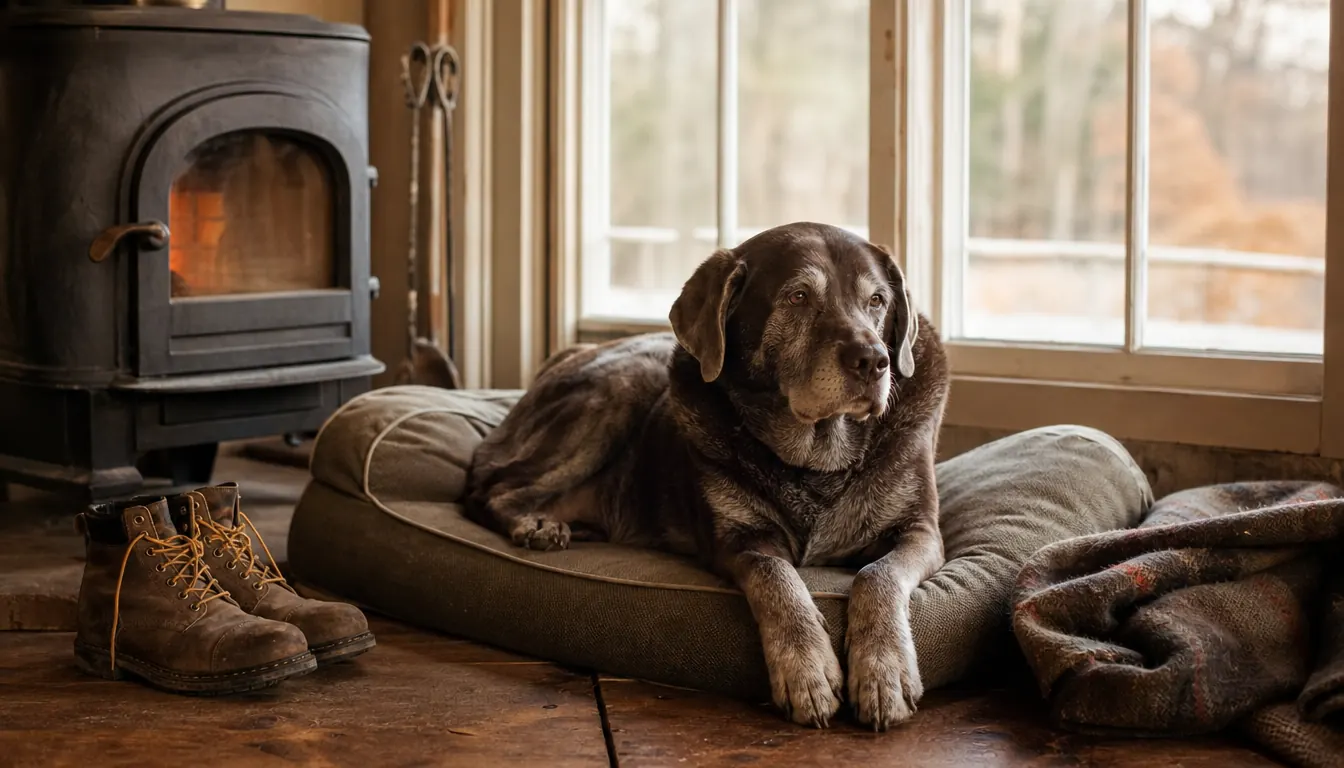
I bought the EHEYCIGA orthopedic bed for Duchess fourteen months ago, and I want to start with the part most reviews leave out: for the first twelve days I thought I had thrown my money at a foam pad. She circled it, sniffed the corner, and went back down on the bare wood floor next to the woodstove. That is not a knock on the bed. It is what a nine-year-old dog does with anything new that showed up in her living room. But it is the honest beginning, and if you are reading this because your dog takes three tries to stand up in the morning, you deserve the whole story instead of the highlight reel.
Duchess is a nine-year-old yellow Labrador, 64 pounds, diagnosed with hip dysplasia and early arthritis in both hips at age seven. She is not a dramatic case. Nobody has mentioned surgery. What she needed was a place to lie down that did not fight her on the way back up, and that is the only thing I am qualified to judge here. This review is about whether a 44 by 32 inch foam bed from EHEYCIGA actually did that, what it does not do, and which dogs I would steer somewhere else entirely.
The Quick Verdict
A genuinely useful orthopedic bed for a big dog that needs a softer landing and a low edge to step over. It will not fix a dysplastic hip, the first two days are a waiting game, and it slides on finished wood. Four stars, and I would buy it again.
Amazon Check Today's Price →The bed Duchess finally chose on day thirteen
44 inches long, 32 wide, 6.5 inches of memory foam over egg crate foam, with a waterproof film between the fleece surface and the bottom fabric. Two weeks to win her over. Fourteen months later she still sleeps on it every night.
Amazon Check Today's Price on Amazon →What This Bed Actually Is, and What It Is Not
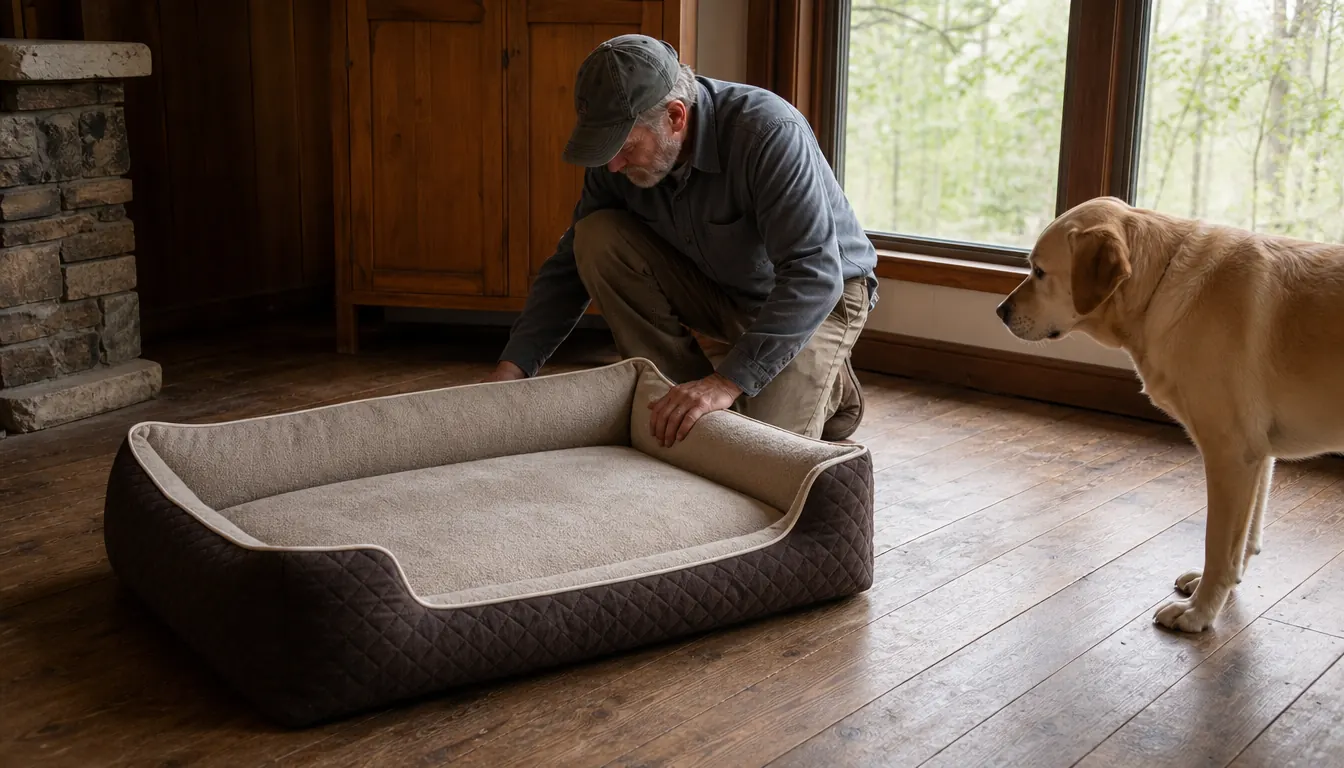
Strip the listing photos away and this is a foam slab with three raised sides. EHEYCIGA builds it from two layers, one memory foam and one egg crate, inside a cover with a waterproof film sitting between the fleece surface and the bottom fabric. The listed dimensions are 44 inches long, 32 inches wide and 6.5 inches thick, and the whole thing weighs about eight pounds. That last number matters more than it sounds like it should, because you will be dragging this bed across a floor to vacuum under it, and you will be wrestling a cover back onto it once a month.
The three-sided bolster is the part I underrated. Duchess does not use it as a pillow. She uses it as a wall. She backs into the bed until her rear meets the bolster, then folds down, and the bolster keeps her from sliding off the back edge onto the floor. On the flat mat she had before, she would shift a few inches every time she lay down and have to reset herself with her back legs. That sounds like a small thing. Over fourteen months of nights it is not a small thing at all.
The maximum weight recommendation on the listing is 45.36 kilograms, which is roughly a hundred pounds. Duchess is 64, so she has room to sprawl. If you have a 130 pound mastiff or a Great Dane, this is not the bed for you, and I would rather say so in the first two minutes than have you find out three weeks from now. Extra large in dog beds is a loose phrase. Measure your dog while she is sprawled out, nose to tail, and compare that number to 44 by 32.
The First Two Weeks Nobody Warns You About
The bed arrives compressed. EHEYCIGA says to let it expand for 24 to 48 hours after unpacking, and they are not being cute about that number. I opened the box in the pole barn on a Saturday morning, set the bed on a clean tarp, and walked away. At the twelve hour mark it looked like a deflated cushion. By Sunday morning it was at full thickness. Unbox it at noon, expect your dog to sleep on it that night, and you will be disappointed, and you will blame the bed for what was really a packing decision.
There is a foam smell out of the box. Not chemical horror, just foam. Two days in the barn with air moving and it was gone. If you are opening this in a small bedroom, give it a couple of days somewhere with a window cracked before you bring it inside.
Duchess ignored it for twelve days and I did not force the issue, because you cannot argue a Lab into a bed. I laid one of her old blankets on it so it smelled like something she already knew, and I set a treat on it every evening when she came in from the barn. On day thirteen she got on it herself and stayed until morning. Fourteen months later she walks to it after her evening pill and lies down without being told. That is the entire endorsement, and it took two weeks to earn, which is worth knowing if you are the sort of person who gives up on day three.
Does 6.5 Inches of Foam Actually Help a Stiff Dog?
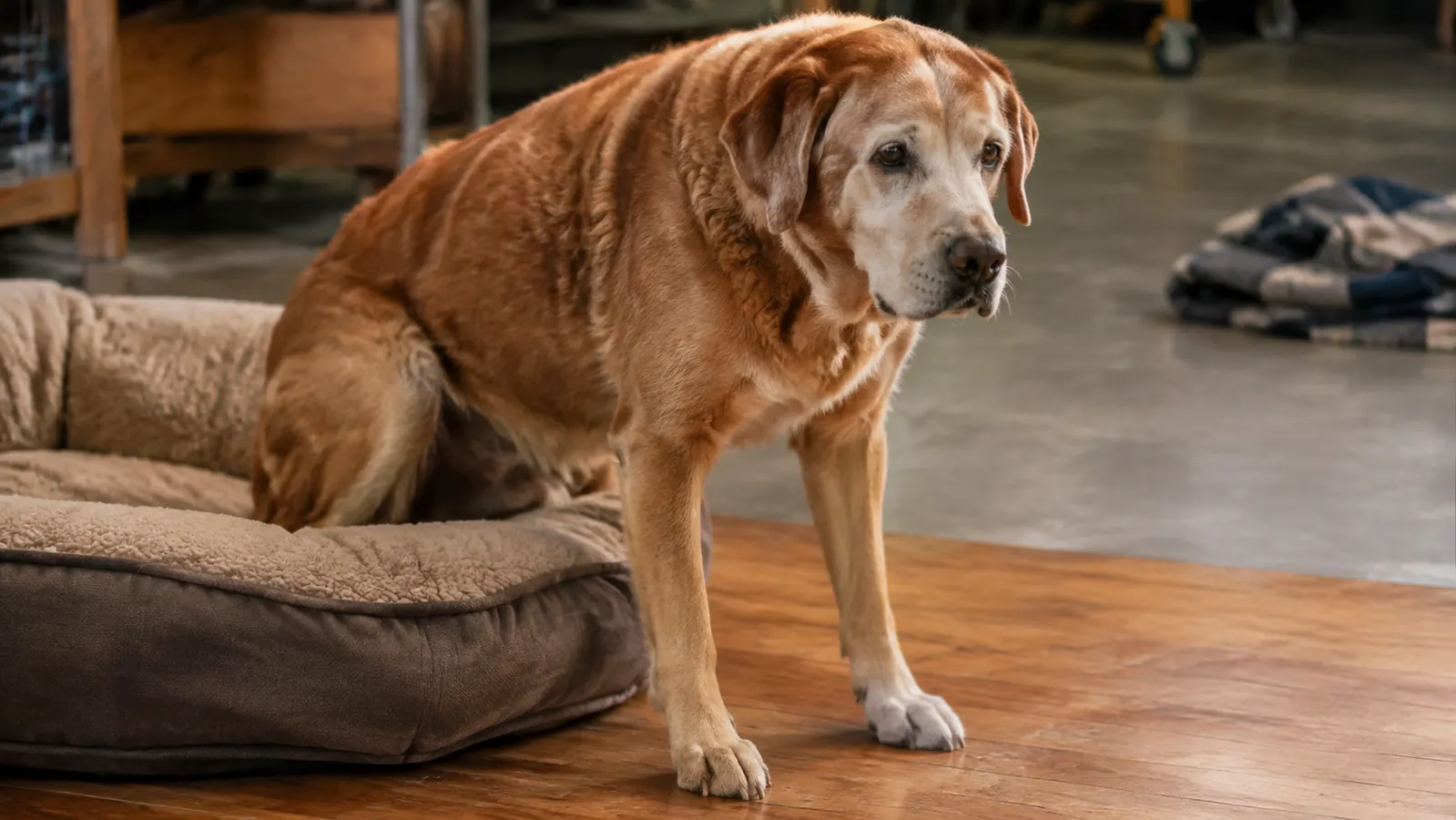
This is the question that matters, so I will answer it the way I would answer a neighbor across the tailgate. Before the bed, on the bare wood floor, Duchess needed three tries to get up in the morning. She would rock forward, gather herself, and push. By the third week on the bed she was up on the first push. That is not a cure and I will not dress it up as one. It is a shorter distance between lying down and standing, and for a dog with dysplasia in both hips, that distance is the whole game.
The egg crate layer is the reason. It gives under her hips and shoulders instead of refusing to, so her elbows and hocks are not carrying the full load against a hard surface. The memory foam on top spreads the pressure rather than letting her sink through to the floor. I have had the cover off and pressed my hand into both layers. The bottom compresses readily. The top pushes back slowly. For a dog that lies in one spot for eight hours, that is the combination you want.
What the bed does not do: it does not hold her hip in a better position and it does not replace the Cosequin our vet put her on two years ago. I want to be blunt about that. A bed is load reduction. Load reduction is real, it helps, and it is not treatment. If your dog is lame, favoring one leg, or yelping when she stands, get the vet out before you spend a dime on anything you found on Amazon. I have said that before and I will keep saying it.
I also do not have a story where the bed replaced exercise or weight management. Duchess sits at 64 pounds and stays there, because our vet was clear that five extra pounds on a dysplastic hip costs more than any foam can give back. The bed is one piece of a routine that includes a joint supplement, salmon oil on her evening kibble, short walks on flat ground, and a sling on the bad mornings. Take the bed out of that and I doubt you would notice it half as much.
The Waterproof Layer, Mud Season, and Fourteen Months of Wear
There is a waterproof film between the fleece surface and the bottom fabric. That is the listing spec. What it means at my place is that a wet dog does not soak the foam underneath. Duchess comes in from the barn wet about nine months out of the year in Michigan, and she has had one accident on the bed in fourteen months. Both times the surface stayed damp for a while and the foam below stayed dry. I checked, because I did not believe it either. I stuck my hand under the cover and felt around.
The cover washes. I do it about once a month and more often in mud season, which around here is March through May and then a second round in November when the fields turn. Cold cycle, then it hangs on the porch rail to air dry. I am not going to put a cover with a waterproof film in a hot dryer to find out what happens. Getting it back on is a two person job if you want it straight. The bolsters are firm and they shift while you pull, and I have put it back crooked twice and had to start over.
Fourteen months in, the foam has not gone flat where she lies, and that is the failure I expected. The cheap beds I have bought before flattened at the hip spot inside one season and then they were just a rug with ambitions. There is a shallow impression where she settles, which is normal for memory foam and is not the same as a collapsed pad. The cover has faded some and there is a small pull near one corner from her nails. Nothing there that would make me replace it.
Where This Bed Falls Short
The non-skid bottom is average, and I will not pretend otherwise. On the pole barn concrete it holds. On a rug it holds. On the waxed part of my kitchen floor it slides a couple of inches when she pushes off to stand, which is exactly the moment you do not want movement. Not enough to matter most days, and enough that I gave up on the kitchen location and moved the bed into the living room next to the woodstove, where it has stayed ever since.
Six and a half inches is a step up, and that is the spec doing its job in both directions. Duchess handles it at nine years old. A dog with a torn cruciate, or one that has lost most of her rear leg strength, will not. At that stage a thick bed is a hurdle, and you need something lower, or a ramp, or a sling. I own a ramp and a sling for exactly that reason and I am not going to tell you a firm mattress solves a mobility problem that has already gone past a certain point.
One more thing, and it applies to every bed in this category: the marketing runs a good lap ahead of the product. This is foam in a cover. Good foam in a good cover, but foam. It will not reverse arthritis and it will not replace medication, and any review that tells you a bed fixed a diagnosis is telling you something our vet would not sign off on.
Size is the last catch. I taped Duchess on the kitchen floor to settle this. Curled up she measures about 38 inches from nose to tail. Sprawled flat on her side with her legs out she is 47, and her nose hangs off the end when she does that. She does not appear to mind. Your dog might, especially a dog that sleeps stretched out rather than folded. If yours sprawls, measure before you order.
What I Liked
- Full thickness at 48 hours, still full at fourteen months, no flat spot at the hip
- The three-sided bolster stops a stiff dog sliding off the back edge, which is half the getting-up problem
- Waterproof film holds up in practice: a wet dog and one accident, foam stayed dry both times
- Cover washes cold and air dries, about once a month here and more in mud season
- Eight pounds and no assembly, so I can carry it out to the porch to air it
Where It Falls Short
- Ships compressed and needs 24 to 48 hours, plus two days of foam smell
- Non-skid bottom slides on smooth finished wood at the push-off moment
- A 6.5 inch edge is too tall for a dog with a torn cruciate or serious rear weakness
- Takes two people to get the cover back on straight
- 44 by 32 is tight for a dog over about 90 pounds that likes to stretch out
Before the bed she needed three tries to get up off the floor. By the third week she was up on the first push. That is not a cure. It is a shorter distance between lying down and standing, and for a dog with dysplasia that distance is the whole game.
Who This Is For
A dog between roughly 50 and 90 pounds that is stiff getting up off a hard floor, that sleeps in one spot most of the night, and whose diagnosis you are already managing with a vet. A dog that has started hesitating on the porch steps or at the truck door is the dog this bed is built for, because this bed is about the getting-up, not the walking. Duchess is exactly that dog, and the change in her mornings was real enough that I noticed it before I was looking for it.
It is also for the owner who would rather wash something once a month than replace a mat every season. I have bought the flat beds. They either flatten at the hip or the cover gives out, and then you are back on Amazon reading listings again. This EHEYCIGA bed has held its shape through fourteen months, one accident, and about fourteen washings, and that is the number I would want if I were reading this instead of writing it.
Who Should Skip It
Skip it if your dog is over about 90 pounds and sprawls, or if you are shopping for a Dane or a mastiff. Skip it if your dog cannot step up 6.5 inches without help, because a thick bed at that point is a hurdle and you want a low platform or a ramp instead. Skip it if you will not wait two days for foam to expand, or if you will not take the cover off and wash it, because a waterproof bed that never gets washed is just a damp bed with a film in it.
And skip it if you are hoping a bed will do the work a vet should be doing. If your dog is lame, dragging a back foot, or crying when she stands, that is a diagnosis problem before it is a bedding problem. Get the diagnosis first. Then come back and pick the bed, and measure your dog before you do.
If your dog needs three tries to stand up, start here
The 44 by 32 inch EHEYCIGA orthopedic bed, 6.5 inches of memory foam over egg crate, waterproof film under a washable fleece surface, non-skid bottom. Give it two days to expand and two weeks to win your dog over. That was the timeline here.
Amazon Check Today's Price on Amazon →