
Duchess is a nine-year-old yellow Labrador, about 64 pounds, and she was diagnosed with hip dysplasia and early arthritis in both hips at seven. For the first two years I treated it like a behavior problem. She was slow getting up off the concrete in the pole barn, she started skipping the three porch steps, and around age eight she quit jumping into the back seat of the truck. She was not being stubborn. Her hips hurt. Our vet took the X-rays and told me the plain truth: the joint is loose, there is arthritis in there, and we are managing it, not curing it.
I tried the easy fixes first. A thicker moving blanket in the barn. A crib mattress somebody left at the end of the driveway. Both were better than bare concrete and neither was enough. About 14 months ago I bought the EHEYCIGA orthopedic extra large bed, the 44 by 32 inch model with 6.5 inches of foam, a waterproof liner and a washable cover. It lives in the living room next to the woodstove now. This is the checklist I would use if I were starting over, and I am using that bed as the worked example because it is the one I have actually lived with.
A bed she can get up from, not just lie on
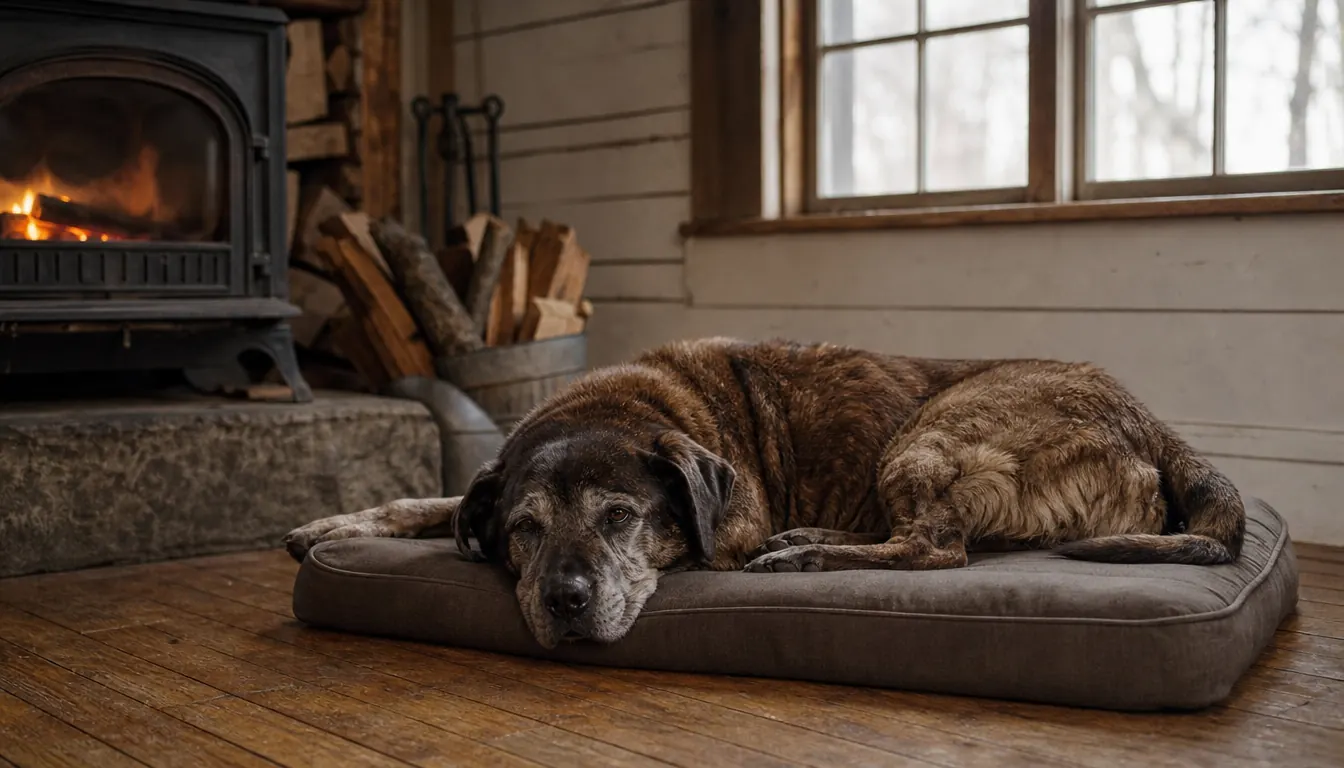
The EHEYCIGA orthopedic XL is 44 by 32 inches with 6.5 inches of foam, a waterproof liner and a non skid bottom. It is the bed Duchess sleeps on every night.
Amazon See the EHEYCIGA Bed on Amazon →The Five Steps I Would Use Again
Step 1: Measure the dog and the floor space
Start with weight and length, not the word XL on the box. Duchess is 64 pounds, and the EHEYCIGA is rated to 45.36 kg, so she is well inside the limit. The footprint is 44 inches long by 32 inches wide, and the foam is 6.5 inches thick. That thickness is the part people forget. A dog with sore hips has to be able to step onto the bed without a big hurdle, and a weak back end makes a tall bed harder to use, not easier.
I put a tape measure on the floor where she already slept, not where I thought a bed should go. The spot next to the woodstove had about 50 inches of wall and a good four feet of open floor in front of it. That second number is the one I would write down first. If your space is tighter, measure the landing zone too, because she needs a clear place to plant her front feet while she swings her back end around. When I first brought a bed home, I shoved it tight against the wall to keep it out of the walkway, and Duchess stood over it for a solid week without ever lying down on it. A bed wedged into a corner looks tidy and makes a dysplastic dog do a three-point turn every time.
The last part of measuring is the dog's posture. Watch how she lies down now. Duchess drops her front end first and then lowers her hips, and she likes to rest her chin on something. That told me I wanted a bed with some edge support, not a flat mat. Do this on a Saturday morning when you are not in a hurry. Sit down with a cup of coffee and watch the whole sequence, from the first slow circle to the last sigh. If your dog circles three times and then flops, a flat bed may be fine. If she lowers herself like she is trying not to spill a cup of coffee, pay attention to the thickness and the edges.
Step 2: Read the foam stack, not the label
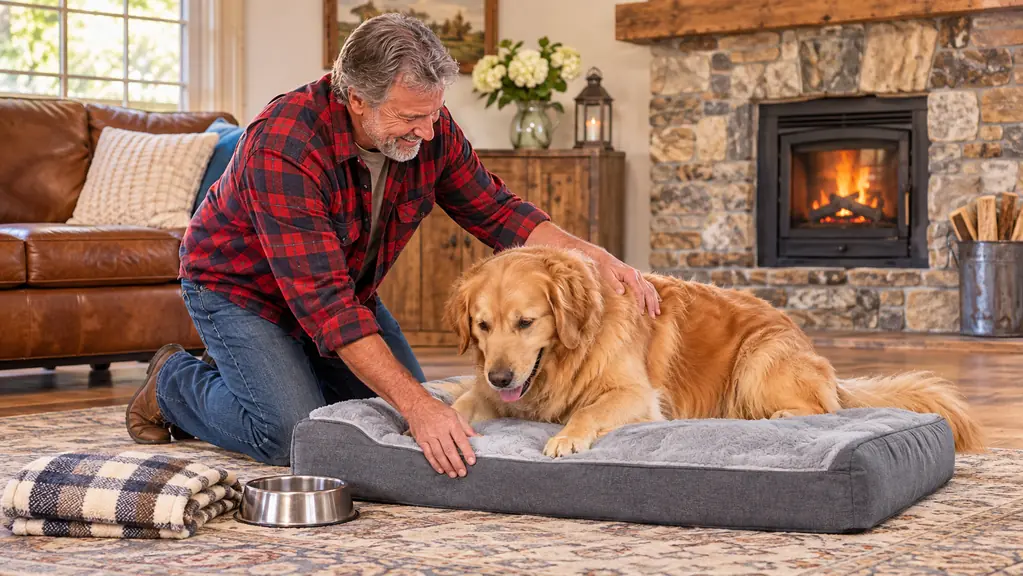
The word orthopedic is a marketing word. It is not a standard, and any bed can print it on the box. What matters is what is inside. The EHEYCIGA lists memory foam and egg crate foam, and the finished bed is 6.5 inches thick. The egg crate foam is the part that spreads the load, and the memory foam is the part that gives a little under the pressure points. That combination is what I would look for again.
A thin bed with a good cover is still a thin bed. I have seen pads that are maybe an inch of foam and a lot of polyester fill. They feel soft in the store and flatten out in a month. The crib mattress I dragged home that first fall was the proof of it. Two inches of foam in a vinyl cover, and by the end of that winter I could press my palm flat to the floor through it with no effort at all. Duchess is 64 pounds. A bed that lets her hips sink until she is basically on the floor is not doing the job. I want enough foam that her body is supported, but not so soft that she cannot push herself up.
This is also where the weight rating matters. The EHEYCIGA is rated to 45.36 kg, and the bed itself weighs 7.96 pounds. That is light enough for me to drag it out of the way when I sweep, and heavy enough that it does not slide across the wood floor every time she steps off. If you have two big dogs, or a dog well over the rating, buy a bed built for that weight instead of squeezing this one.
Step 3: Decide whether bolsters help or hurt
The EHEYCIGA has three-sided bolsters. For Duchess, that is a plus. She likes to rest her chin on the raised edge, and when she is lying on her side the bolster gives her something to push against when she starts to get up. The listing says the bolsters are there to support the neck and head, and that matches what I see.
But a bolster can also be a curb. If your dog is unsteady on her back legs, a raised edge on the entry side can make her hesitate or catch a toenail. I set the open side toward the middle of the room so she can walk on without stepping over anything. The three-sided design makes that easy. A four-sided bed with a high wall all the way around would be harder for her.
The test is simple. Put the bed down and watch your dog get on it. If she steps in cleanly, the bolsters are support. If she stands there and looks at it like it is a flight of stairs, turn the bed so the open end faces her, or look for a flatter design. Do not force it. A dog with sore hips will choose the cold barn floor over a bed that is hard to climb, and she will do it quietly enough that you might not notice for a week.
Step 4: Check the waterproof layer and the cover
A senior dog has accidents. That is not a failure, it is part of the deal. The EHEYCIGA has a waterproof film between the fleece surface and the bottom fabric, so a wet accident does not go straight into the foam. That matters more than the word waterproof on the outside. The foam is the important part, and once it is soaked and sour, the bed is done.
The cover is washable, and I wash it about once a month, more in mud season. Around March the ground by the barn turns to soup, and Duchess comes in with wet feet and whatever she found in the back field. That is a weekly wash, not a monthly one, and the cover comes off and goes back on without a fight. A cover that cannot be removed is a bed you will throw away. I also like that the bottom is non skid. On our wood floors, a sliding bed is dangerous for a dog that is already unsure on her feet. One winter I had a bed that skated a foot every time she stepped off it, and I spent more time straightening that thing than she spent sleeping on it.
Check the seams and the zipper when it arrives. I have had covers that were soft and covers that were tough, and for a big dog I want tough. The EHEYCIGA has held up for 14 months with monthly washing. It is not a chew toy, and I would not leave a puppy alone with it. Duchess does not chew, so that has not been an issue for us.
Step 5: Let it expand, then put it where the dog already sleeps
The bed ships compressed. The instructions say to allow 24 to 48 hours after unpacking for it to expand. Mine came in a box about the size of a case of motor oil, in a vacuum bag that hissed when I cut into it. I opened it in the living room on a Friday, worked the foam loose with my hands, and gave it the weekend. Do not judge the thickness on the first afternoon. It looks flat and sad right out of the box, and cold slows the whole thing down, so a bed opened in an unheated barn in February will take longer than one opened next to the stove. By the second morning mine was the full 6.5 inches.
Placement matters as much as the foam. Duchess already slept next to the woodstove. That is where the bed went. I did not put it in a spare room and expect her to follow a new routine. A dog with hip dysplasia does not need to learn a new part of the house on top of everything else. Put the bed where she already lies down, and let her find it.
Keep the old blanket in the barn. Duchess spends most of the workday on the concrete while I am fixing equipment, and the EHEYCIGA stays in the house. I fold an old moving blanket for her in the pole barn, and that is enough for a nap. The bed is for the long overnight sleep and for the evening when she is stiff. Two different jobs, two different setups.
What Else Helps
The bed is one piece. Our vet was clear that hip dysplasia is managed with several things, not one purchase. Duchess is on Cosequin Maximum Strength, chewable tablets we started two years ago right after the diagnosis, and I pump Natural Dog Company Wild Alaskan Salmon Oil on her evening kibble, which we added about a year back. Both were on the vet's suggestion. The first change I noticed was at about six weeks, when she got up off the barn floor with less rocking. I cannot tell you which thing is doing the most, and I am not going to pretend I can. The bed, the supplements, the sling and the ramp are a package.
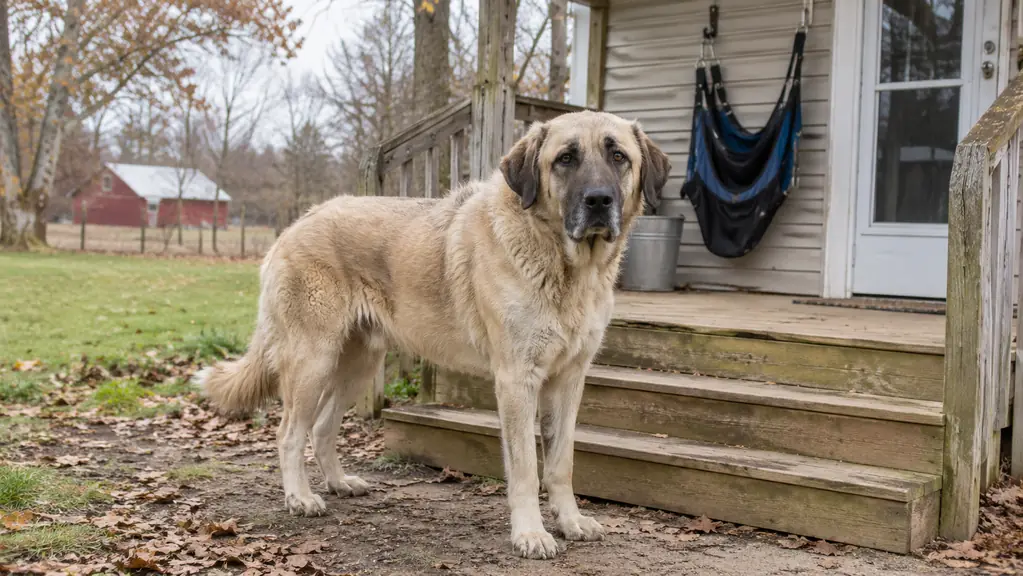
The sling is a LOOBANI rear support sling, size Large, and it hangs by the back door. I bought it last January after an icy morning when she could not get her back legs up the three porch steps. I use it on bad mornings and on ice. The ramp is a Pawaboo 74 inch folding ramp, rated to 250 pounds, and it hooks on the back door sill of the crew cab. It took about two weeks of short sessions with treats before she walked it on her own. If your dog is lifting a back leg or dragging a toe, stop reading about beds and call your vet. That can be something else entirely.
Weight is the other lever. Duchess is 64 pounds, and our vet wants her to stay there. Every extra pound is more load on a bad hip. I measure her kibble instead of free feeding, and I keep the treats small. That is not as satisfying as buying a new bed, but it is simple and it matters. The bed makes her comfortable. The weight keeps the load down. Neither one fixes the joint.
The morning after the first cold snap, she got up off the EHEYCIGA without the rocking. That told me more than the word orthopedic on the box.
Put the bed where she already sleeps
The EHEYCIGA orthopedic XL gives Duchess 6.5 inches of foam, three-sided bolsters and a waterproof liner. If your dog has already picked a spot, start there.
Amazon See the EHEYCIGA Bed on Amazon →