

Duchess was seven when our vet finally put words to what I'd been watching for a year. Hip dysplasia in both hips, with early arthritis riding on top of it. She's a yellow Labrador, nine now, about 64 pounds, and the first thing that changed was not her walk. It was the pause. She'd lie on the concrete in the pole barn, gather herself, and push up with a small rocking motion before she got her back feet under her. I know that motion. I've seen it in worn bearings.
If you're further behind than that, you're in good company. You've got a big dog who has slowed down, a bottle of joint tablets on the counter, and a label written for someone who already knows what a loading amount is. Ours came from Nutramax, on our vet's suggestion, and I have bought it off Amazon ever since. Half the internet says glucosamine is a waste of money. The other half says it gave them their dog back. Neither one tells you what to do on a Monday morning. Here is the order I did it in, and what I would do the same way again.
The Chewable Our Vet Named at the Age-Seven Diagnosis
Cosequin Maximum Strength is a chewable tablet with 600 mg of glucosamine hydrochloride and 300 mg of sodium chondroitin sulfate, plus MSM and hyaluronic acid. It is the one on my kitchen counter, next to the coffee maker, that Duchess takes for a treat every morning. 75 chewable tablets to a bottle.
Amazon Check Today's Price on Amazon →Step 1: Get a Real Weight and a Real Diagnosis Before You Buy Anything
Glucosamine is dosed by weight, which means a guessed weight is a guessed dose. My bathroom scale said 64 pounds. The clinic scale said 61 that first visit, and 68 the winter she figured out how to get into the barn cat's dish. None of those numbers is a plan. Our vet weighed her properly, felt both hips, and took x-rays before he said the word arthritis.
The other reason to go first is that not every stiff dog has a joint problem. A torn cruciate, a sore back, a soft tissue strain from a bad landing out of the truck all look like a dog that is slow to rise. A supplement will not touch any of them, and you do not want to be six weeks in before you find out the real answer needed something else. Our vet put it plainly. Come in, let me look at her, then we will talk about what you are feeding her.
Step 2: Read the Label for Your Dog's Weight, Not for a Serving Size
There is no single serving of a joint supplement. The label carries a small chart that runs by weight, and your dog's row is the only number that applies to your dog. Find the row, read across, and that is the daily amount. It takes thirty seconds and almost nobody does it.
Do not eyeball half a tablet, and do not copy a friend. Two dogs at the same weight on two different bottles can be getting very different amounts of glucosamine, because the strength per tablet is not the same from brand to brand or from chew to tablet. Cosequin Maximum Strength from Nutramax carries 600 mg of glucosamine hydrochloride and 300 mg of sodium chondroitin sulfate in a chewable, along with MSM and hyaluronic acid. A soft chew from another company carries its own number, and it will not be the same one.
If your dog's weight lands between two amounts on the chart, call and ask the vet which way to round. Splitting a chewable by eye is how you end up with a dog on three quarters of a dose for a month without knowing it. The bottle holds 75 chewable tablets and keeps best somewhere dry and out of the sun, which on this place means a kitchen cabinet and not a shelf in the barn.
Step 3: Start at the Loading Amount the Label Gives, Then Step Down
Joint supplements are usually not dosed the same in week one as they are in month three. The Cosequin label from Nutramax lists a higher amount for the first stretch and then steps down to a maintenance amount. Follow the order it prints. Starting at the lower maintenance number to make a bottle last longer is how people end up saying glucosamine did nothing after three weeks, when what actually happened is that the dog never got the starting amount at all.
Do not invent your own shortcut, and do not double up the next morning to make up for a missed one. This is a supplement that builds slowly, not a pain pill that works in an hour. If you lose track of where you are in the starting stretch, call the vet's front desk and ask. They answer that question several times a day and they will not think less of you for it.
One more note on switching. If the bottle runs out in the middle of the starting stretch, replace it with the same product. Changing brands in week three resets the question, because the strength per tablet is different and the amounts on the label are different, and now you have no idea what your dog has actually been getting.

Step 4: Anchor the Dose to Something You Never Skip
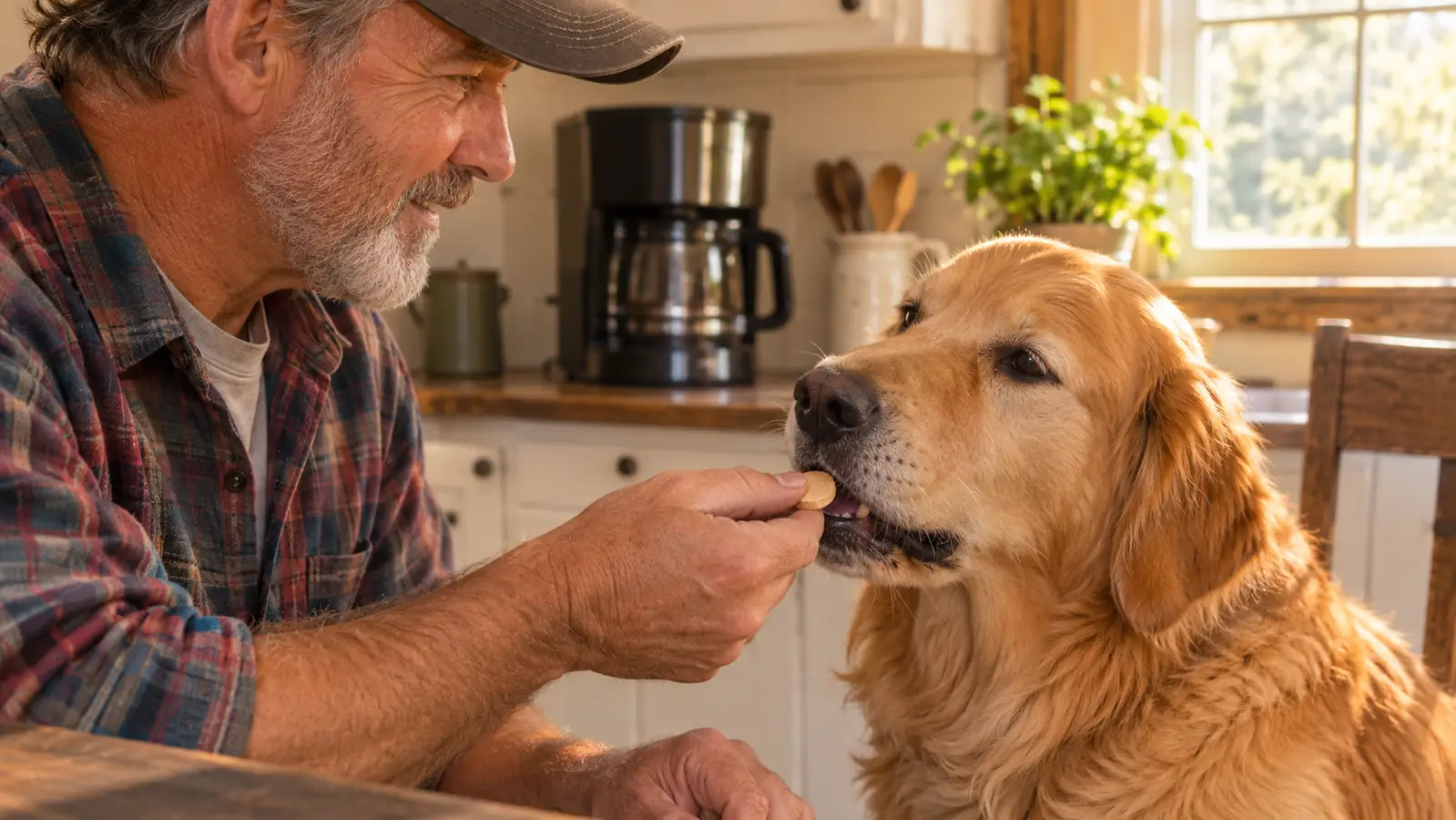
Ours is the coffee maker. The bottle sits on the counter beside it, and Duchess gets her tablets while the pot fills. She takes them dry, out of my hand, like a treat. Two years in, she hears that cabinet open and she is already sitting.
The point is not the coffee. The point is that this works on average, and the average is built out of the days you did not feel like it. A dog who gets her tablets four days out of seven is a dog on a lower average amount, and you will blame the product for that. Pick a habit you already keep, the morning feed, letting her out before bed, the walk you never miss, and put the dose on top of it. That is worth more than any reminder on a phone.
If your dog spits the chew out, tuck it under the kibble instead of setting it on top where it gets licked and left in the bowl. Ours has never turned one down. Not every dog is that easy, and a tablet on the floor is a dose that did not happen.
Step 5: Give It Six Weeks and Write Down What You Can Actually See
Six weeks was when I first noticed. Not a transformation. A small thing. She got up off the barn floor without the rock. I only caught it because I had been watching for it, and I would have talked myself out of it if I had not written the baseline down first.
So pick two or three things you can actually see before you start, and put them in a notebook with the date on it. Mine were getting up off the concrete after a rest, the three back porch steps, and whether she would still put her front feet up on the tailgate. Score each one on an ordinary day. Then leave the notebook alone for six weeks and read it again. Memory is a poor judge of slow change in a dog you look at every single day. Mine is, anyway.
If you are at eight or ten weeks with nothing moving, that is information and not failure. Take it to the vet. The answer might be that the amount needs to change, that she needs something for pain on top of the supplement, or that the joint you were worried about is not the whole story. Duchess is on a supplement, not a cure. She still has bad mornings when the weather turns, and I still watch her get up.
Where People Go Wrong
The two mistakes I see most are starting at the maintenance amount and quitting at three weeks. Both come from expecting a supplement to behave like a drug. It does not. It builds, and it fades if you stop, and the dog cannot tell you which week she started feeling better.
The third is buying three joint products at once and starting them all in the same week. Then nothing can be judged, because you changed everything at the same time. Change one thing, give it six weeks, write it down, and move on to the next thing only after that.
The fourth is skipping the vet because the bottle is easy to buy. Easy to buy is not the same as nothing to check. If your dog is lame on one leg, yelps when she rises, or stops eating, that is a vet visit and not a dosing question. I am not a vet and I am not going to play one here. I fix tractors. The joint advice in this piece is what our vet told me, applied to one dog over two years.
What Else Helps
Weight is the biggest lever I have and it does not come in a bottle. Every extra pound on a dysplastic hip is a pound she carries up those steps four times a day. Our vet wants her lean enough to show a waist from above, so we weigh her at the clinic twice a year and the kibble comes down before anything else changes.
Bedding and floors matter more than people expect. Duchess sleeps on a thick orthopedic bed in the living room next to the woodstove, one with a washable cover that I run through about once a month and more often in mud season. In the pole barn she gets a folded moving blanket, because the barn is where the mud is. I also laid two runners over the kitchen wood floor. A dog who slips braces, and a bracing dog is sore by evening.
For the bad mornings, gear does what a supplement cannot. Last January, on an icy day, she could not get her back legs up the three porch steps. I bought a rear support sling that afternoon, and it hangs on a hook by the back door now, used on ice and after long days. In March I added a folding ramp for the truck, 74 inches and rated to 250 pounds, hooked over the back door sill of the crew cab. It took about two weeks of short sessions with treats before she walked up it on her own. Now she loads herself and rides on the back seat like she always did.
Keep her moving, too. Short and often beats long and rare on a dog with sore hips, so we do two slow walks a day instead of one big one on Saturday. About a year ago our vet also suggested a salmon oil pumped onto her evening kibble, and her coat was noticeably glossier inside a month. I will be honest with you. I cannot tell you what it did for her joints, because she started it while she was already on the chewable, and I am not going to claim credit I cannot separate.
That is the whole program. One chewable from Nutramax every morning, a bed she actually sleeps on, runners on the slick floor, a sling and a ramp for the bad days, and a notebook that tells me the truth about whether any of it is working.
Six weeks in, she got up off that concrete without the rocking motion. That was the whole result. Small, and it changed her mornings.
If Your Dog Is Slow Off the Floor, Do the Vet Visit First and Then Start Here
Same order I used: get the hips looked at, read the weight chart on the label, start at the amount it gives, and hand over six honest weeks before you judge it. The chewable has sat by my coffee maker for two years now.
Amazon Check Today's Price on Amazon →