
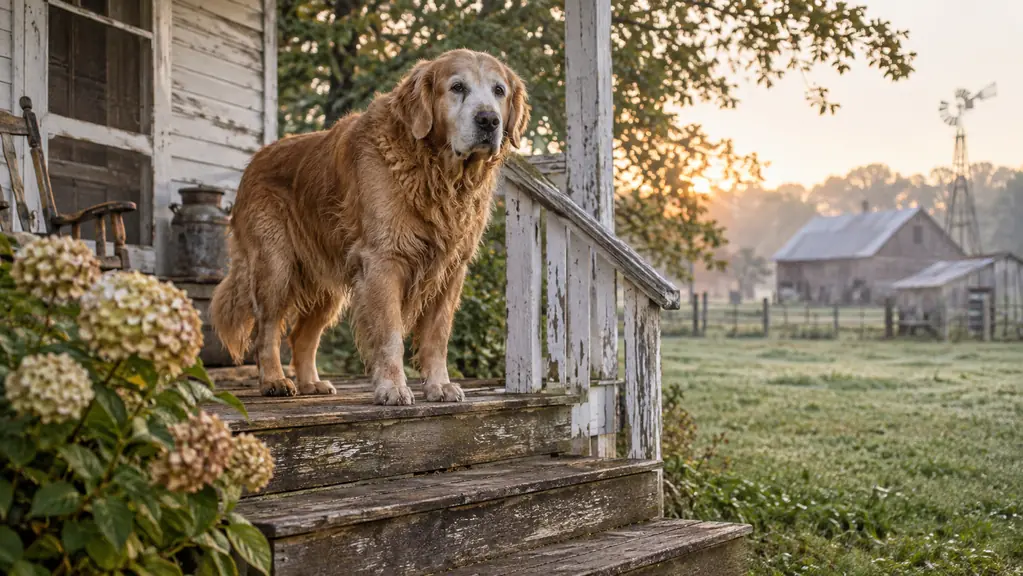
Two winters back I stood in the barn aisle at six in the morning, coffee going cold in my hand, watching a 64 pound yellow Lab try to get her back legs under her on a concrete floor. Her name is Duchess. She was seven then. Our vet took x-rays, called it hip dysplasia in both hips with early arthritis, and handed us a plan with more moving parts than I expected: weight, bedding, traction, a joint supplement, and a leash instead of a free run to the mailbox. I am not a vet and I am not going to play one here. What I am is a man who fixes worn equipment for a living, and the way I look at a dog's hips is the way I look at a bearing that has started to growl. Catch it early, take some load off it, keep it moving. About a year ago we added Natural Dog Company Wild Alaskan Salmon Oil to her evening meal, and this is what twelve months of that has actually looked like.
A fair warning about what this review can and cannot tell you. Duchess has been on a chewable joint supplement since the week of that diagnosis two years ago. The salmon oil came about a year later. So if you are hoping I will tell you the oil is what turned her around, I can't, and anybody who claims they can separate one bottle from another in a single dog is selling something. What I can tell you is what the routine costs in effort, what changed in her coat and in how willing she was to move, what I did not care for, and who I think should spend the money.
The Quick Verdict
A salmon and pollock oil pump bottle that put a shine on a dull barn dog inside a month. A year in, I cannot prove what it did for her hips, and I am still reordering it.
Amazon Check Today's Price →The simplest thing in Duchess's routine, and the one I reorder without thinking
Natural Dog Company Wild Alaskan Salmon Oil, 32 fluid ounces, pump bottle. It goes over the evening kibble at the amount the label lists for her weight, and that is the whole job.
Amazon See Today's Price on Amazon →How I've Used It
Our vet brought it up at the end of a recheck, the way he brings up most things, as a maybe. Her coat was dull, her skin was dry every winter, and she was already on a joint supplement, so his thinking was that omega-3s were worth a try on both counts. I ordered the 32 ounce pump bottle that week and started her on it right away.
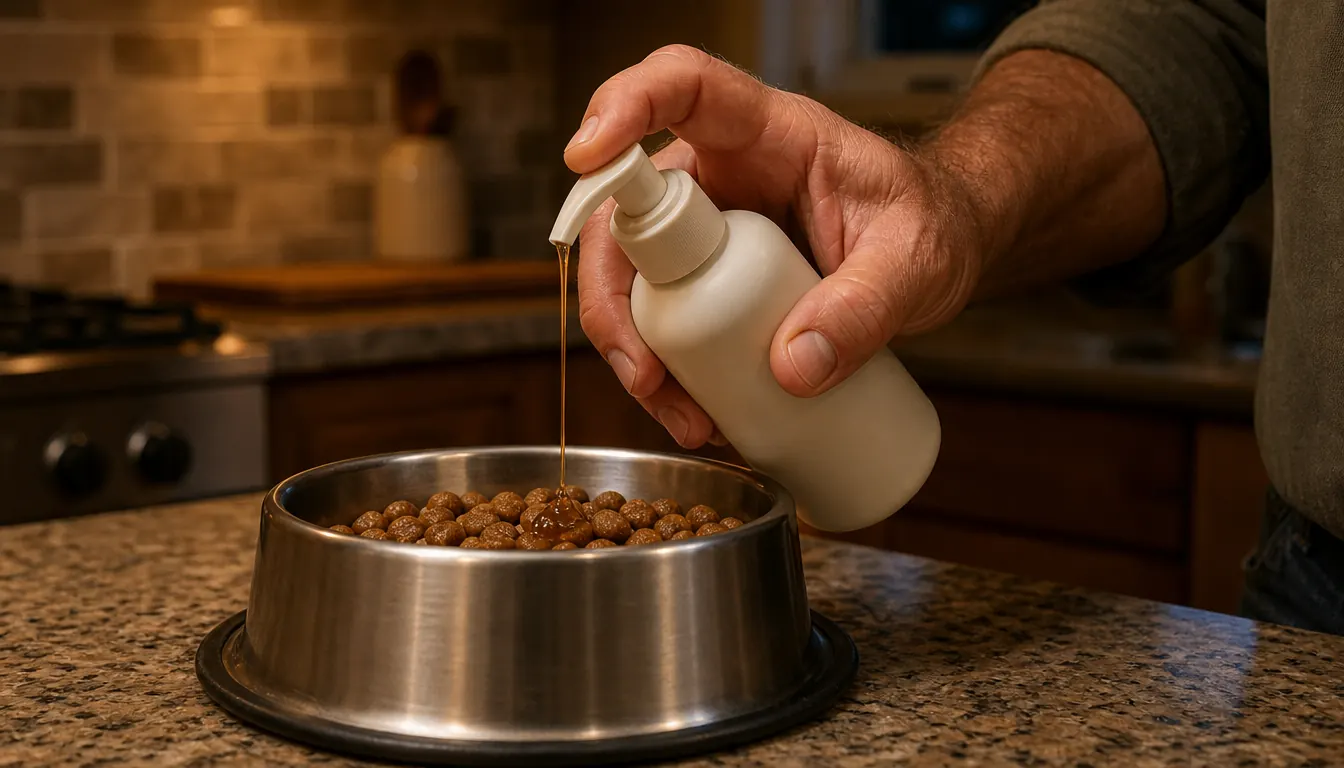
The routine is about as simple as a supplement gets. One dose a day, in the evening, pumped over her kibble at the amount the label gives for her weight. I put it in the evening for no better reason than that the morning slot already belongs to the chewable tablet, and I would rather keep the two habits in two separate slots so I don't lose track of either. She eats it without any coaxing. She is a Labrador, so that sentence carries less information than it sounds like, but I have had dogs that ate around a powder and left it in a ring at the bottom of the bowl, and this is not that.
Storage is the fridge door once the bottle is open. It measures about ten inches tall and a touch over two pounds, so it takes up a door shelf and nothing else. There is a rag in the door pocket because the pump leaves a bead on the spout after every use, which is not a defect, it is just what a pump does.
What Is Actually In It, and What That Means
The label on the Natural Dog Company bottle is short, which I like. Wild Alaskan salmon oil blended with pollock oil, EPA and DHA omega-3 fatty acids, and vitamin E listed as the active ingredient. It is a liquid food topper, not a chew and not a pill, and the bottle's own claims cover skin, coat, joint, heart, immune and mobility support. That is a wide net. Fish oil is one of the few supplements where the mechanism is not hard to follow: omega-3s are fats a dog's body cannot make enough of on its own, and they go into cell membranes, including the ones in skin and in the tissue around a joint.
What it is not is a painkiller, and it is not a fix for a bad hip. Nothing poured over a bowl changes the shape of a joint. If your dog is carrying extra weight, taking that weight off does more for those hips than any supplement on the market, and our vet has said that to me twice now, both times while looking at me instead of at the dog. What a supplement can reasonably do is support the tissue around the joint and the skin and coat above it, and that second part matches what I actually saw.
I also want to be straight about something the listing does not promise and I will not either. There is no way to measure omega-3 levels in a dog from a farm kitchen in Kalamazoo. I am going on observable things: coat, skin, appetite, stool, and whether she moved any better or any worse. That is a low bar for proof and I know it.
What Changed Over Twelve Months
The coat was the first thing, and it was not subtle. About a month in, my wife came in off the porch and asked what I had changed. Duchess had gone from a dry, dull barn coat to something with a shine on it, and the rough patches along her back and on her elbows had settled down. That has held for a year now, through two Michigan winters, which is when her skin used to look its worst.
The hips are the honest part of this review. I cannot tell you the oil helped them. Duchess started the salmon oil about a year into the chewable supplement, and by then the chewable was already doing whatever it was doing. What I can tell you is what a nine-year-old Lab with dysplasia in both hips looks like after a year on both, plus the bedding, the ramp and the sling we added, and that answer is: about the same as she looked a year ago. She still rocks a little getting up off the concrete. She is still slow on the three porch steps. She has not gotten worse in any way I could point at. For a dog with a structural problem at nine years old, holding steady is not nothing.
One thing I had to manage myself. The oil is fat, so it carries calories, and I pulled back a little kibble when we started, maybe a couple of tablespoons, then watched her waistline for a month. If your dog is already at the top of the weight chart, do that arithmetic with your vet before you add a fat to every meal. A heavy dog with bad hips is a dog with worse hips, and no bottle undoes that.
Two things I braced for and did not get: no loose stool, and no refusal. Some dogs turn their nose up at fish oil, and I have heard enough of those stories to know that Duchess eating it clean is luck rather than a feature. No fish smell in the house worth mentioning either, other than the bottle itself when the fridge door opens.
Her coat was shinier inside a month and I would stake my name on that. Her hips I cannot prove anything about, and I would rather say so than sell you a story.
The Annoyances, Because There Always Are Some
The Natural Dog Company bottle holds a fridge door shelf for good. In a house with one refrigerator and a garden's worth of produce in it, that is a real cost, and my wife has mentioned it more than once. The oil stays liquid in the fridge, which is what you want when you are pouring it, but the pump does leave that bead on the spout that will find your sleeve if you are careless.
The smell is mild and it is a fish smell. On the food it disappears into the kibble. On your hand it does not, and if you have ever had a dog decide your fingers are more interesting than the bowl, you know how that goes. I wipe the spout with the rag and I wash my hands. That is the routine, every night, and it takes maybe ten seconds.
Then there is the ordering. When a bottle runs out you notice a few weeks later, because the coat tells you before you do. I put it on a repeating order after the second time I ran dry, and I keep a note on the whiteboard in the barn so I am not guessing. That is not a knock on the product. It is me being honest about the admin it adds.

Where It Falls Short
If you want proof, this is the wrong category to go looking for it. I cannot show you before and after x-rays. I cannot tell you the oil is why she gets up the way she does. What I can tell you is that a year of it has cost me a monthly line item, a fridge shelf, and about ten seconds a night, and I have not once thought about stopping.
It is also the most expensive single thing in her routine. Not by a wide margin, but by my rough math the chewable tablets come in under it month to month. Nobody likes hearing that. I would rather you hear it from me than find out at checkout, and I would rather you skip it entirely than buy it and quit in three weeks because it felt like too much.
And it will not do the work that bedding, traction, weight and a leash do. I bought a rear support sling ten months ago for the icy mornings, and a folding ramp eight months ago after a couple of months of lifting her into the back seat of the truck myself, and those two pieces of equipment changed her day more than any bottle ever will. The oil is the thing I keep buying on top of all that. It is not the foundation.
What I Liked
- Coat and skin change showed up in about a month and held for a full year
- Pumping it over kibble is the easiest supplement routine I have run
- No stomach upset and no refusal in twelve months on a 64 pound dog
- Short label: salmon and pollock oil, EPA and DHA omega-3s, vitamin E
- Easy to adjust the amount as her weight moves
Where It Falls Short
- I cannot separate its effect on her hips from the chewable she was already taking
- The most expensive monthly item in her routine
- Holds a fridge door shelf permanently once opened
- Fish smell on your hand, and a bead on the spout if you rush it
Who This Is For
If you have a big dog that is slowing down and you have already handled the boring things, meaning a vet diagnosis, her weight, decent bedding and something for traction on slick floors, this is a reasonable next line item. It is also a fair choice for a dog with dry skin and a dull coat, which is the reason our vet brought it up in the first place. And if your dog eats dry kibble twice a day and you want one liquid topper instead of three powders and a pill, this is close to as simple as it gets. Duchess is 64 pounds and nine years old with dysplasia in both hips, and it suits her.
Who Should Skip It
Skip it if your dog has a fish allergy, or if your dog is on a prescription diet and you have not asked your vet about adding a fat to it. Skip it if the hips are the only concern and nothing has been done about weight and traction yet, because that is buying the roof before the foundation. Skip it if you cannot commit to the fridge space and the ten seconds a night, since half a routine is money in the drain. And skip it if you need certainty before you spend, because a year in, I can hand you a shinier coat and a dog holding steady, and I cannot hand you proof. Get your vet involved on dosing and on anything that looks like an injury rather than a worn joint.
Twelve months in, this is still the one I reorder
Natural Dog Company Wild Alaskan Salmon Oil, 32 fluid ounces, pumped over the evening meal at the amount the label lists for your dog's weight. Check today's price and read the label dosing for your own dog.
Amazon Check Today's Price on Amazon →