
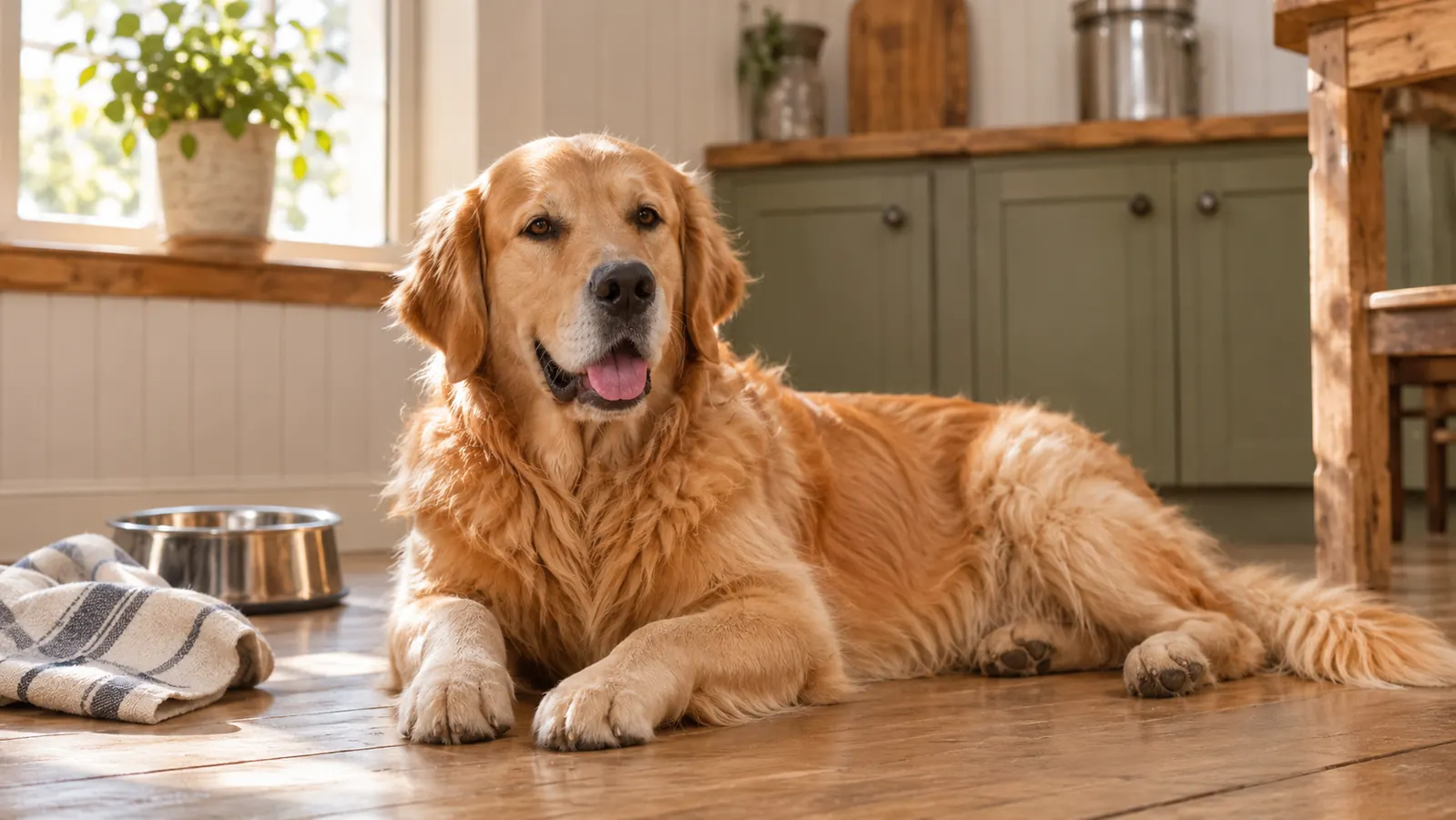
Duchess is nine years old, sixty-four pounds, and dysplastic in both hips. She has been on a chewable joint tablet for two years. For the last year she has had salmon oil pumped over her evening kibble, and that oil is the Natural Dog Company Wild Alaskan Salmon Oil, the 32 ounce bottle, which I bought myself on Amazon after our vet told me to get a fish oil into her. I am not a vet. I fix tractors out of a pole barn outside Kalamazoo and I have kept big dogs my whole life, which means I know a worn bearing when I hear one and I know a dog that is favoring a hip. What follows is the comparison I wanted and could not find: that bottle against the Zesty Paws salmon oil, for a dog heavy enough that dose and bottle size are not small details.
Here is the short version. If your dog takes oil on kibble without an argument, I would buy the Natural Dog Company bottle again. Thirty-two ounces, a pump, a short ingredient list, and a year of watching my dog's coat come back. If your dog refuses oil, or if you would rather use a chew than a liquid, Zesty Paws is the better fit for your house and I will not pretend otherwise. Both brands are respectable. Neither one repairs a dysplastic hip, and if you have not had a diagnosis yet, get the vet involved before you spend anything on a supplement.
| Natural Dog Company | Zesty Paws | |
|---|---|---|
| What is in it | Wild Alaskan salmon and pollock oil with the omega-3s EPA and DHA, vitamin E listed as the active ingredient | Salmon oil sold under more than one label format, so read the one you are buying |
| Format | Liquid only, pumped straight onto the food | More than one format under the salmon oil name, including chews for a dog that refuses oil |
| Storage | Liquid, kept in the fridge door once the bottle is open | A chew needs no refrigeration and travels better |
| Dosing for a big dog | Pump count against the weight band on the label | Chews dosed by count, oil by pump, both by weight |
| Where to buy it | Online; I have not seen it on a shelf within an hour of my place | Stocked in big-box pet stores and farm stores around here |
| Coat and skin support | Label lists skin, coat, joint, heart, immune and mobility support from the fish oil | Also sold for skin and coat, and plenty of people start there |
| Best for | A big dog that already eats oil off kibble without complaint | A dog that will not take oil, or a household that would rather use a chew |
Where Natural Dog Company Wins
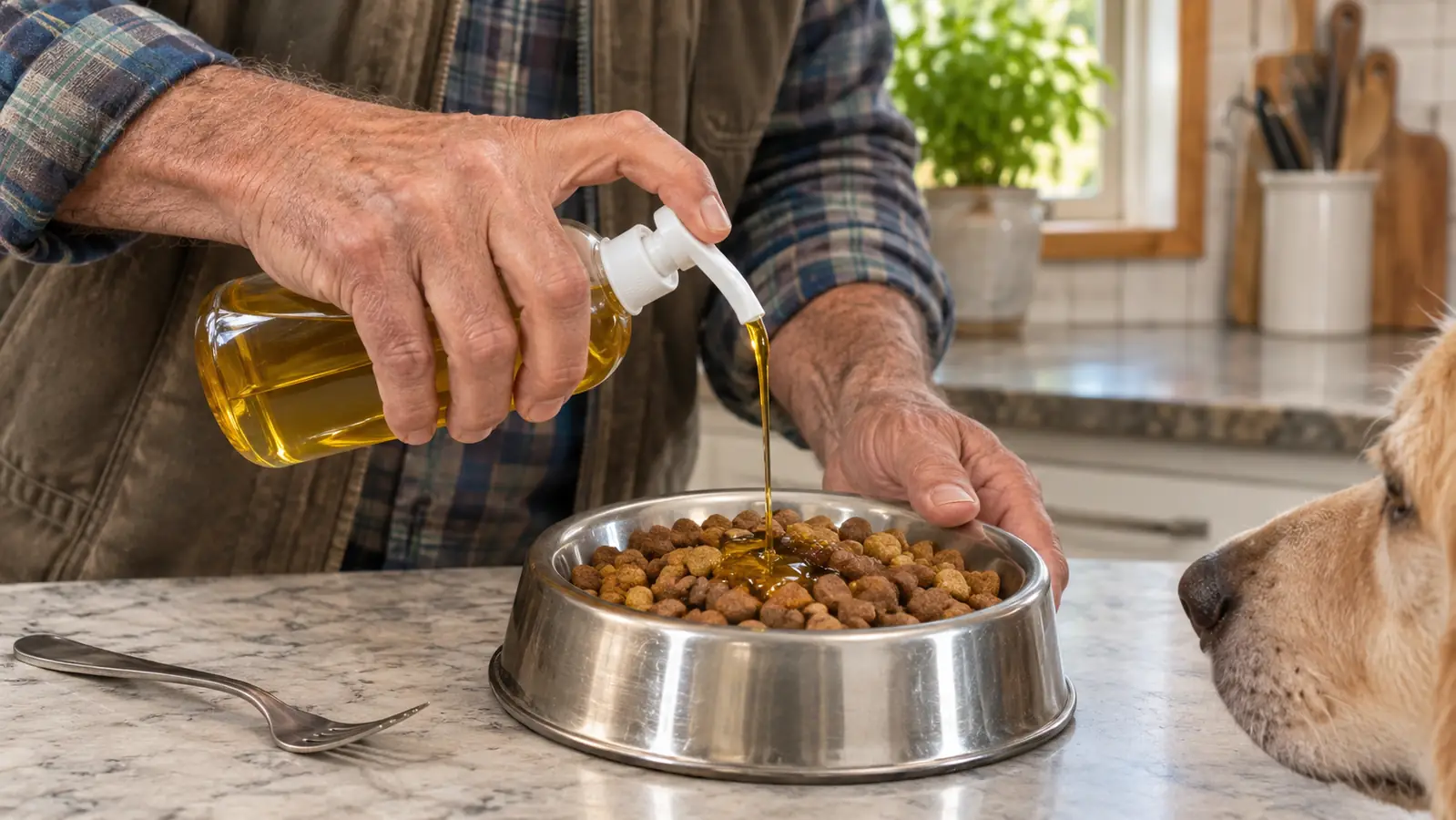
The pump is the first thing, and it is the thing I did not know I needed. A sixty-four pound dog needs a real dose, not a decorative drizzle, and the label settles that by weight. I pump it over her evening kibble, stir it through with a fork, and the bowl goes down. No measuring spoon, no oil running down the outside of the bottle, nothing to guess at seven in the evening when I am tired and the barn is already locked up. A bottle with a pump and a wide base sits on the fridge shelf without tipping over. Small thing. It is the small things you quit a supplement over, and I have quit two in my life over a cap that would not seat right.
The second thing is the ingredient list, which I can read out loud in one breath: wild Alaskan salmon and pollock oil, the omega-3s EPA and DHA, and vitamin E listed as the active ingredient. The label claims skin, coat, joint, heart, immune and mobility support, and I take those the way I take any label claim, as a starting point and not a warranty. What I can tell you is what I saw, and what I saw was a coat that had gone dull and dry coming back glossy in about a month. That is a real result and I do not need to dress it up.
One more piece of plain practicality. The bottle came in a box on the porch in November with the pump head already on it, so there was no funnel, no second container to decant into, no label to write. I unscrewed the cap, put it in the fridge door, and that was the entire setup. For a man who has spent an afternoon plumbing a transfer pump onto a diesel tank, I will take that trade every time.
Her coat changed in about a month. Her hips did not. I would rather hand you that than a promise I cannot keep.
Where Zesty Paws Wins
Zesty Paws has the wider catalog, and for some dogs that is the whole decision. If Duchess had turned her nose up at oil, I would have gone looking for a chew, and Zesty Paws is the name I would have started with, because chews are what they are known for and they sell more than one thing under the salmon oil name. Read the listing closely so you know which one is coming. The point stands either way: a dog that will not take liquid will often take a chew off the floor like it is a treat, and no amount of label reading fixes a dog that walks away from the bowl.
The other thing Zesty Paws has is a shelf. I can drive twenty minutes to a farm store or a big-box pet place and put my hand on a Zesty Paws product. I stood in that aisle in April, turning a tub over while my wife was up front paying for horse wormer, and I can tell you it is a normal, well-made product with a busier label than the bottle in my fridge. I cannot do that with the Natural Dog Company bottle, which for me comes in a box and gets here in a couple of days. That matters when you are out and did not plan, and it matters more in January when the roads are drifted.
The Bottle That Lives in My Fridge Door, Not the Whole Cabinet
Wild Alaskan salmon and pollock oil in a 32 ounce pump bottle. Read the label for the amount that matches your dog's weight, have your vet confirm the number, then check today's price on Amazon.
Amazon Check Today's Price on Amazon →Dosing a Sixty-Four Pound Dog
Dosing is where big dogs get shortchanged. A twelve pound terrier and a sixty-four pound Labrador do not take the same amount of anything, and the bottle has to make the difference easy to hit. I use the amount the label gives for her weight, pump it over the evening meal, and that is the whole method. I do not double up because she had a hard morning and I do not skip a day because she seems fine. If you are guessing at the number, ask your vet what they want and write it on a strip of tape on the bottle.
The pump earns its keep here more than you would expect. With a pour bottle I am tilting and eyeballing, and on a big dog the difference between a little and a lot ends up on the floor and on the outside of the bottle. With a pump I count. Duchess gets it on her supper, the bowl goes down, and the bottle goes back in the fridge door. That is a routine I will still be doing next year, and a routine you will still be doing beats a fancier bottle you quit on in March.
On a normal evening I come in from the barn around five, feed her, and count the pumps before I set the bowl down. Somebody asked me once why I do not just eyeball it, and the answer is that on a dog this size, eyeballing drifts. You get generous in February because the dog is stiff, you get stingy in July because she seems fine, and by October you have no idea what you have been doing. Counting pumps means I know, and knowing is worth more to me than the twenty seconds it costs.
What a Year on the Bottle Actually Looked Like
The coat came first. About a month in, my wife said something about it before I did, and she is not the one who brushes the dog. The dry patches along her spine smoothed out and the dullness went away. That is the part of salmon oil everybody talks about, and it is the part I can vouch for without hedging.
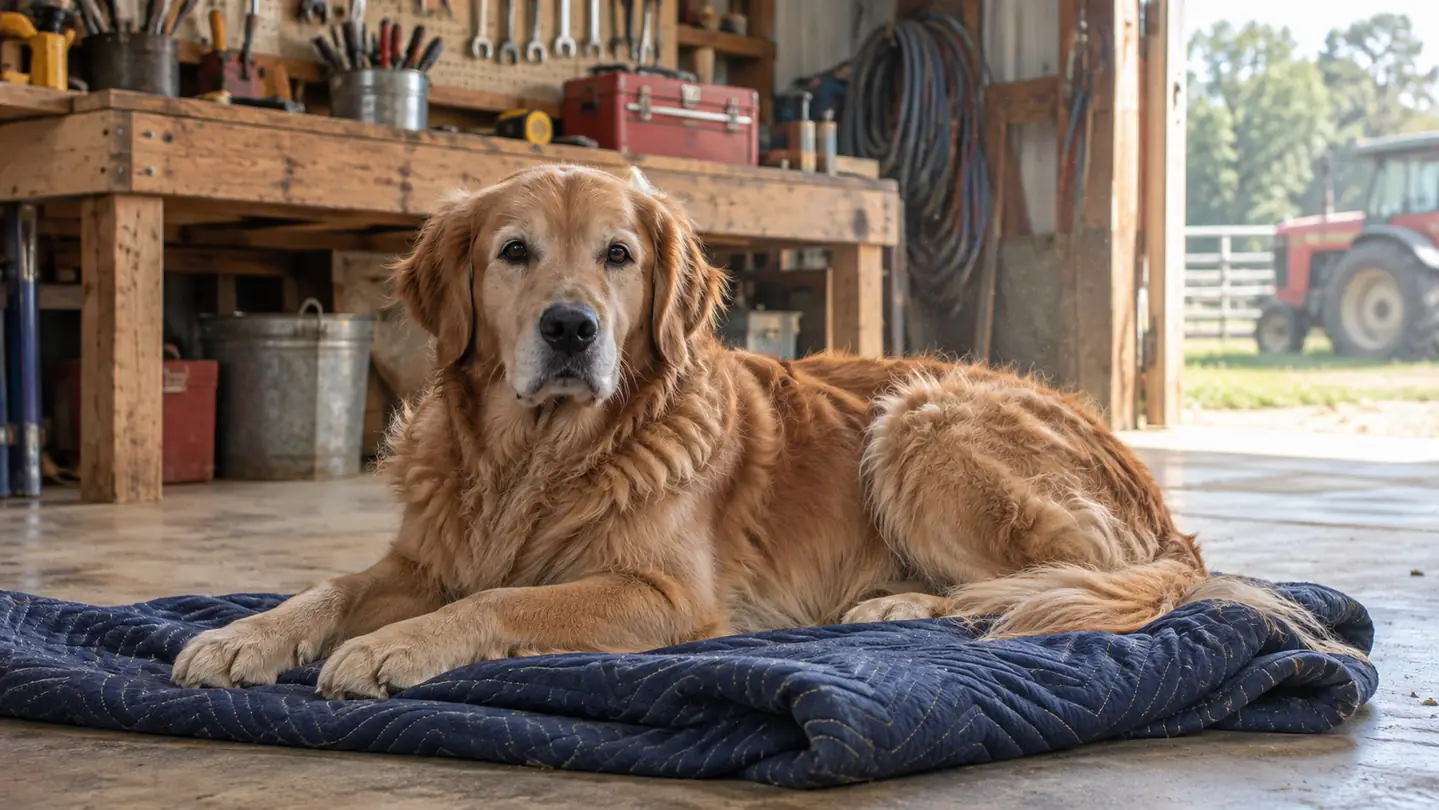
The hips are a longer and more honest story. Duchess was diagnosed at seven. She was stiff getting up off the concrete in the barn and she had quit jumping into the pickup by eight. She has been on the joint tablet for two years and the oil for one, and I cannot separate one from the other. What I can give you is the sequence. The tablet first, and about six weeks in she got up with less rocking. The oil a year later, and the coat changed. The porch steps are still slow. She still uses the ramp I bought in March to get onto the back seat, and the sling still hangs by the door for icy mornings.
There is one more thing worth writing down. I keep a paper calendar in the barn office with the tractor service hours in it, and after the diagnosis I started putting a mark on it on mornings when she came off the blanket slow. It is not a science experiment. It is a habit from the equipment side of my life, where you write down the hour meter reading so you can tell whether a thing is getting worse or holding. The marks got thinner over that year and then they flattened out. Not a cure. A trend, and I will take a trend.
That is the honest version. Salmon oil is not going to hand you a dog that bounds up the steps again, and anybody who tells you otherwise is selling something. What it did here was support the skin and coat and put omega-3s into a diet that needed them, alongside a joint supplement, a good bed, a ramp, a sling, and a vet who checks her twice a year. If you want the whole picture, the bed and the ramp did more for her hips than anything that came out of a bottle.
The Ingredient Question
Read both labels before you decide. The Natural Dog Company bottle lists wild Alaskan salmon and pollock oil, EPA and DHA, and vitamin E. That is a short list, and a short list is easier to argue with your vet about. Zesty Paws sells salmon oil in more than one form, and some of those forms carry flavoring and other ingredients to make a chew something a dog will take. That is not a scandal. It is just something to read. If your dog has a sensitive stomach or an allergy you are tracking, you want the shortest list you can get and you want your vet to see it.
The smell deserves a mention because nobody else mentions it. Fish oil smells like fish. I keep the bottle in the fridge door, I wipe the neck after I pump, and I do not leave it on the counter in July. A chew does not have that problem and does not need refrigeration, which is the trade. The liquid disappears into the food. The chew gets eaten off the floor like a treat. Neither one is better on its own. It depends on your dog's nose and on your kitchen.
What I Liked
- Pump dosing, which makes the weight-based amount easy to hit twice a day
- 32 fluid ounces in one bottle, so fewer reorders
- Short ingredient list you can hand to your vet
- Visibly glossier coat on my dog in about a month
Where It Falls Short
- Liquid only, so it cannot help a dog that refuses oil on kibble
- Needs refrigeration once opened
- No shelf within an hour of my place, so I wait on shipping
- Does nothing for a dysplastic hip on its own, and I would not pretend otherwise
Who Should Buy Which
Buy the Natural Dog Company bottle if your dog already eats oil on kibble, if you want a 32 ounce pump bottle sitting in the fridge door, and if you would rather count pumps than measure spoonfuls. That is my situation and I have reordered it. Buy it if the short ingredient list matters to you, or if your vet has asked for a fish oil and you want something plain enough to hand them the label. Buy it if your dog is big enough that dose is a real question, because the pump makes the answer repeatable.
Buy Zesty Paws if your dog walks away from an oily bowl, if you would rather use a chew, or if you want to put your hand on the next one at a store instead of waiting on a delivery. Buy it if you are just starting out and want a smaller commitment before you go all in. And in either case, buy nothing until your vet has looked at the dog. Stiffness in a nine year old Labrador can be arthritis, it can be an injury, and it can be something else entirely. A supplement is not a diagnosis.
One Bottle, One Year, One Honest Result
If your big dog already takes oil off kibble, this is the bottle I would hand you. If it does not, scroll back up and read the Zesty Paws section again, because a chew is a fair answer too. Either way, get the diagnosis first.
Amazon See the Natural Dog Company Bottle on Amazon →