
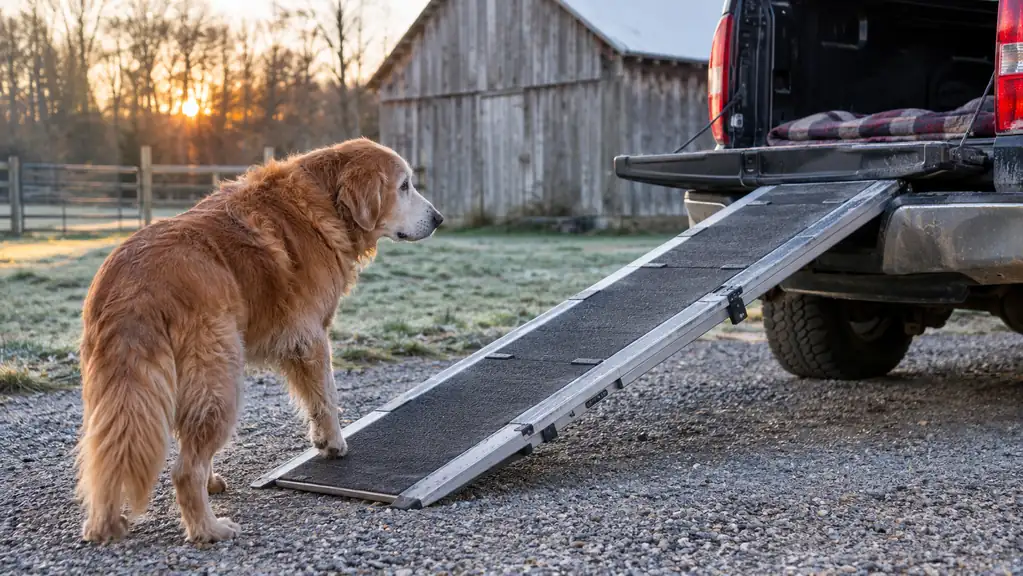
The first time I lifted Duchess into the back seat of my truck, I told myself it was a one-off. She had slipped coming off the porch that morning, I was running late for a parts run to town, and 64 pounds of Labrador is not the worst thing a 61-year-old man can pick up. Then it happened the next week. Then twice the week after that. By February I was lifting her every single time we went anywhere, and she had started planting her front feet against the door frame, which is a polite way of saying she had stopped liking it. A dog that size does not argue out loud. She just stops offering to help.
Duchess is 9. Yellow Lab, about 64 pounds, diagnosed with hip dysplasia and early arthritis in both hips at 7. Our vet's advice was the same thing he tells me about every worn bearing on the place: keep it moving, cut the load, and stop asking her to jump. I bought the Pawaboo 74 inch folding ramp in March, about eight months before I sat down to write this. I picked it because it was the longest one in front of me on the listing, and length is the whole argument with a ramp. It has gone in and out of the truck four or five days a week since, through a wet spring, a hot summer and the front edge of a cold fall. Here is what that did to it, and what it did for her.
The Quick Verdict
A long, wide, plain metal ramp that turned a two-man lift into a dog walking up on her own. It lives in the truck, it wants a flat spot to sit on, and it is not magic on ice. Eight months of farm use and it is still the ramp I hook on the sill.
Amazon Check Today's Price →The ramp I bought in March is the same one riding in the truck bed today
Same sill, same dog, eight months later. Current price and the folded dimensions are on the listing.
Amazon Check Today's Price on Amazon →How I've Used It
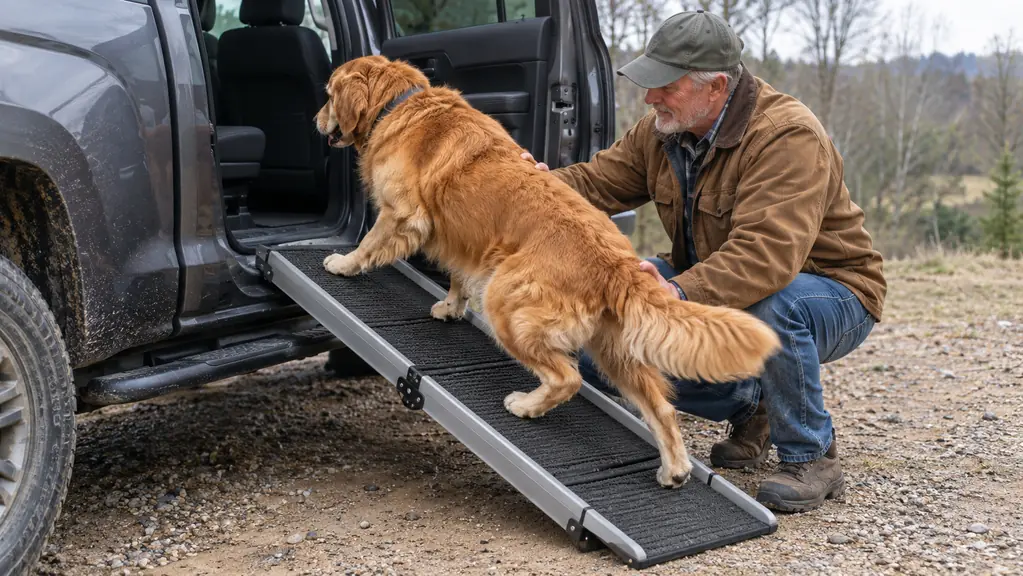
The ramp hooks over the door sill of the back door on my crew cab and the base sits on whatever is underfoot that day, which around here is gravel, packed dirt, or the concrete apron in front of the pole barn. That sill is about knee high on me, and for a dog with dysplasia it might as well be a cliff. The 74.8 inch length is what makes that work. Every inch of run you add flattens the angle she has to climb. A short ramp turns that door into a step stool. This one turns it into a walk.
Training took about two weeks and it was not a straight line. I started with the ramp folded out flat on the barn floor with nothing attached, just so she would put a paw on it and take a treat. Then I leaned it against the open door with the bottom on flat ground, no truck trip attached, up and back, three or four times, and quit for the day. Duchess is food motivated and stubborn in equal measure. The first time she committed to the whole thing she went up fast and shot me a look like I had been holding out on her. Day nine she did it with the treat still in my pocket. Day twelve she was standing at the door waiting for me to set it.
The first actual trip was to the vet for a nail trim, which was either brave or stupid. I set the ramp, walked her to the base, and she went up like she had been doing it since she was a pup. What I noticed on the other end was the part I had not planned for. She stepped down out of the truck at the clinic without that half second of brace she used to do, the little gather before she committed her weight to the leg she trusted less. Same dog, same hips, one less hard thing between her and the ground.
Now the routine is dull, which is the point. I open the back door, hook the top on the sill, set the base, and she is already moving. She walks up, turns around on the seat, and I fold the ramp and put it away. On the way out she comes down nose first, slow, one paw at a time, and I stand at the bottom doing nothing. That was the whole goal. Me doing nothing.
The Slope Is the Whole Point
If you take one thing from this, take the math. A steep ramp is a set of stairs with extra steps. A shallow one is a walk. The difference between those two things for a dog with bad hips is most of the reason you would buy a ramp at all, and it is entirely a function of how long the thing is.
I looked at shorter ramps first, the ones that fold down to something you could tuck behind a seat. Every one of them, held up to the same door sill, made an angle I could see Duchess refusing. She will not walk up something that makes her feel like she is climbing a ladder. The Pawaboo is 74.8 inches long by 19.69 inches wide by 0.83 inches thick, and that length is the feature. Everything else is supporting cast.
Before I bought anything I ran a dumb test that turned out to be the most useful thing I did. I took a piece of scrap plywood, laid it from the sill to the ground, and watched her look at it. She would not put a foot on it. Then I laid a longer piece down to the same sill and she walked up it in the barn for a treat on the end. Same dog, same day, same height off the ground. The only thing that changed was the run. That is how I knew not to buy the short one, and it is why the extra length never felt like a luxury to me.
The practical catch is that a long ramp needs runway. I park with the base landing on flat ground, which on my place means pulling forward a little further than I used to, and I have a rut worn in the gravel where the base sits so I know I am in the right spot without getting out to look. If you park tight against a wall or in a crowded lot with your back door facing a curb, you will want to think about that before you commit. It is not a defect in the ramp. It is what a gentle angle costs.
Width, Grip and What Wet Paws Do
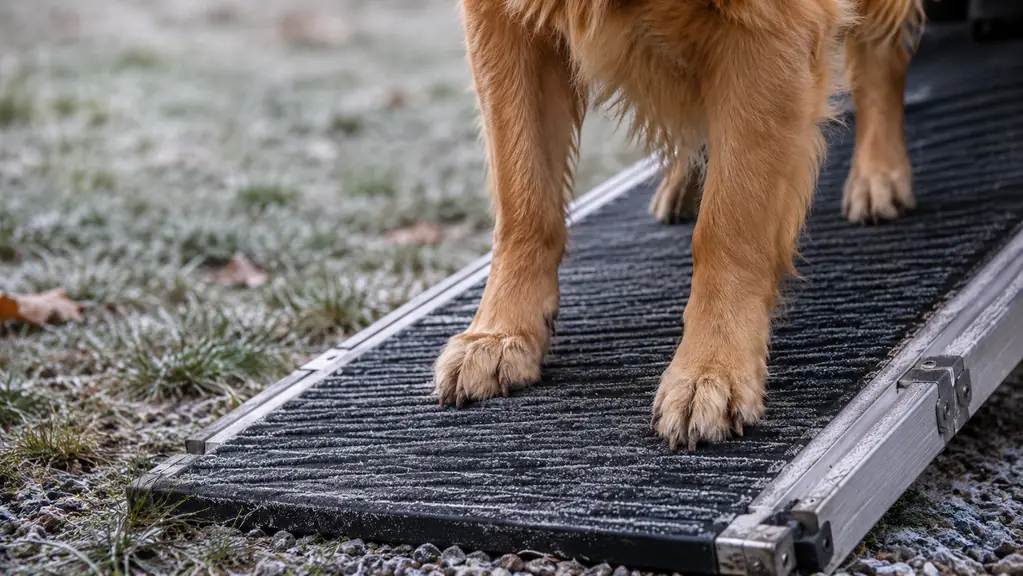
The walking surface is 19.69 inches wide, and I did not think that number mattered until I watched her use it. On a narrow ramp a dog has to place her feet with care, and a dog with sore hips does not want to think about her feet. At this width she just walks, feet where they land, no correction. The deck is a textured non-slip surface rather than smooth metal, and I can feel the tooth of it with a boot heel.
Wet is where it earns its keep, and wet is also where I have to pay attention. Coming in from the lawn after a rain, her pads are slick and the texture gives her something to push against. After a hard freeze, or on a morning when the deck has a glaze on it, the texture helps and does not save you. Nothing does. On those mornings I set the base, hold her collar, and let her take it slow, same as I would on the porch steps.
There was a morning in late March where it did exactly what I bought it for. We had a hard freeze overnight after two days of thaw, the gravel was locked up in ruts, and the deck had a skim of ice on the high side. I set the ramp, put the sling on her back end, and we went up together with me holding the collar and her taking it one paw at a time. It took maybe forty seconds. Two years ago that would have been me lifting her, which is how a man my age ends up at a chiropractor instead of a parts store. Forty seconds and a slow dog beats that every time.
The other honest note is mud. Gravel and clay come in on her feet, and the surface holds a little of it until I knock it off. It is a thirty-second job with the ramp still hooked on the door, and I do it more in March than in July. There is no drain, no cover, no clever answer to that. It is a metal ramp that lives outdoors sometimes.
Folding, Storage and Living With It
It folds and it lies flat, 0.83 inches of flat, which is why it rides in the truck bed under the tonneau cover without me fighting it. That is where it lives. It is rated to 250 pounds and the frame is metal, and after eight months of a 64 pound dog plus my own weight on it once when I was checking the sill, nothing has bent, sagged or loosened. The surface still has its tooth.
The one thing I would tell somebody buying this sight unseen is to measure the bed of their truck before they assume it will live there. Mine is a crew cab with a standard bed, and the folded Pawaboo slides in crossways with room to spare and sits under the cover where it stays dry. If you have a short bed packed with tools, or a cap instead of a cover, you are going to have to think harder about where it goes. 74.8 inches of anything does not tuck behind a seat.
If I have a complaint about the day to day, it is that this is a ramp that wants a home. It is happiest staying in the truck rather than being carried out to the barn and back every time, and I would not want to be hauling it up a flight of apartment stairs twice a day. For my use, which is one vehicle and one dog, the storage question answered itself in the first week.
What Eight Months Changed, and What It Didn't
What changed is that I stopped lifting her. That sounds small and it is not. Lifting a big dog who is stiff and unhappy about being handled is a two-person job done badly by one person, and I was doing it four times a week all winter. The ramp removed it entirely. She gets in and out on her own feet, and the difference in how she carries herself after a truck ride is noticeable. She is not sore from the loading before we even get where we are going.
What did not change is her hips. The ramp is not a treatment. Duchess is still on the chewable tablets our vet put her on two years ago, still gets salmon oil on her evening kibble at the amount the label gives for her weight, still sleeps on the orthopedic bed in the living room next to the woodstove, and still wears the rear support sling on the porch steps on bad mornings. The ramp took one hard thing off the list. It did not touch the diagnosis, and I would not want anybody reading this to think a piece of equipment replaces a conversation with their vet.
I keep a log of this kind of thing because I keep a log of everything, and the number that matters to me is the lifting count. January, before the ramp: nineteen lifts. March, the month I bought it: eleven, most of those in the first two weeks while she was still learning. April through October: zero. That is not a cure and I am not selling one. It is one less hard thing a 9-year-old dog with bad hips has to deal with, and one less thing my back has to deal with, and I will take that trade every month of the year.
If your dog is limping, dragging a leg, or suddenly refusing a step she took yesterday, that is a vet call, not a shopping decision. I bought this because our vet had already told me what was wrong and what to stop doing. The ramp was me finally listening.
What I Liked
- 74.8 inches of length makes a genuinely gentle angle to a truck back seat
- 19.69 inch walking surface means the dog walks instead of aiming her feet
- Textured non-slip deck gives wet paws something to push against
- Folds to 0.83 inches and lies flat under a tonneau cover
- 250 pound capacity and a metal frame that has not bent in eight months
Where It Falls Short
- Long ramp needs flat runway behind the truck, which changes how you park
- Texture holds mud and gravel until you knock it off
- Not magic on ice or frost, still a slow, held-collar job on bad mornings
- Wants to live in the vehicle, not be carried back and forth
- Took about two weeks of treat sessions before Duchess used it on her own
The ramp did not fix her hips. It stopped me from being the thing that hurt them twice a week.
Who This Is For
This is for the owner of a big dog who has started balking at the truck, the SUV or the porch, and who is tired of lifting. It suits a taller vehicle where the door sill sits well above the ground, because that is the situation where length does the most work. It suits someone with a driveway or a lot where they can leave a little room behind the vehicle. And it suits a dog who is stiff rather than injured, one whose vet has already said the words keep her moving and quit letting her jump. For that dog and that driveway, the Pawaboo is the one I would buy again.
Who Should Skip It
Skip it if your dog is small enough to lift without effort, because the length becomes a nuisance for no gain. Skip it if you routinely park nose in against a wall, a curb or another car with no room at the back. Skip it if you are shopping because your dog is suddenly lame, since that is a diagnosis problem and not a ramp problem. And skip it if you want something you can fold up and carry in the house every night. This is a leave it in the truck kind of tool.
Eight months later, she still walks up it without being asked
Same ramp, same door sill, same stubborn Labrador. If your dog has started balking at the truck, this is the one I would buy again.
Amazon Check Today's Price on Amazon →