
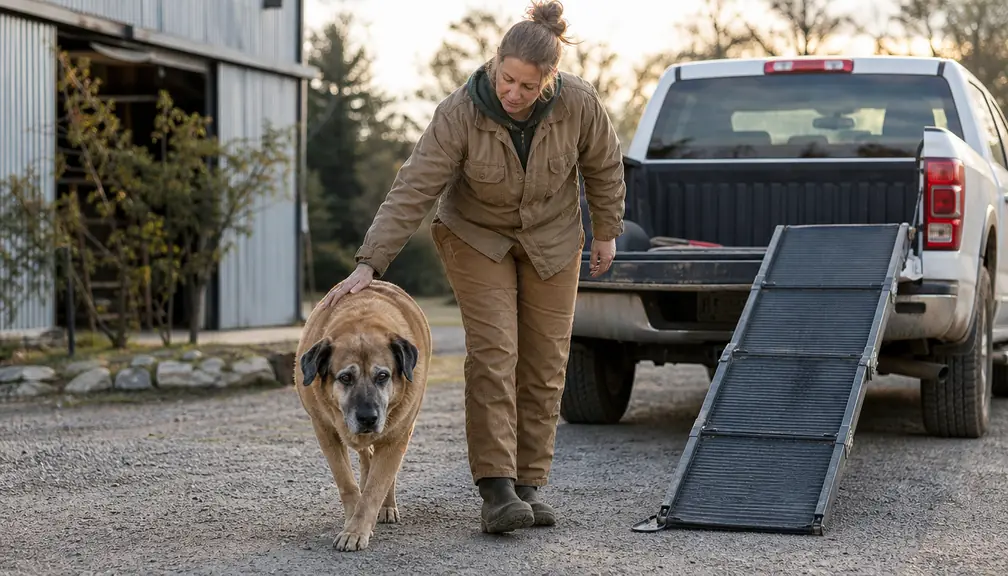
Duchess is nine, a yellow Lab, 64 pounds, and she has hip dysplasia and arthritis in both hips. Our vet diagnosed her at seven. For a while I did what most people do with a big dog that stops jumping: I lifted her into the back seat of my crew cab. At 64 pounds that is not a circus act, but it is a poor way to start every trip to town, and she got stiff while I fumbled with the door and my footing. Eight months ago I bought the Pawaboo 74 inch folding ramp. I also borrowed a set of dog stairs for two weeks and set them against the same truck and the back porch. The short answer is that the Pawaboo ramp is the better tool for a truck, and dog stairs are still the better tool for a porch.
The ramp I use is the Pawaboo Dog Ramp for Car, 74 inches long by 20 inches wide, with a listed measurement of 74.8 by 19.69 by 0.83 inches. It is metal, rated to 250 pounds, and it has a textured non slip surface. It folds. That is the whole spec sheet, and it is enough to compare against a set of stairs because the two products solve the same problem in opposite ways. One spreads the climb over distance. The other stacks the climb into steps. For a dog with sore hips, that difference is the whole argument. I did not come to that by reading listings. A neighbor had a folding set of stairs he keeps for his camper, and I borrowed them for two weeks in February and set them against the same back door I had been lifting Duchess into. She took to them in about three days, which told me the height was the problem and not the idea of climbing. Then I put the tape on the truck. The sill of the back door on my crew cab sits at roughly the middle of my thigh, and a set of stairs gets a dog up that height in three or four hard rises. A 74 inch ramp gets her up the same height in one long incline. I am not saying stairs are junk. I have used them. They have a place. But the place is not the back door of a lifted truck, and the place is not a dog that has already quit jumping. The place is a porch, a camper, a tight hallway, or a dog that trusts a step more than an open slope. If you mix those jobs up, you buy the wrong thing and then blame the dog.
| Pawaboo ramp | Dog stairs | |
|---|---|---|
| Approach | 74 inches of run spreads the climb out, so the dog steps up instead of hopping. | A short stack of steps asks for a higher lift at each step. |
| Surface | 20 inches wide, enough for a 64 pound Lab to place both front feet without crowding the edge. | Usually narrower than a full ramp, and the tread depth varies by model. |
| Rated load | 250 pounds. | Varies by build and hinge quality, so check the label. |
| Footprint when open | Needs about six feet of clear run behind the truck or SUV. | Takes less floor length at a porch or doorway. |
| Porch steps | Too long and awkward on a three step stoop; the base wants flat ground. | Sits on the landing and matches the steps the dog already knows. |
| Truck storage | Folds and rides under the tonneau cover. | Many models fold, but the step stack is taller and bulkier. |
| First week | Open sides and a long surface took two weeks of treat sessions before Duchess walked it alone. | Enclosed steps feel familiar to a dog that already uses porch stairs. |
| Wet or uneven ground | The textured surface helps paws, but the bottom still needs a dry, flat landing. | Carpet or plastic treads can pack with grit and ice, and the stack can shift on a slope. |
| Best job | Truck and SUV access for a large dog that cannot jump. | Indoor or porch steps in a tight spot. |
| Setup | Hook the top on the sill, check the base, send the dog. | Unfold and set it on level ground; quick once you have a flat spot. |
Where Pawaboo Wins
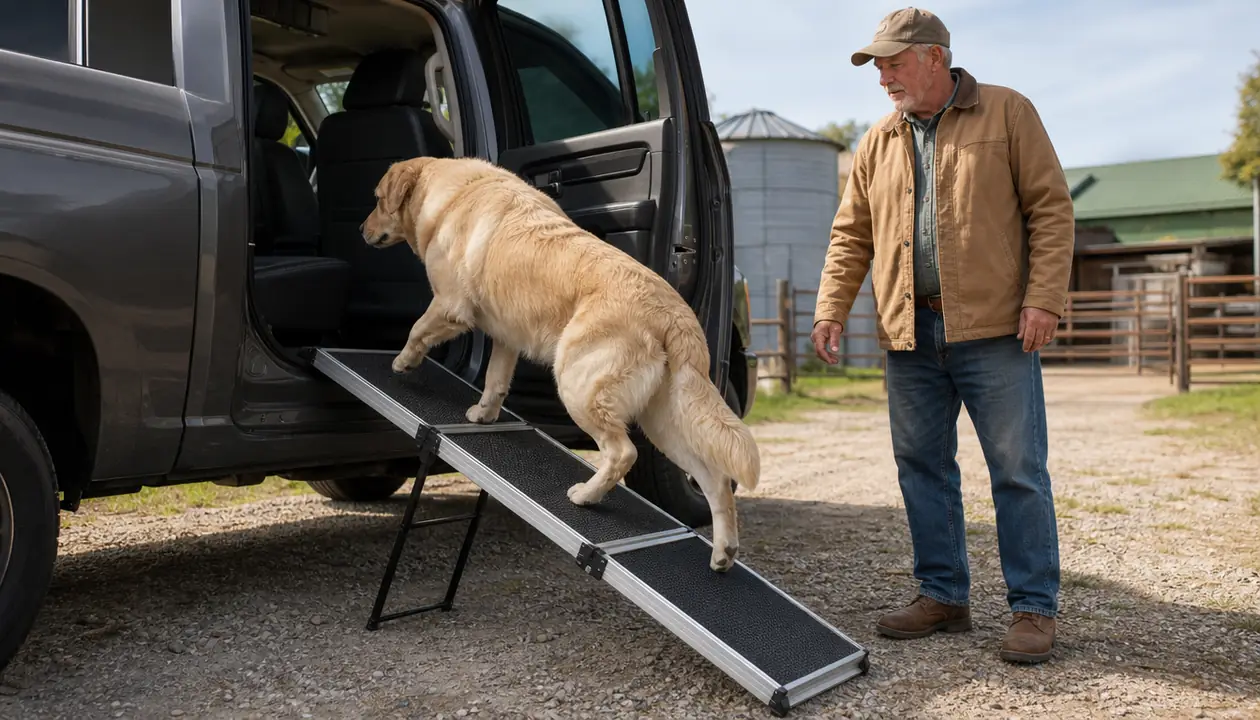
The ramp wins on the truck because it turns a jump into a walk. The back seat of a full size crew cab sits high enough that Duchess was asking her hips to do a small broad jump every time. The 74 inch run spreads that height over a long slope, so she can put one paw in front of the other instead of gathering herself and launching. The 20 inch width matters more than I expected. A narrow surface makes a big dog crowd the edge and slow down; this one gives her room to place both front feet without thinking about it. The 250 pound rating is not a number I test on purpose, but it tells me the ramp is not flexing under a 64 pound dog the way a light plastic step can. Setup is the part I want to be honest about. The top of the ramp has to hook on the sill, and the base has to sit on ground that is not going anywhere. In my gravel yard I back the truck to the same flat spot every time, because a base on loose gravel will slide a little when a dog commits her weight to it. On the concrete apron in front of the pole barn it does not move at all. That is ten seconds of positioning, and it is worth doing every trip.
The other truck advantage is storage. The Pawaboo ramp folds and rides in the bed under my tonneau cover. I do not have to wrestle a stack of stairs behind the seat or leave it on the passenger floor. When I pull up at the vet, I open the back door, hook the top of the ramp on the sill, and let Duchess walk up while I stand at the side. She learned it in about two weeks of short sessions with treats, not because she is a genius, but because the slope gave her a choice about where to put her feet. The ramp did not cure her hips. It ended the daily wrestling match at the truck door, and that is the part I could measure.
The surface is the quiet part of the win. The textured non slip surface gives her paws something to push against, and she does not skid when the truck bed is damp or when her back feet are slow to follow her front. I still wipe the ramp before she uses it if the tonneau cover has been off in the rain. That is not a product flaw. That is a farm. The ramp also gives Duchess a job. She knows the routine now: door open, ramp down, walk up, lie down. A dog with arthritis does better with a routine that does not ask for a guess. The point is that the ramp gives me one more thing I can control on a bad morning, and with a dog that has hip dysplasia, control is worth more than a clever feature.
Where Dog Stairs Wins
Dog stairs win at the porch, and I will not pretend otherwise. Three steps up to the back door is a short, familiar climb that Duchess already understands. A set of stairs sits on the landing and lets her use the same motion she has used for years. The ramp is too long for that stoop. It wants a flat run and a clean place to set the top, and a porch with a turn and a screen door is not that place. If your dog's problem is the porch, stairs are the right shape of tool.
Stairs also win in tight spots and in the house. A narrow hallway, a side door, a camper step, or a spot where you cannot leave six feet of ramp out: stairs take less floor length. Some dogs are also more confident on steps because the sides feel enclosed. Duchess slowed down the first few times on the open ramp and looked at the drop on either side. That is not a defect in the ramp. It is a fact about dogs. If your dog balks at open edges, stairs may get you a faster yes, even if the slope is steeper.
The honest tradeoff is that stairs ask more of the dog at each step. A set of stairs does not spread the height out; it breaks the height into a stack. For a dog with good strength and a little stiffness, that is fine. For Duchess, the porch stairs had already become the place she slowed down and thought about it. That is why I still use the rear support sling on icy mornings and after a long day. There was a morning last January, before the ramp, when the three back porch steps iced over and she got her front feet up and could not get her back legs under her. That is what the sling was bought for. Stairs are convenient for the human. On a sore hip, they are not automatically easier for the dog. That is the part people miss when they compare a ramp and a set of stairs on a screen. A step is a small jump. Four steps is four small jumps, and a dog with dysplasia feels every one of them, even when she does not show it until the last one.
The ramp did not cure her hips. It ended the daily wrestling match at the truck door, and that is the part I could measure.
The 74 Inch Ramp That Ended the Daily Lift Into the Truck
This is the Pawaboo folding ramp I use on a full size crew cab. It rests on the back door sill, gives Duchess a long slope instead of a hop, and folds under the tonneau cover when the trip is done. It is rated to 250 pounds. If your dog is 60 pounds or better and has quit jumping, start here.
Amazon See the Pawaboo Ramp on Amazon →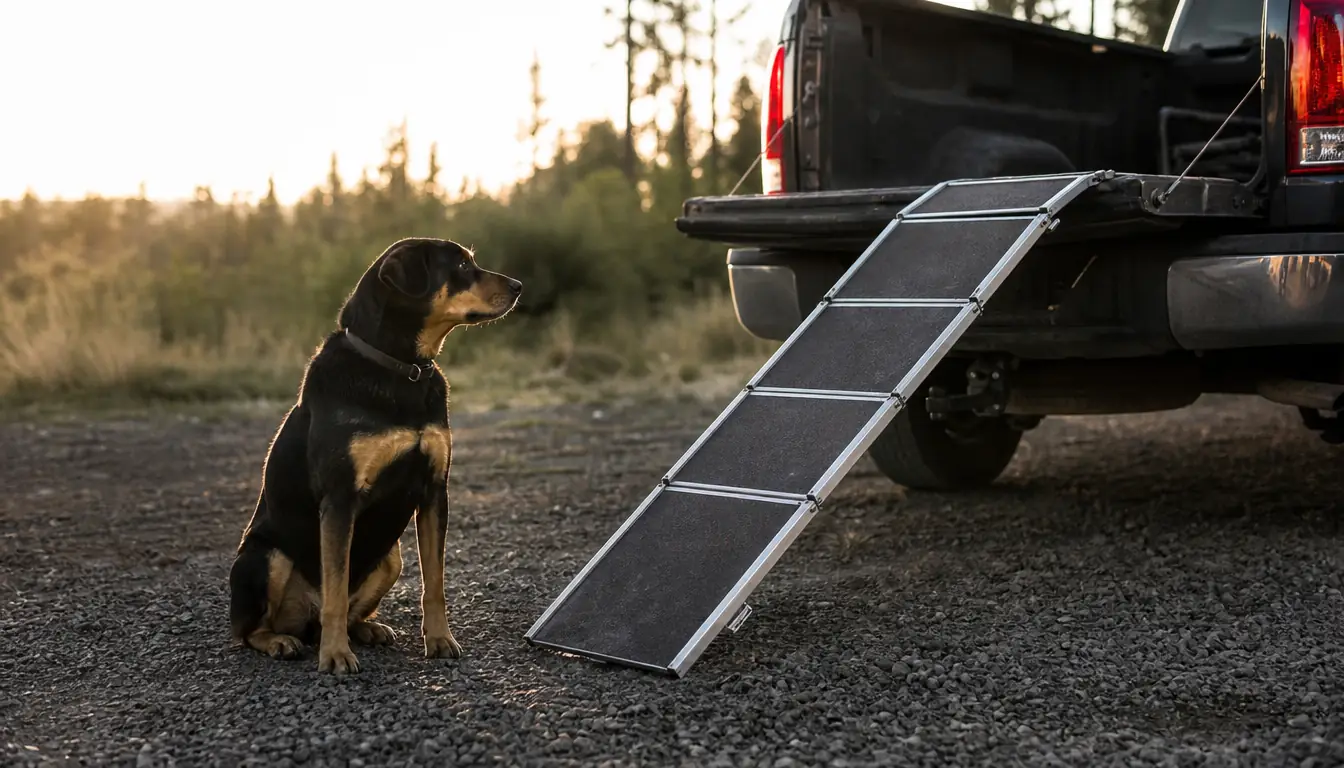
Who Should Buy Which
Buy the Pawaboo ramp if your dog rides in a truck or SUV and has stopped jumping into the back seat. Buy dog stairs if the problem is a porch, a doorway, or a tight indoor spot. That is the clean split. The ramp is for height and distance. The stairs are for a short, familiar rise. Where it gets muddy is the middle case, an SUV with a low cargo floor and a dog that is stiff but still willing. There I would still lean ramp, because the ramp can be set at a shallow angle and the dog gets to choose her pace. Where I would not lean ramp is a sedan with a small door opening or a hatch that already sits low. At that height the run is short, the slope is barely a slope, and a set of stairs does the same job in less space. I would not use the ramp indoors, and I would not use stairs at the truck door for a 64 pound dog with sore hips. The wrong tool in the wrong place is how people end up lifting a dog anyway.
One more thing, and I mean this plainly: get your vet involved before you buy either one. A ramp is not a diagnosis. If your dog is dragging a back leg, yelping when you touch a hip, or falling on stairs that she used to climb, that is not a problem a piece of equipment fixes. Our vet handled the diagnosis and the dosing for Duchess. I handle the load. The ramp helps me reduce the load at the truck door. It does not replace the exam, the medication, or the weight control. If you are not sure which end of the problem you have, start with the vet and then pick the tool.
If your dog is bigger than Duchess, the ramp still makes sense as long as you check the rating and the door opening. A 250 pound rating is a ceiling, not a target. If your dog fights the ramp, do not force it. Short sessions, treats, and a handler at the side got Duchess up the first time. If she had refused after two weeks, I would have gone back to the vet and the sling, not pushed harder. Equipment should lower the stress. If it raises it, you have the wrong equipment or the wrong week. The point is not to win an argument about ramps. The point is to get the dog in the truck without a fight and without a lift that hurts both of you.
If the Truck Door Is the Problem, Fix the Truck Door First
Stairs are not wrong. They are just wrong for a tall truck door and a big dog with sore hips. The Pawaboo ramp is the tool I would buy again for the truck, and the one I would leave at home when the job is the porch.
Amazon See the Pawaboo Ramp on Amazon →