
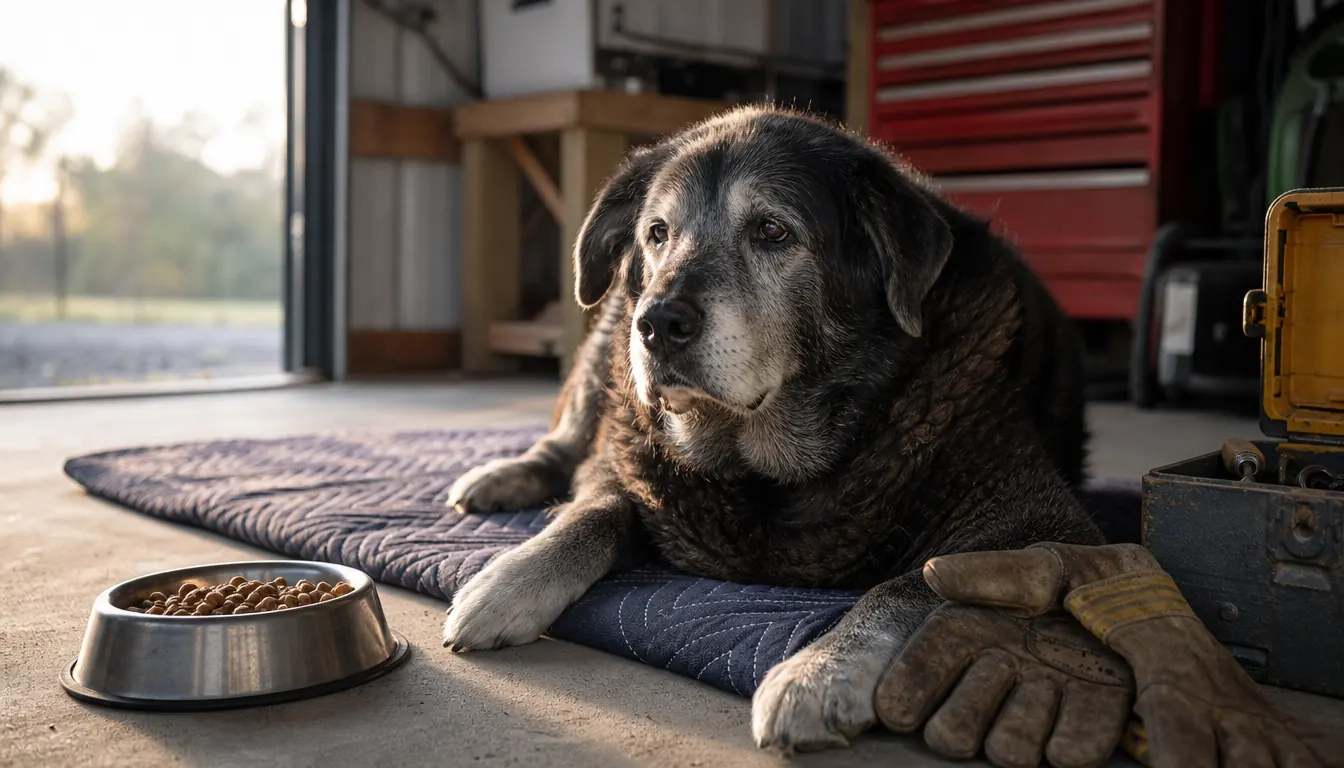
Duchess came off the barn floor in stages, the way an old bearing goes. First it was a rock forward and back before she got her back legs under her. Then it was the three porch steps. By the time she quit jumping into the truck at eight years old, I had been telling myself for months that it was just age.
What she had was hip dysplasia and early arthritis in both hips, diagnosed at seven. Our vet put her on Cosequin that same week. Two years later he suggested adding a fish oil to the routine, and I picked up a 32 ounce bottle of Natural Dog Company Wild Alaskan Salmon Oil mostly because it had a pump on it and my hands are oily half the day anyway. It has been about a year now. The dosing is the part people ask me about, so here is the whole process in the order I actually do it, including the two places I got it wrong at the start.
What is in the bottle matters less than how you use it, but for the record it is wild Alaskan salmon and pollock oil in liquid form, with EPA and DHA as the omega-3s and vitamin E listed as an active ingredient. It is a food topper, not a medicine. It goes on the meal. Nothing about it needs a syringe or a pill pocket.
The bottle that goes on the food instead of down the side of the bowl
The Natural Dog Company Wild Alaskan Salmon Oil comes in a 32 ounce pump bottle, so the amount lands on the kibble instead of in a measuring spoon you then have to wash. Over a year of nightly feeds, that is the difference between a routine you keep and one you quit in February.
Amazon Check Today's Price on Amazon →Step 1: Weigh the dog, not the guess
Every dosing chart on every bottle is built on body weight, and the bands are wide enough that a few pounds can move a dog from one line to the next. Duchess sits at 64 pounds and has held there for two years now, which is not an accident. It is half the plan.
At the vet, use their scale, because theirs is right. At home, the trick that works is to weigh yourself, then weigh yourself holding the dog, then subtract. Do it first thing in the morning before breakfast, once a month, and write it down. A Lab that creeps up five pounds over a Michigan winter is pushing that weight straight through two bad hips, and no amount of oil in a bowl fixes that.
I am not going to hand you a pump count for your dog, because I do not know your dog and I am not a vet. The chart is on the bottle. What I can give you is the order of operations, and the order matters more than people think.
Step 2: Find your dog's band and start at the bottom of it
Our vet confirmed which band Duchess falls in before I ever cracked the seal. Left to myself I would have started at the top of the range, because that is what I do with grease in a bearing, and it would have been the wrong instinct here. Fish oil is fat. Fat is the thing most likely to give a dog loose stool in the first week, especially a dog whose gut has never seen it.
So for the first seven days I ran her at roughly half of what the chart gave for her weight. I did not read that anywhere. I just would rather ramp up than clean the rug. She had no trouble at all, so on day eight I went to the full amount for her weight and have stayed there ever since.
If your dog goes soft in the stool, drop back to the smaller amount for a few days and try again. If it keeps happening, that is a call to the vet, not a reason to push through it. And expect a little fishiness on the breath for the first week or two. That part fades once the gut settles.
Step 3: Pump it onto the evening meal and stir it in
Duchess gets her Cosequin in the morning and the salmon oil at night. That split is deliberate. Change two things at once and you learn nothing about either one. I wanted a clean read on what the oil was doing on its own.
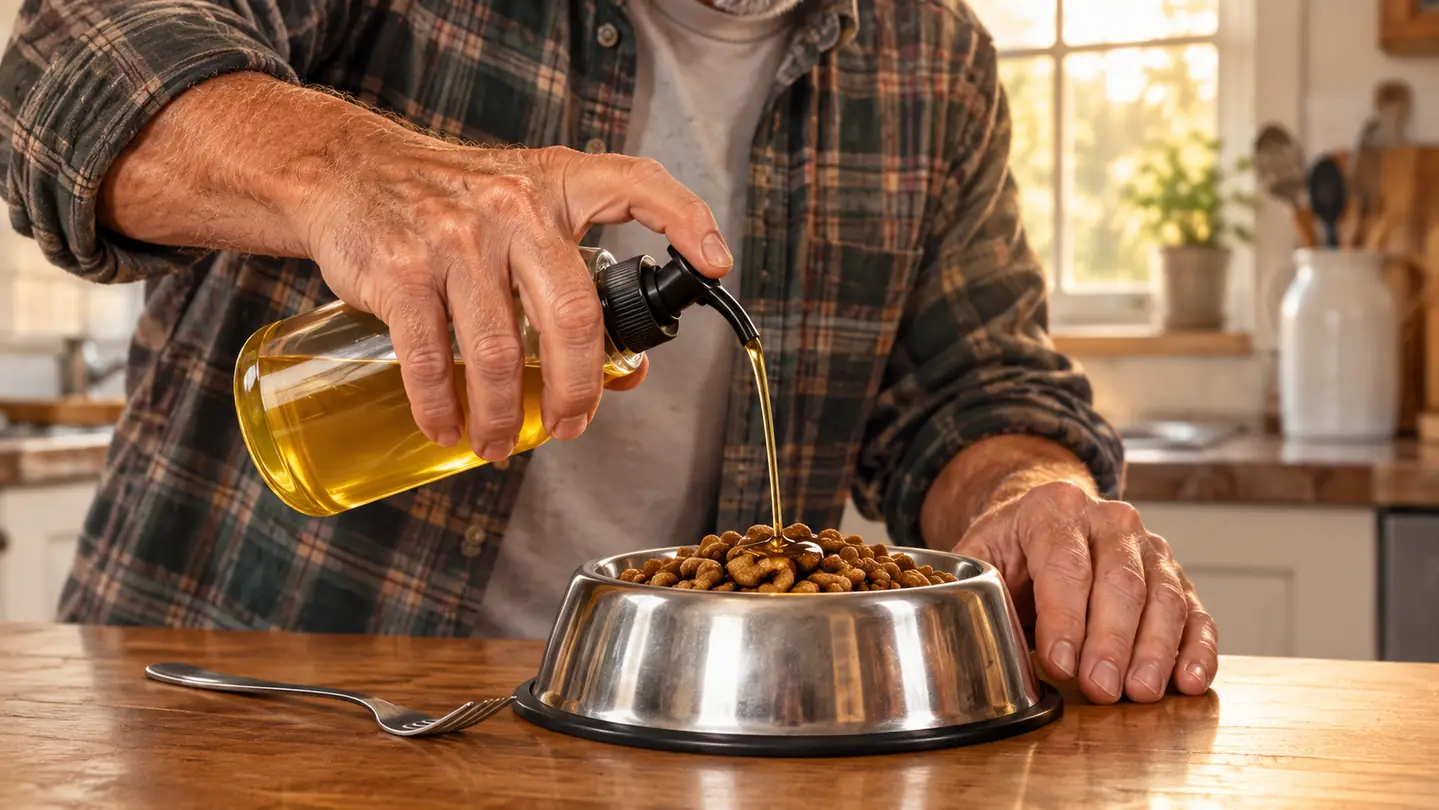
The pump goes on the kibble and then I stir it through with a fork instead of setting the bowl down with a puddle sitting on top. A dog will lick a puddle off and walk away from the kibble, and then you have fed her the oil and none of the food. Stirred in, it goes down with the meal.
A word on how it sits against the meal itself. I feed Duchess the same amount of kibble I always have and the oil goes on top of that, not instead of it. If your dog is carrying extra weight, the answer is less kibble and more walking on the flat, not more oil. That is a conversation to have with your vet, not something to work out in the feed aisle.
This is the small thing a pump bottle buys you. I feed her in the pole barn with gloves on and a tractor half apart behind me. One hand on the bowl, one press, done. Nothing to hunt for in the dark and nothing to wash after. That sounds like nothing until you have quit a supplement because it was a hassle at seven in the evening in February.
Step 4: Hold the dose for three weeks and write down what you see
This is the step nearly everybody skips. You give the oil, you watch the dog for two days, you decide nothing happened, and you either quit or double the amount. Neither one tells you anything, because the things you are watching for move on a slower clock than that.
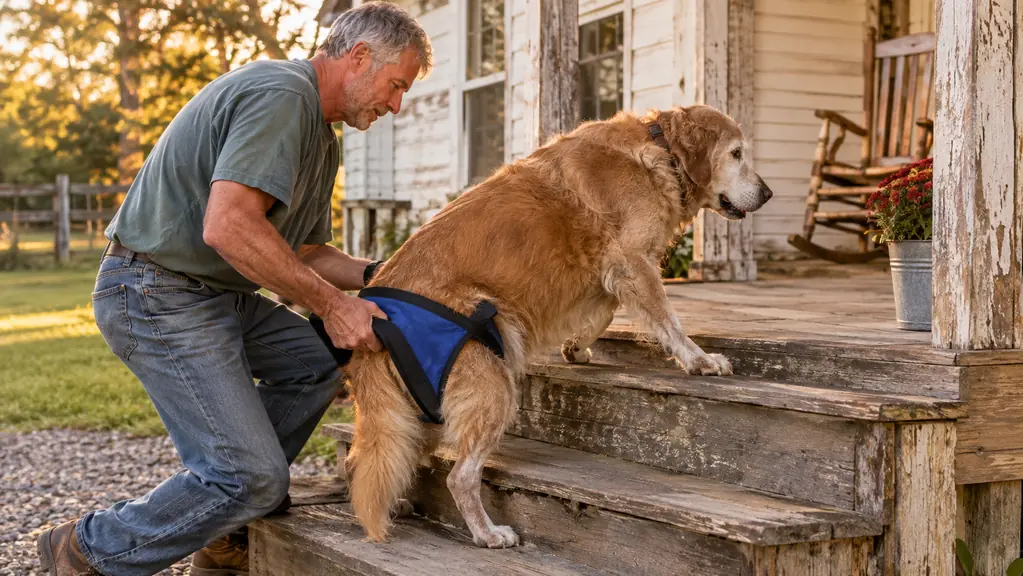
I keep a notebook in the barn. Every Sunday I write three lines: how she got up off the concrete, whether she took the porch steps without the sling, and anything I noticed about her coat. Three lines. It takes less time than checking the weather on my phone.
The coat was the first thing I could actually point at, somewhere around a month in. Noticeably glossier, enough that my wife asked what I had changed. The hips I cannot separate honestly. She was already on Cosequin when I started the oil, so I have no clean read on whether the oil added anything there. What I can tell you is that her worst mornings have not gotten worse over the past year, and at nine years old with dysplasia in both hips, holding steady is worth writing down.
Give it a full season before you make a call on it. I started the oil in the fall and did not trust my own read until the following spring, when the ground firmed up and she was still getting up on her own.
If you want something to compare against later, take a short video of your dog getting up from a down on a hard floor. Thirty seconds, same spot, same time of day, once a month. Memory is a poor witness and you will swear she was worse last spring when she was not.
Step 5: Keep it cold, keep your vet in the loop, and do not stack supplements
Once that Natural Dog Company bottle is open it lives in the fridge door, not on the shelf next to the kibble. It is fish oil. It will turn, and a turned bottle is a wasted bottle and possibly a sick dog. The fridge door is where ours stays and the pump still works cold.
The other half of this step is a phone call. Tell your vet what you are adding and how much, especially if your dog is on anything else. This bottle lists vitamin E as an active ingredient, so stacking a separate vitamin E capsule on top of it without asking is exactly the kind of quiet overlap that causes trouble. Same goes for anything else going in the bowl.
We are on a twice a year recheck with our vet anyway, spring and fall, because of the hips. Both times I bring the notebook and the bottle and we talk about whether the amount still matches her weight. If your dog has not been on a scale in a year, that appointment is where you start.
If you miss a night, do not make it up with a double pump the next morning. Give the normal amount and move on. This is a food topper, not a medication where the level has to stay tight.
What Else Helps
Oil in a bowl is one line item. It is not the whole plan, and I would be lying if I told you it was the thing that changed the most around here.
The bed came first. She has a 44 by 32 inch orthopedic bed with 6.5 inch foam in the living room next to the woodstove, and she sleeps on it every night instead of on the wood floor. In the barn she lies on an old folded moving blanket, which is not as good, but it beats concrete. Then came a rear support sling, size Large, hanging on a hook by the back door for the porch steps on bad mornings and for ice. Then the folding ramp on the back door of the crew cab, so she walks up into the truck instead of being lifted into it. That one took about two weeks of short sessions with treats before she would use it on her own.
One more thing about the truck. The ramp is rated for 250 pounds and hooks over the door sill, and it rides folded in the truck bed under the tonneau cover so it is always with us. Duchess rides on the back seat, never loose in the bed. If you have a dog that can no longer make the jump, that is a small fix that saves her shoulders and your back both.
Add the Cosequin she was already on, keep her at 64 and not 72, and walk her on the flat instead of the ditch bank. None of it is dramatic. All of it together is the difference between a dog that needs a hand off the floor and a dog that gets up on her own.
I will also tell you what did not amount to much: a chewable joint treat from the feed store that she liked and that did nothing I could measure, and about a month of me carrying her down the porch steps instead of letting her use them. That last one was a mistake. The sling lets her do the work. Carrying her did not.
The coat I can point at. The hips I cannot, because she was already on Cosequin when I started the oil. Holding steady at nine with two bad hips is still worth writing in the notebook.
If your dog is limping hard, knuckling over, or will not put a foot down, that is not a dosing question. That is a vet visit and possibly an injury, and no bottle off Amazon is going to sort it out. Get the diagnosis first, then come back and work out the amount.
One bottle, one pump, and a notebook in the barn
A year in, this is the routine that has held at our place: the amount on the chart for her weight, on the evening meal, out of the fridge door, and three lines in the notebook every Sunday. It is the Natural Dog Company bottle on the shelf by the door and nothing more complicated than that. Start with your vet and your scale, then come back to the bottle.
Amazon Check Today's Price on Amazon →