
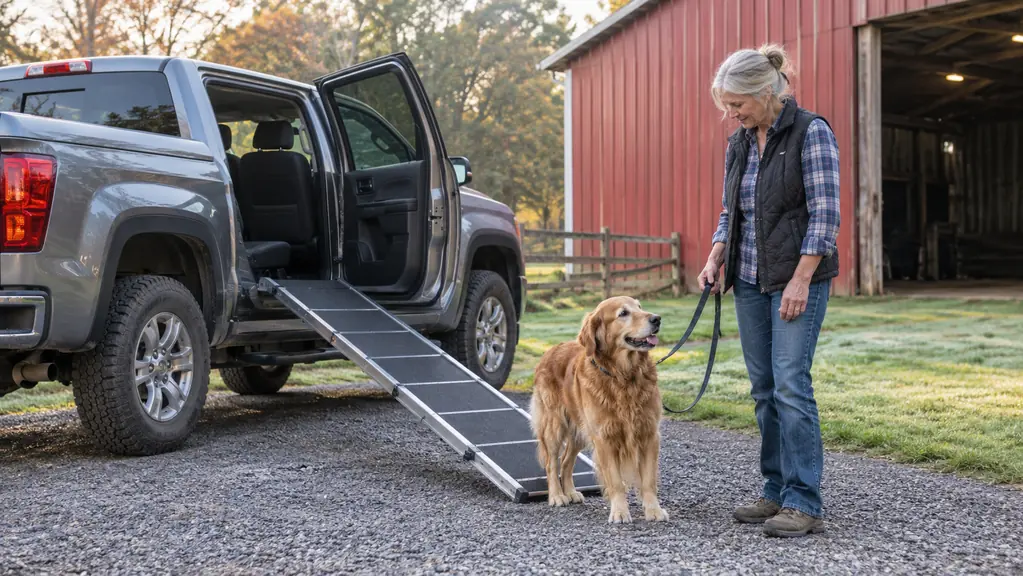
Duchess stopped jumping into the truck somewhere around her eighth birthday. Not all at once. She would put her front paws up on the back door sill, think about it for a second, and then set them back down on the gravel like she had changed her mind. So I started lifting her. Sixty-four pounds of Labrador going up and into a crew cab is not a lift you can do forever, and my lower back figured that out well before my pride did.
That is the whole reason I bought the Pawaboo dog ramp for the truck, about eight months ago now, in March. It is 74.8 inches long, 19.69 inches wide, rated to 250 pounds, metal frame, and it hooks onto the back door sill of a full size crew cab. I am not going to pretend it solved anything by itself. A ramp is a piece of equipment, and equipment only works if you teach the dog how to use it. What follows is the actual sequence I used, over roughly two weeks of short sessions, to get a stiff nine-year-old Labrador walking up into the truck on her own instead of being hoisted.
A 74 inch ramp changes the angle, and the angle is the part that matters to a bad hip
The ramp in my truck is the Pawaboo folding ramp: 74.8 inches long, 19.69 inches wide, 250 pound load capacity, metal frame, textured non-slip walking surface. A longer ramp means a gentler climb, which is the entire reason it works for a dog with hip dysplasia.
Amazon Check Today's Price on Amazon →The Five Steps That Worked
Step 1: Park Level and Set the Ramp Before You Bring the Dog Out
The first mistake I made was doing this on a slant. My driveway has a crown to it, and the truck was parked half on the crown, so the ramp foot sat lower than the sill and the whole thing pitched to one side. Duchess took one look at it and refused. She was right to. A dog with bad hips reads the ground before she reads anything else, and a ramp that is fighting the grade reads as unsafe. Park on the flattest surface you have. If the foot has to sit on gravel, pack the gravel down with your boot first.
Second thing, and this one matters more than people think: set the ramp up before the dog is out of the house. If you open the truck door first and then fuss with the ramp while she is standing there, she loads herself up with anticipation and then has nowhere to put it. I open the door, hook the ramp on the sill, check both ends, and only then do I go get her.
Check the hook point with your hand, not your eyes. I push down on the top end with my palm and watch whether the whole ramp shifts or rocks. Once the dog commits her weight, it needs to be settled. My crew cab sill is wide enough that the ramp sits flat. Yours may not be, and if it is not, take up the gap with a folded towel under the foot rather than letting it rock. A rocking ramp teaches a dog that the ground is unreliable, and you will spend a month undoing that lesson.
Step 2: Let Her Sniff It With All Four Paws Still on the Ground
For the first three days I did not ask Duchess to climb anything. I set the ramp up, walked her to the bottom of it, and stood there. She sniffed the surface. She put one paw on it and took it off. She walked around the side and looked at me like I had lost my mind. Total time per session, about ninety seconds.
What I was doing was letting her decide the ramp was not a trap. This matters more with a big dog than a small one. A fifteen pound dog that balks can be picked up. A sixty-four pound dog that balks plants her feet and becomes a piece of furniture, and no amount of pulling moves her. So the goal in week one is not progress. The goal is that she stops backing away when she sees the ramp come out of the truck bed.
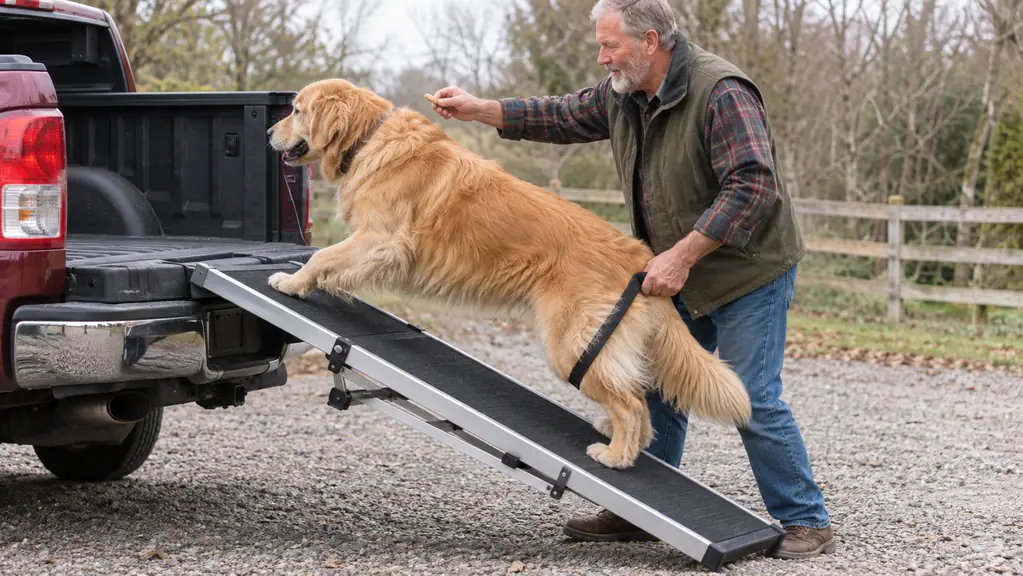
I used food she only gets for this, not her regular kibble. Something with a smell to it. I set a piece on the bottom third of the ramp and let her reach for it with her front feet still on the ground. When she took it without backing off, the session was over. That was the whole win for day two, and it was enough.
Step 3: Reward the First Paw, Then the Second, Then Stop
Day four was the first time I asked her to put any weight on it. I stood at the side of the ramp, not in front of it, and held a piece of food about a foot up the surface. She put one front paw on. I gave her the food right there. Then I walked her off and we were done for the day.
Next day, two paws. The day after that she got her front end up and her back end followed, which is the moment where a dysplastic dog either commits or quits. She committed. Then she immediately wanted to come back down, and coming down is harder on the hips than going up. Let her. Do not stand behind her and push. Let her turn around on the ramp and walk down at her own pace with your hand near her collar but not on it.
This is the point where most people move too fast. The dog gets three feet up and the owner figures it is done, so the next day they expect a full climb and the dog says no. Three feet is a win. Three feet twice is a bigger win. I spent four days at the halfway mark with Duchess before I asked her for the whole length of the ramp.
Step 4: Walk Beside Her, Not Behind Her, and Keep Your Hands Off
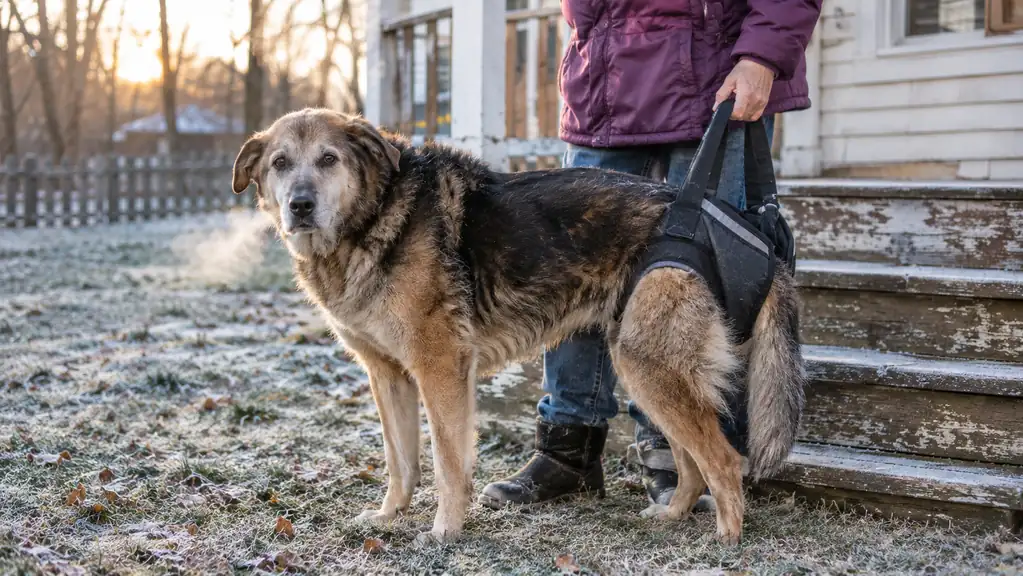
I have a rear support sling hanging by the back door. I bought it ten months ago for the porch steps on icy mornings, and I brought it out for ramp training as insurance. The way I use it is one hand on the handle, sling under her hips, no upward pull. It is there to catch her if a back leg gives. It is not there to carry her.
The mistake is standing behind the dog with both hands steadying her rear. It works, in the sense that she gets up the ramp. It also means she is not carrying her own weight, so the muscles that need the work are not getting it, and she learns to stop and wait for your hands. Walk alongside her instead. One hand on the sling handle if you need it. Let her do the climbing.
Talk to her the whole way up, low and boring. Not a party. A dog that gets excited at the top of a ramp is a dog that launches herself off the end, and a bad landing on a concrete apron is how a mild problem turns into an injury. Calm is the whole technique here.
Step 5: Keep It Short, Quit While She Is Still Willing, and Repeat Every Trip
Two weeks in, Duchess was walking up the ramp on her own. I still went up alongside her for another month, and I still do not rush her. Sessions stay under five minutes. I quit while she is still willing, which is the opposite of what feels natural. You want the last thing that happened to be her getting food for doing something easy.
The other half of this is consistency, and it is where most people lose the ground they gained. Every single time she gets in the truck, she uses the ramp. No exceptions for a quick trip down the lane, because the day you lift her just this once is the day she remembers that lifting is an option and starts waiting for it again. Eight months in, I open the back door, hook the ramp on the sill, and she is already up it before I have finished straightening the sling.
If she refuses on a given day, do not force it and do not turn it into a fight. Some mornings she comes out of the barn stiff and does not want to climb, and that is what the sling and a lower expectation are for. If she refuses two days running, that is a conversation with our vet, not a training problem. He has told me more than once that a sudden change in a dog's willingness to move is information, not stubbornness.
What Else Helps
The ramp solves one specific problem: getting a heavy dog up and into a vehicle without either of you getting hurt. It does nothing for the hips themselves. Everything else I do for Duchess is aimed at the joint, and I will list it plainly because people ask me at the feed store.
She gets Cosequin Maximum Strength every morning at the tablet count the label lists for her weight, and has since two years ago when our vet suggested it. She gets a pump of Wild Alaskan Salmon Oil on her evening kibble, added about a year ago. She sleeps on an orthopedic bed in the living room, 44 by 32 inches, and in the pole barn she lies on a folded moving blanket. The sling comes out for the three porch steps when there is ice. None of that is a cure. I am not a vet and I cannot tell you what will work for your dog. What I can tell you is that reducing the load on a bad hip, every single day, is the part you actually control.
Of all of it, the Pawaboo ramp took the most load off. Lifting a sixty-four pound dog into a truck is a bad lift for her hips and a bad lift for your back, and it happens twice per trip. Two weeks of treats and ninety-second sessions replaced it. That was a good trade, and it is the one I would make first if I were starting over with a dog who had quit jumping.
Two weeks of ninety-second sessions, and Duchess has not been lifted into the truck since March.
If your dog is still being lifted, fix the angle first
74.8 inches long, 19.69 inches wide, 250 pound load capacity, folding metal frame with a textured non-slip surface. Mine folds and rides in the truck bed under the tonneau cover, so it is there every time she needs it.
Amazon Check Today's Price on Amazon →