
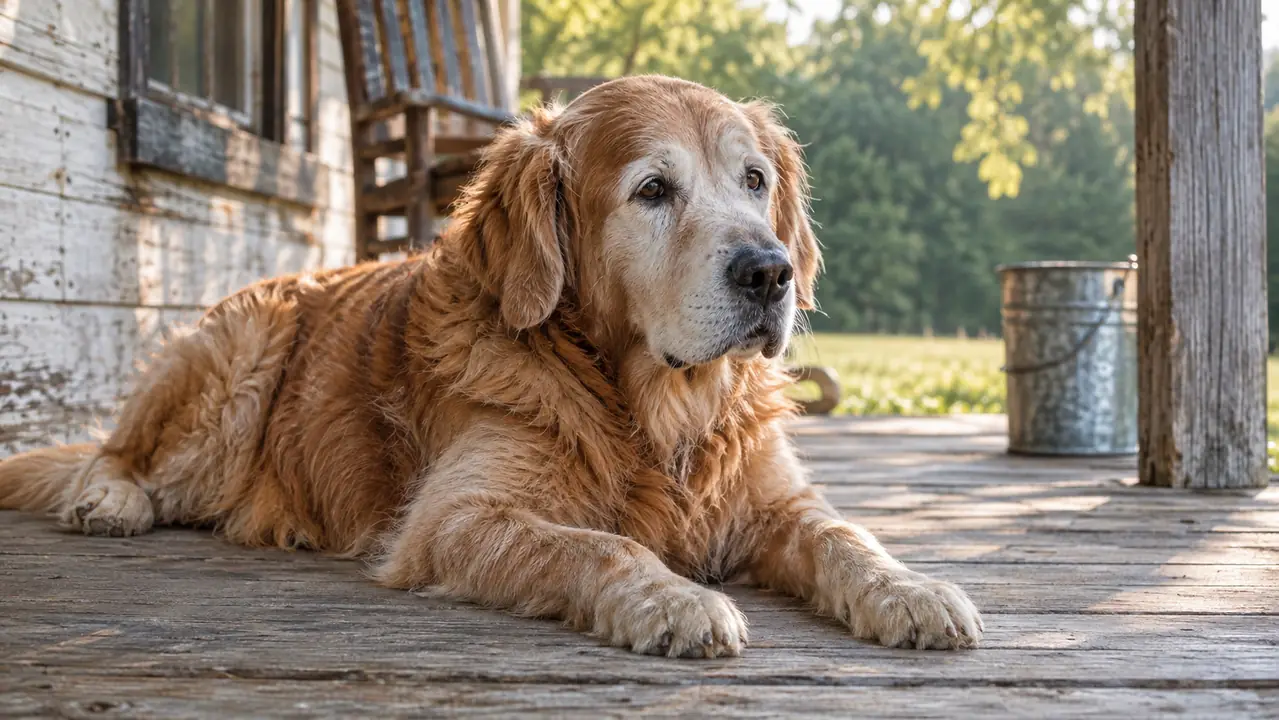
Most reviews of a salmon oil supplement spend a lot of words telling you it is wonderful. This one is going to spend more time on what it will not do. I have a 9-year-old female yellow Labrador named Duchess. She weighed about 64 pounds at her last check. Our vet diagnosed hip dysplasia and early arthritis in both hips when she was 7. I started her on Natural Dog Company Wild Alaskan Salmon Oil about a year ago, on the vet's suggestion, and I have kept her on it since. I am not a veterinarian. I am a guy with a hobby farm outside Kalamazoo, a pole barn full of tractor parts, and a dog who still wants to follow me around it.
That last part is why I keep buying the bottle. Duchess is not a puppy anymore, and she is not going to be. The salmon oil did not turn her into one. What it did do, and what it did not do, is the whole point of this review. If you are looking for a sentence that says this fixed my dog's hips, you will not find it here. If you want to know how a 32-ounce pump bottle fit into a real routine with a big dog, keep reading.
The Quick Verdict
A useful omega-3 food topper with a real place in a joint routine, but it is not a stand-alone answer for a big dog with bad hips.
Amazon Check Today's Price →This is the exact bottle I keep in the fridge door.
I bought the 32-ounce pump bottle myself. The listing has the current price and the full label if you want to compare it to what your dog is already getting.
Amazon Check Today's Price on Amazon →How I've Used It
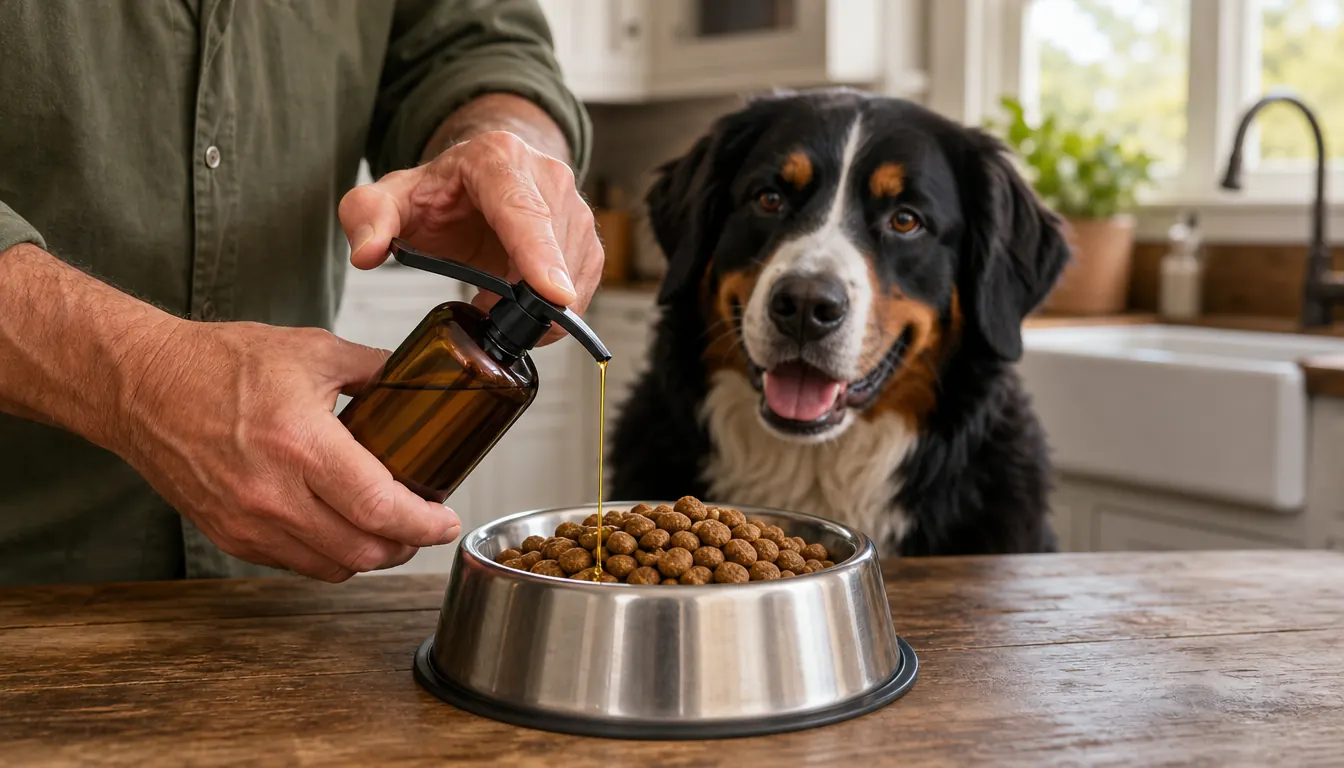
The timeline matters here. Duchess started Cosequin Maximum Strength two years ago, right after the age-7 diagnosis. That was our vet's suggestion. I give her the number of tablets the label lists for her weight every morning, and she takes them like a treat. The salmon oil came about a year later, also on the vet's suggestion. I pump the amount the label gives for her weight onto her evening kibble. The bottle lives in the fridge door once it is open. That is the whole routine.
I did not ease her into it with a spoon or a syringe. I put it on the food and set the bowl down. The first night she sniffed the bowl, looked at me, and then ate it. She has not turned her nose up at it since. That is not a guarantee for your dog. Some dogs are pickier about oil on kibble. I got lucky.
The pump is the reason this format works for me. I do not have to measure with a spoon, cut open a capsule, or deal with a bottle that glugs. I give it a wipe with a paper towel after I use it, because the neck gets a little oily. That is not on the label. It is just what keeps the fridge shelf from getting greasy. A 32-fluid-ounce bottle is a decent size for a 64-pound dog, but it is not a lifetime supply.
What the Label Actually Tells You
The Natural Dog Company listing describes this as wild Alaskan salmon oil for dogs. The features mention salmon and pollock oil, EPA and DHA omega-3 fatty acids, and the active ingredient line lists vitamin E. It is a liquid, it comes in a 32-fluid-ounce bottle, and the shipping weight is 2.2 pounds. The listing calls it a food topper and a daily supplement. That matches how I use it. I am not using it as a meal replacement or a medicine. It goes on top of her kibble.
One thing I noticed on the listing: the breed-size field says small. I would not read that as a feeding instruction for a 64-pound Lab. The label gives dosing by weight, and our vet confirmed the amount for Duchess. If you have a giant breed, or a dog on other medication, ask your vet rather than scaling up on your own. A pump bottle is convenient, but convenient is not the same as automatic.
This is also not a glucosamine and chondroitin product. The bottle does not list those ingredients. If you are looking for a chew that carries the joint-building ingredients, this is not that. It is an oil that adds omega-3s to the food. That is a different job. I already had the Cosequin for the other part of the job.
The coat change showed up in about a month. The joint change is the part I cannot prove, and I am not going to pretend I can.
The Coat Change Was Real. The Joint Change Is Hard to Prove.
The first change I noticed was in her coat, about a month in. It looked glossier, especially over her shoulders and down her back. Duchess is a yellow Lab, so a dull coat is not hard to spot in the light. I am not going to tell you it was dramatic. I am telling you it was noticeable enough that my wife asked what I had changed.
The joint part is murkier. Duchess was already on Cosequin for a year when I added the salmon oil. So when she gets up from the barn floor with less rocking, I cannot tell you which supplement is doing the work. It could be the Cosequin. It could be the oil. It could be both. It could be the orthopedic bed, the sling, the ramp, and the fact that I stopped letting her jump into the truck. That is the honest answer.
What I can say is that she has not gotten worse in the year since I added it. On a cold wet morning she is still stiff. The salmon oil has not changed that. If she has a bad day, the oil does not fix it. I use the sling on the porch steps and I call our vet if something looks different. The oil is one part of the routine, not the routine itself.
The Thing Nobody Tells You: It Is a Food Topper, Not a Fix
The name on the bottle is Natural Dog Company, and the product is a food topper. That word matters. You are not giving your dog a treatment. You are adding oil to the food. If your dog has a sensitive stomach, a history of pancreatitis, or a condition where fat intake matters, talk to your vet before you start. That is not a small point. I would not add any oil to a dog's diet without asking first.
The pump is the best part of the design. I pump it over the bowl, put the bottle back in the fridge, and that is it. The tradeoff is that the pump can leave a little oil on the bottle neck. I wipe it. If you are the kind of person who wants a clean, dry bottle every time, this will annoy you. It is oil. It is going to be a little oily.
The other thing nobody tells you is that you have to actually use it. A bottle in the cupboard is not doing anything. It has to go on the food every day. If you are not going to keep up with it, buy a chew instead. I put it next to the coffee maker in my head, even though it lives in the fridge, because that is the only way I remember. Morning Cosequin, evening salmon oil. That is the system.
Where It Falls Short for a Big Dog
The cost is the part I do not love. It is not the cheapest way to add omega-3s to a dog's diet. I have looked at fish oil capsules and plain salmon oil. This one costs more. I keep buying it because the pump is easy and Duchess eats it without a fight. That is a personal call, not a mathematical one. If you are on a tight budget, capsules may be the better route for you.
The 32-ounce bottle takes up fridge door space. If your fridge is already full, that is a real annoyance. For a 64-pound dog, you are going through it faster than a small dog would. The listing I bought is the 32-ounce bottle. I have not tried to stretch it. I give the amount the label lists for her weight and I do not skip days to make it last.
This is not a pain pill. If Duchess ever yelps or refuses to put weight on a leg, I am calling our vet, not reaching for the pump bottle. Same if she stops eating or starts vomiting. A supplement is not the thing you reach for when something is wrong. It is the thing you use when things are stable and you want to support the baseline. That is a line I do not cross.
The Vet Conversation I'd Have First
Before I added the salmon oil, I asked our vet. That was not a dramatic conversation. I told him Duchess was already on Cosequin and asked whether adding a fish oil made sense. He said it was reasonable, gave me the amount to use based on her weight, and told me to watch her stool. That was it. No prescription, no sales pitch. If your vet says no, or says to wait, listen to that.
I would have the same conversation if I were starting today. Duchess is 9. She has hip dysplasia and early arthritis. She is not a candidate for every supplement on the market, and neither is your dog. The vet is the one who can look at the whole picture. I am the one who sees her every day, so I know when something changes. Those are two different jobs. I do not confuse them.
What I'd Do Differently
I would have started the ramp sooner. The salmon oil is fine, but the ramp changed more for us than any bottle did. Duchess stopped jumping into the truck around age 8, and I spent a couple of months lifting her into the back seat before I bought the ramp. That was hard on my back and probably not great for her. The ramp took two weeks of short sessions with treats before she walked it on her own.
I also would have written the start date on the bottle. I know I added the salmon oil about a year ago, but I could not tell you the exact week. If you are trying to judge whether a supplement is doing anything, a date on the bottle is a simple thing. I did not do it. I am doing it now. That is the kind of thing I would tell a friend.
What I Liked
- Duchess eats it on her kibble without a fight
- Her coat looked glossier in about a month
- The pump is easier than capsules or a spoon
- It fits into a routine that already includes Cosequin
- The bottle is a simple thing to keep in the fridge door
Where It Falls Short
- I cannot separate its joint effect from the Cosequin she already takes
- It is not a glucosamine supplement and does not replace one
- It costs more than plain fish oil capsules
- The bottle takes fridge space and the pump neck gets oily
- Dogs with a sensitive stomach or pancreatitis history need a vet conversation first
How I Decide Whether to Reorder It
I reorder when I can answer three questions. Is Duchess still eating it without a fight? Is her coat still looking good? And has anything changed in her hips that makes me want to talk to our vet? If the answer to the first two is yes and the third is no, I keep the bottle in the rotation. If she starts refusing it, or if her coat goes dull, I stop and look at what else changed. That is not a scientific trial. It is just how I keep from buying things on autopilot.
The joint question is the hard one. I do not expect the salmon oil to fix her hips. I expect it to add omega-3s to her food and maybe help her coat. If I wanted a joint supplement, I would buy a joint supplement. The Cosequin is that part of the plan. The salmon oil is the oil on the kibble. Keeping those jobs separate is the only way I can tell what is worth paying for. That is the honest way I look at it.
Who This Is For
This is for the owner of a large dog who already has a joint plan and wants to add an omega-3 food topper that is easy to give. If your dog is on a joint supplement, a good bed, and a sensible exercise routine, this can fit alongside that. It is also for the owner who wants a coat and skin supplement and will actually use it every day. Natural Dog Company sells it as a daily topper, and that is how it works best.
It is for someone who does not mind keeping a bottle in the fridge and wiping the pump once in a while. It is for someone who understands that a 9-year-old Lab with hip dysplasia is not going to be a 3-year-old Lab again. If you are looking for a small improvement in coat and a reasonable addition to a joint routine, this is a fair choice.
Who Should Skip It
Skip it if you want a glucosamine and chondroitin product. This is not that. Skip it if you will not refrigerate it, or if you will forget to use it. Skip it if your dog has a sensitive stomach or a history of pancreatitis and you have not asked your vet. Skip it if you are looking for a pain medication, because it is not one. And skip it if the cost per day bothers you more than the convenience is worth. That is a fair reason to choose capsules instead.
The bottle I reorder, one year in.
If you want to read the label and check the current price for yourself, this is the 32-ounce pump bottle I bought for Duchess.
Amazon Check Today's Price on Amazon →