
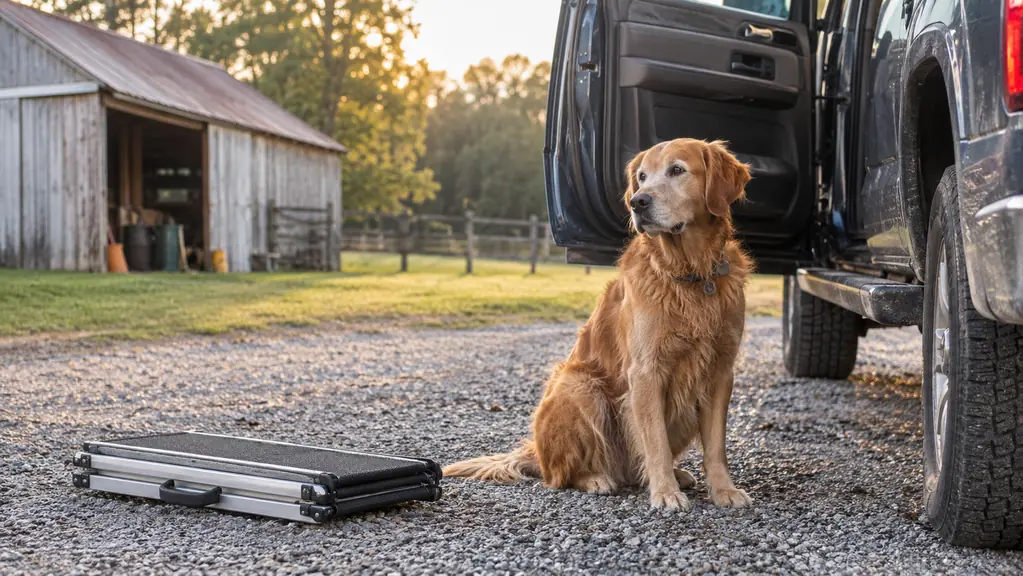
I bought the Pawaboo dog ramp in March with my own money, after two months of lifting a 64-pound Labrador into the back seat of my pickup and telling myself my back was fine with it. Eight months later I still use the ramp three or four times a week. I also still lift her sometimes. That second sentence is the part most ramp reviews leave out, and it is the reason I sat down to write this one. If you are shopping for a ramp because you want the lifting to stop completely and forever, you should know before you order that it probably will not. What it does is narrower and more useful than that, and it is worth understanding before you spend anything.
Duchess is a nine-year-old yellow Lab, about 64 pounds. Our vet found hip dysplasia and early arthritis in both hips when she was seven. She gets up stiff off the concrete in the pole barn, she takes the three steps off the back porch one at a time, and somewhere around age eight she quit jumping into the truck. I am not a vet. I run a small farm outside Kalamazoo, I fix tractors and implements for neighbors out of a pole barn, and I have kept big dogs my whole life. The one thing I am sure of with a bad hip is that the less you load it badly, the longer it holds up.
The Quick Verdict
A long, wide, plainly built ramp that solved the truck problem for a big dog. It is not light, it is not a cure, and it will not train your dog for you.
Amazon Check Today's Price →The ramp that ended the lifting in my driveway
74.8 inches of run and 19.69 inches of width, rated to 250 pounds. Long enough that the slope stops scaring her, wide enough that she is not walking a balance beam in the gravel.
Amazon Check Today's Price on Amazon →What Nobody Tells You Before You Order One
The first thing nobody tells you is that a ramp is training equipment, not furniture. You cannot lean it against the truck, call the dog, and expect a nine-year-old Lab with sore hips to walk up a surface she has never seen in her life. I know because I tried exactly that on a Saturday morning in March and got a dog standing at the bottom of the ramp looking up at me like I had lost my mind. What changed it was a bag of hot dogs cut into nickel-sized pieces and about ten minutes a day. Front paws on the ramp, treat. Two steps up, treat, then back down. Two weeks of that before she went the whole way on her own, and the day she did I did not have to say a word to her.
The second thing nobody tells you is that length is the entire ballgame. A short ramp puts the dog at a steep angle, and a steep angle puts the load right back on the hips you were trying to spare in the first place. The sill on my truck sits high enough that a two or three foot ramp would have been a wall with grip tape on it. The Pawaboo is 74.8 inches long, which sounds like overkill in the listing and stops sounding like overkill the first time you watch a dog walk it. Spread that height over more than six feet of run and she is walking up a hill instead of climbing a ladder.
The third thing is width, and I did not think about this at all until I watched her balk at a narrow plank I use for loading the wheelbarrow. It was not the surface that bothered her. It was that her feet had nowhere to go if she drifted an inch to one side. The Pawaboo is 19.69 inches wide. Six months ago that is a number I would have skimmed right past. Now it is the first thing I look for on any ramp, ahead of the rating and well ahead of the reviews.
How I've Actually Used It
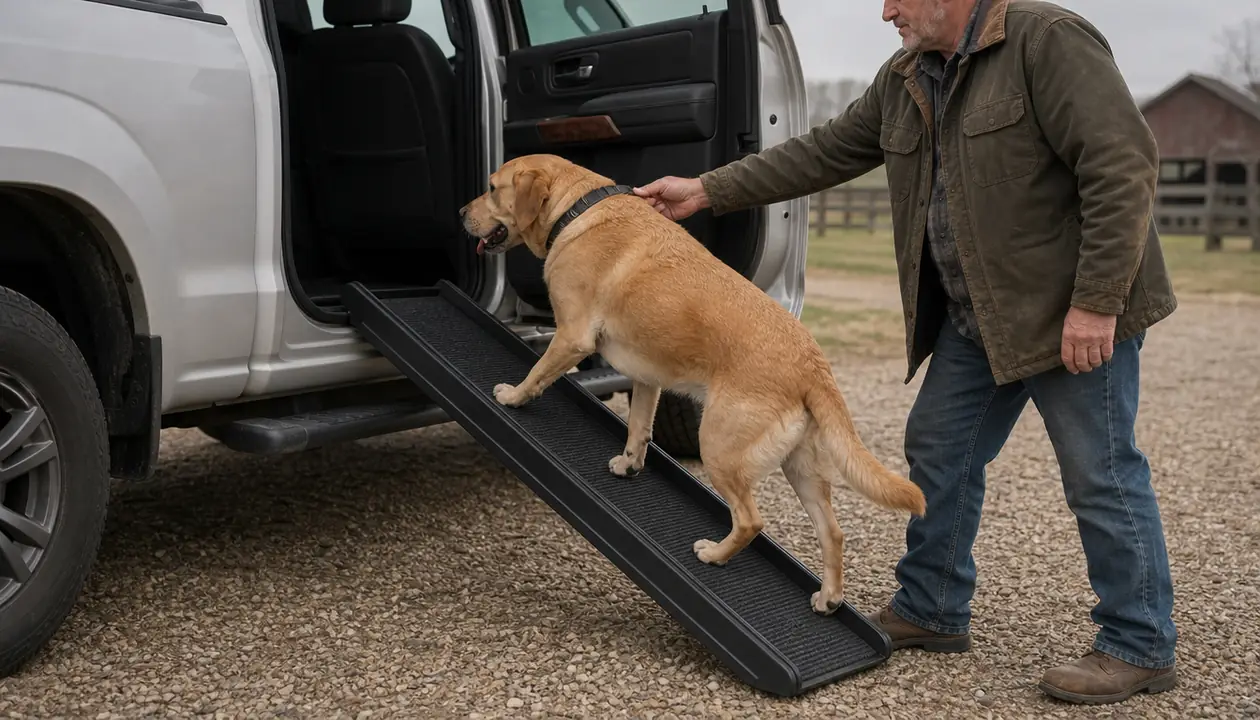
The ramp rests on the back door sill of a full-size crew cab, and during the week it stays there. I pull it out when I need the whole bed. The rest of the time it folds and rides under the tonneau cover, which matters more than I expected it to. A ramp that does not fold is a ramp that lives in the driveway, and a ramp that lives in the driveway gets rained on twice and then lives in the garage forever.
Our routine takes about ninety seconds. Ramp on the sill, hot dog in my hand, Duchess up, Duchess in the back seat, ramp back in the bed. The part people forget to train is the way down. A dog will climb a ramp for a treat all day long and then stand at the top of a six foot drop and refuse to come off it. We practiced down as much as up, and the descent took her a solid extra week before she stopped rushing it.
I keep a short lead on her for the whole thing. Not because the ramp moves around, because it does not. Because a 64-pound dog that changes her mind halfway up is going to come off sideways no matter what she is standing on, and I would rather be holding something when that happens.
The ramp did not teach my dog to use a ramp. Ten minutes a day and a pocket of cut-up hot dogs taught my dog to use a ramp.
The Two Numbers That Decide Whether a Ramp Works
There are two numbers on a ramp listing that mean anything, and the star rating is not one of them. The first is how long the run is. The second is what the thing is rated to hold. Everything else, the finish, the logo, the paragraph about how much the company loves dogs, is decoration. You are buying geometry and a frame, and if the geometry is wrong the frame does not save you.
The Pawaboo is rated to 250 pounds. Duchess is 64 pounds. I did not run a stress test in the pole barn, but a rating roughly four times the weight of the animal standing on it is the kind of margin I want under a dog. The frame is metal. Eight months of weekly use, most of it outdoors in Michigan weather, and nothing has bent, nothing has loosened, and nothing rattles when I pull it out from under the cover.
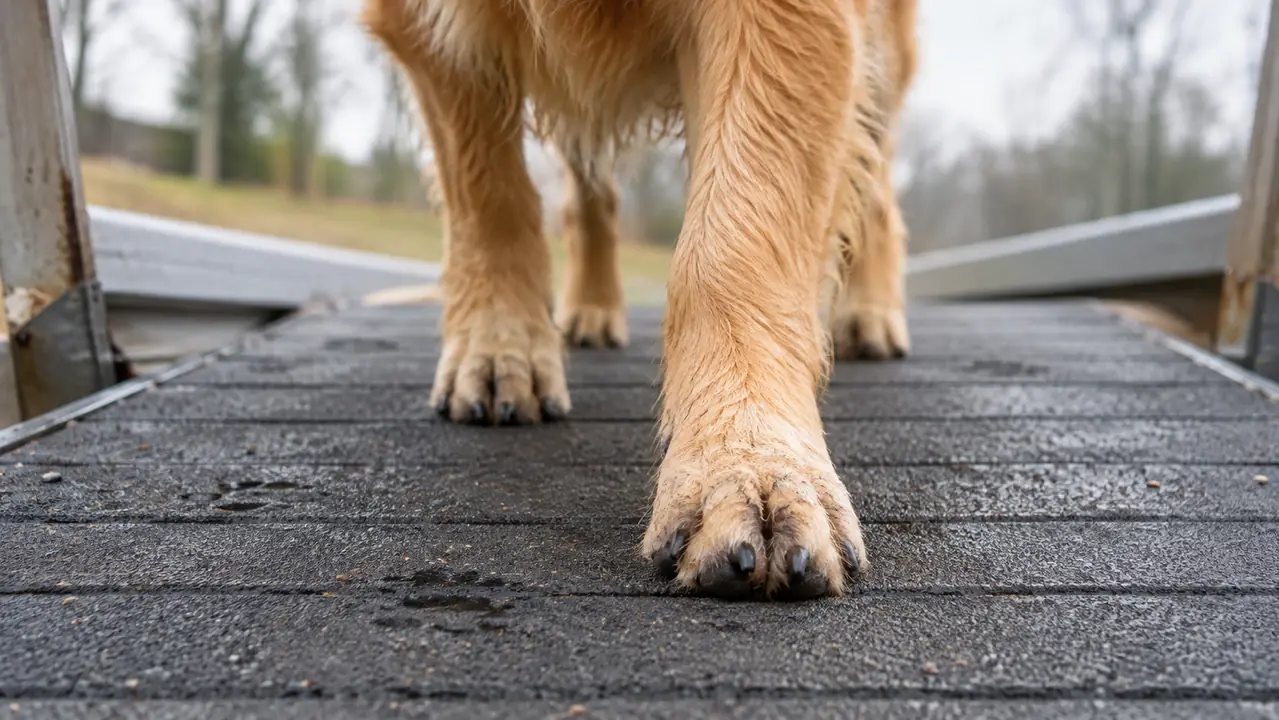
The surface is textured and non-slip, and that is the other piece that has to be right. A slick ramp with a dog on it in the rain is a slide, and a slide is worse than no ramp at all, because now the dog is afraid of the ramp and you have lost a month. Duchess has walked this one with wet paws after a November walk and with gravel dust all over her feet, and she has not slipped on it once. The trade is that the texture holds grit. I rinse it with the hose every couple of weeks, more in mud season, and that is the whole maintenance routine.
Build, Stowing, and Eight Months of Wear
The listing gives the ramp as 74.8 inches long, 19.69 inches wide and 0.83 inches of height. Folded, it slides under a tonneau cover and does not eat the whole bed, which is what makes it usable on a working truck instead of a truck that exists to carry the ramp. Eight months in the fold still sits tight. I have opened and shut it well over a hundred times at this point and there is no slop in it yet, which is more than I can say for the folding sawhorses in my barn.
What I watch on any piece of equipment is the joints, because that is where cheap metal tells on itself. This one has not opened up and has not developed a wobble. I have loaded a dog onto it in March mud, in July heat and in a cold November drizzle, and the ramp has not cared about any of it. That is not a dramatic finding. It is the finding you want, which is that after eight months I have nothing to report.
What I Looked At Before This One
I looked at three other options first. Dog stairs were the top of the list. They fold smaller and they sit flatter in the bed, but the ones I handled were narrow, and a narrow set of stairs on a gravel driveway with a crown in it is a wobbly set of stairs. Duchess had already told me what she thought about narrow footing, so I stopped there.
The second option was a shorter ramp. Plenty of them are two or three feet. On a low car that is fine. On my truck it is a steep little chute, and a steep chute is the same load on the hips with an added chance of slipping. The third option was doing nothing and just lifting her twice a day, which I did for two months, and my back filed a formal complaint in February. The Pawaboo was the only one of the four that was both long and wide, and the width is what decided it.
Where It Let Me Down
Length is the ramp's best feature and its biggest inconvenience, and I want to be straight about the second half of that. Over six feet is a real object. It is longer than the tailgate is wide. It does not tuck neatly into a small crossover or the back of a hatchback. If you park nose in against a garage wall you will find out precisely how long it is, probably with the bumper. On uneven ground it takes a minute to seat properly. My driveway is gravel with a crown in it, so I set the ramp down, look at the gap underneath, and nudge it once. That is not a defect in the ramp. That is what a rigid ramp does on soft ground.
The larger letdown is that the ramp solved one problem and left the other three alone. Duchess gets into the truck now without me lifting her, which was the entire reason I ordered the thing. She still takes the three back porch steps one at a time. She still needs the sling on icy mornings, and she still needs it after a long day when the back end is tired. The ramp is not a cure for bad hips and I would be lying to you if I dressed it up as one. It is one less bad load per trip.
And the last thing I will say on that, as plain as I can put it. If your dog is showing pain, favoring a leg, or losing strength in the back end, get the vet involved before you buy equipment. A ramp helps a diagnosed dog do less damage to a joint that is already damaged. It does not diagnose anything, it does not treat anything, and it is no substitute for the medication and the weight management your vet is going to talk to you about. That is the honest frame, and I would rather you hear it from me now than figure it out after the box arrives.
What I Liked
- 74.8 inches of run produces a genuinely gentle slope for a high truck sill
- 19.69 inches wide, so a big dog has room to drift without stepping off the edge
- Rated to 250 pounds, roughly four times the weight of my 64-pound dog
- Textured non-slip surface holds up to wet paws and gravel grit
- Folds flat and rides under a tonneau cover without eating the bed
- Metal frame with nothing bent, loosened or rattling after eight months of weekly use
Where It Falls Short
- Over six feet long, which is awkward in a small vehicle or a tight garage
- Does not train the dog. Two weeks of short sessions with treats comes first
- The textured surface traps dirt and needs a rinse every couple of weeks
- Does not replace a sling on steps, on ice, or after a long day
- The descent is a separate skill and takes longer to teach than the climb
Who This Is For
This is for the owner of a big dog and a tall vehicle, which is the combination that makes a ramp worth owning. If you are lifting 60 or 80 pounds into a crew cab a couple of times a day, or your dog has quietly stopped jumping in on her own, the length and the width here are aimed straight at that job. It suits a dog that is nervous but willing, because the width gives her room to be wrong without stepping off. It suits a truck owner, because it folds and stows flat under a cover. Mostly it suits someone who has already talked to a vet, knows what they are dealing with, and now just needs the dog to stop climbing a six foot wall three times a day.
Who Should Skip It
Skip it if you drive a small car with a low sill, because the run is more than you need and the thing is long enough to be a nuisance to store. Skip it if your dog is set against new surfaces and you are not willing to spend two weeks with hot dogs, because the ramp will not do that work for you. Skip it if what you actually need is help on stairs, on ice, or after a long day, since a support sling does those jobs better and costs a fraction as much. And skip it if you are hoping this replaces a vet visit. It does not, and no ramp does.
One less bad load on those hips, every time she gets in
The 74.8 inch run and 19.69 inch width are the two things I would check on any ramp. Rated to 250 pounds, folds flat, and it has held up to eight months of Michigan weather and gravel.
Amazon Check Today's Price on Amazon →